
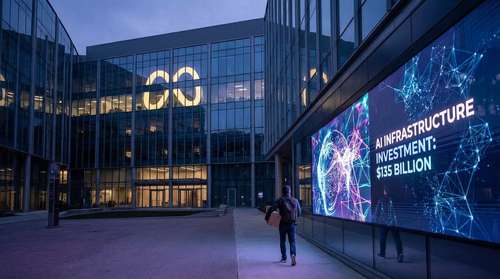
The tech industry is bracing for another massive workforce reduction as Meta Platforms reportedly prepares to eliminate 20% of its global headcount. The sweeping Meta layoffs 2026 could impact nearly 15,800 employees out of the company's 79,000-person roster. This historic restructuring comes as the social media giant aggressively pivots its financial resources to cover staggering AI infrastructure costs, with projected capital expenditures hitting a record $135 billion for the year.
As the race for artificial general intelligence accelerates, Meta is signaling that human capital will be sacrificed to secure computational supremacy.
Unprecedented AI Infrastructure Costs Drive Restructuring
Meta's latest structural shake-up marks its most significant downsizing since the efficiency reductions in 2022 and 2023, which saw roughly 21,000 roles eliminated. However, the underlying rationale for these upcoming Facebook job cuts represents a fundamental shift in the company's operational playbook. Rather than reacting to sluggish ad revenues or macroeconomic headwinds, executives are swapping traditional payroll expenses for silicon and data centers.
The company's official guidance forecasts 2026 capital expenditures to fall between $115 billion and $135 billion, nearly doubling its roughly $72 billion infrastructure spending from the previous year. To finance this massive build-out, the company must free up significant capital. Restructuring could yield up to $8 billion in annual savings, which will be funneled directly into custom MTIA chips, multi-gigawatt data centers, and the high-priced hardware required to run Meta's newly formed Superintelligence Labs.
Meta spokesperson Andy Stone recently categorized the layoff reports as \"speculative reporting about theoretical approaches\". Still, internal sources confirmed that top executives have already instructed senior leaders to begin planning operational scale-backs, aiming for leaner teams empowered by AI-assisted tools.
Inside the Mark Zuckerberg AI Strategy: The Cost of Catching Up
The Mark Zuckerberg AI strategy relies heavily on the premise that 2026 will be the year AI dramatically changes the way employees work. The chief executive has been clear about his ambition to build the highest talent density lab in the industry, pursuing generative AI dominance at an unprecedented scale.
To accelerate this vision, Meta has made splashy acquisitions and high-profile hires. The company recently committed $14.3 billion to bring in Alexandr Wang from Scale AI, and spent upwards of $2 billion on AI startups like Manus. They have also aggressively courted top researchers with compensation packages purportedly exceeding $100 million, while bringing on former GitHub CEO Nat Friedman.
Yet, throwing money at the problem hasn't yielded an immediate technical advantage. Meta AI spending is under intense scrutiny as the company struggles to keep pace with industry frontrunners.
The \"Avocado\" Delay and Strategic Shifts
Sources indicate that Meta's highly anticipated frontier AI model, code-named \"Avocado,\" has missed multiple internal deadlines and currently trails competing models from OpenAI, Anthropic, and Google across key reasoning and coding benchmarks. The delayed rollout has pushed Meta to consider unusual stopgap measures, including reports that executives discussed temporarily licensing Google's Gemini to power some of the platform's consumer-facing AI features. This technical bottleneck highlights the immense pressure on Meta to convert its record-breaking capital commitments into tangible consumer products.
Meta Stock News: Wall Street Applauds the Efficiency Push
Despite the technical setbacks and the human toll of the impending cuts, financial markets have reacted positively to the restructuring plans. In recent Meta stock news, shares jumped roughly 3% in premarket trading when reports of the 20% workforce reduction first broke.
Wall Street analysts broadly view the aggressive cost-cutting as a necessary lever to offset the company's ballooning budget. Major financial institutions maintain optimistic outlooks on the stock, noting that an AI-assisted, leaner workforce could provide a 5% to 10% upside to the company's 2027 earnings before interest and taxes. Investors are increasingly comfortable with a business model that mandates massive spending on computing power, provided it is balanced by ruthless operational efficiency elsewhere.
A New Era for Big Tech Layoffs
The impending cuts at Meta reflect a broader, more structural transformation across Silicon Valley. These are not the traditional Big Tech layoffs aimed at surviving an economic downturn. Instead, they represent a permanent reallocation of resources toward a single technological paradigm. The trend is visible across the sector, with companies like Amazon also confirming massive corporate job cuts earlier this year to fund their own robotics and AI divisions.
Companies operating in winner-take-all markets recognize that falling behind in the generative AI race poses an existential threat. Consequently, tech giants are simultaneously laying off thousands of traditional software and operational employees while fiercely competing for niche machine-learning specialists.
As Meta prepares to execute these sweeping cuts, the industry is watching closely. The move sets a new benchmark for how far legacy tech companies are willing to go to secure their position in an AI-dominated future.