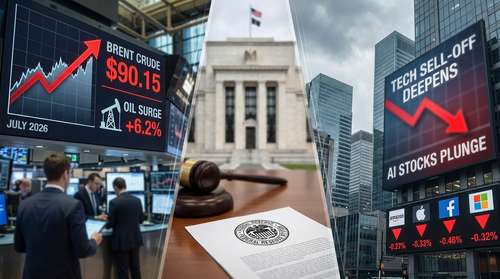
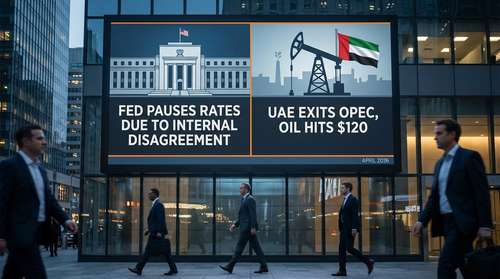
In an unprecedented collision of domestic monetary policy and international geopolitics, the financial world is grappling with a dual shock this week. Wednesday’s highly anticipated Federal Reserve rate pause 2026 coincided with a tectonic shift in global energy markets. As policymakers opted to keep the target rate unchanged at 3.50% to 3.75%, the central bank exposed a deeply fractured committee. Compounding the economic anxiety is the latest UAE leaves OPEC news, a bombshell departure that has exacerbated an already volatile energy landscape and triggered a dramatic oil price surge April 2026.
A Divided Central Bank: The Federal Reserve Historic Rift
During Wednesday's FOMC meeting interest rates announcement, Chairman Jerome Powell—presiding over what is expected to be his final meeting before his term ends in May—revealed the central bank's decision to hold borrowing costs steady. However, the real story emerged from the voting breakdown. The committee recorded four official dissents, marking a Federal Reserve historic rift not seen since October 1992.
Stephen Miran broke ranks by advocating for a quarter-point rate cut to stimulate an uneven labor market. Meanwhile, Beth M. Hammack, Neel Kashkari, and Lorie K. Logan supported the rate hold but strongly opposed the inclusion of an "easing bias" in the post-meeting statement, arguing that sticky inflation warrants a more hawkish posture. This internal struggle underscores the immense pressure policymakers face as they attempt to balance economic growth with stubbornly high consumer costs.
A Seismic Shift in Energy: UAE Leaves OPEC News
While the Fed grappled with its own internal discord, energy markets were reeling from an announcement that fundamentally alters the balance of power in the Middle East. After 59 years of membership, the United Arab Emirates officially declared its exit from OPEC and OPEC+, effective May 1.
The UAE has long chafed under OPEC’s strict production quotas. Capped at around 3.2 million barrels per day, the emirate has been pouring billions into expanding its infrastructure to reach a 5 million barrel-per-day capacity by 2027. The decision to abandon the cartel signifies a prioritization of national revenue over collective supply management, essentially weakening Saudi Arabia's grip on the global crude market and structurally altering global oil alliances.
Oil Price Surge April 2026
The UAE's departure arrives at a precarious moment. Ongoing geopolitical conflicts have effectively bottlenecked the Strait of Hormuz, severely constraining global supply lines. The immediate consequence of these compounded events is a relentless oil price surge April 2026, with Brent crude briefly pushing toward a wartime peak of $120 per barrel as traders panic over supply chain security.
While the UAE's eventual goal is to flood the market with its spare capacity, the short-term reality is dictated by the ongoing logistical constraints in the Persian Gulf. The global energy crisis impact is already reverberating through the U.S. economy, acting as a regressive tax on consumers. As Chairman Powell cautioned on Wednesday, spiking prices at the pump directly erode discretionary income, creating a psychological and financial drag on broader economic output.
US Stock Market Volatility 2026: What Investors Should Know
The confluence of a fractured Fed and a fractured OPEC has injected immense uncertainty into equities. US stock market volatility 2026 has reached new heights this week, as investors struggle to price in the simultaneous risks of sustained inflation and a potential delay in rate cuts.
Traders are increasingly pushing back their expectations for an easing cycle. Markets now reflect a growing consensus that the Fed may not comfortably lower rates until late 2027, largely due to the inflationary pressures of triple-digit oil prices. While energy sector stocks may see a temporary boost from higher crude valuations, the broader market faces a sobering reality: the era of unified central bank guidance and stable energy alliances has come to a definitive end.
As Powell prepares to pass the baton, potentially to nominee Kevin Warsh, the path forward remains fraught with hurdles. The interplay between domestic monetary fractures and international oil politics will ultimately define the economic trajectory of the year, leaving both Wall Street and Main Street bracing for prolonged turbulence.