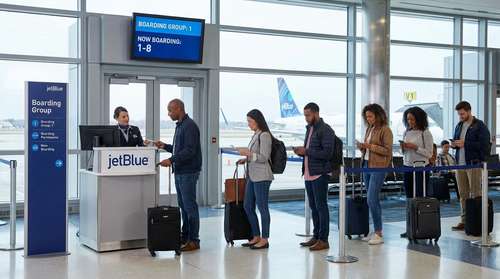
If you have flown JetBlue recently, you likely know that the boarding process could sometimes feel like deciphering an alphabet soup of branded names, letters, and special tiers. Starting today, April 29, 2026, that era is officially over. The airline has launched its new JetBlue boarding process, transitioning its entire fleet to a simplified, numbered system. Passengers will now queue up using JetBlue flight boarding 1-8, a move designed to cut through gate-area noise and streamline the pre-flight experience. But while the airline promises greater efficiency, the change has sparked debate among frequent flyers bracing for intense overhead bin competition.
Breaking Down the JetBlue Boarding Groups
Under the previous framework, passengers navigated a mix of pre-boarding categories, Mosaic loyalty tiers, and lettered groups ranging from A through F. The overhaul strips away the letters entirely, replacing them with a strict numerical hierarchy from 1 to 8. JetBlue claims this adjustment will make announcements more intuitive and easier to hear over the din of a busy terminal.
Here is exactly how the new system dictates your path to the plane:
- Pre-boarding: Customers with disabilities requiring extra time continue to board first.
- Group 1: Reserved for Mint premium cabin customers and top-tier loyalists with Mosaic 3 and 4 status.
- Group 2: This tier includes Mosaic 1 and 2 members, but it now welcomes travelers who purchased extra-legroom "EvenMore" seats.
- Group 3: A newly created category for JetBlue Premier and Business credit card holders, Blue Extra fare purchasers, and travelers who selected Early Boarding as a TrueBlue perk. Notably, Blue Basic (basic economy) flyers are excluded from these perks.
- Courtesy Boarding: Active military personnel and families traveling with car seats or strollers board immediately following Group 3.
- Group 4: JetBlue Vacations customers and the first wave of general boarding based on seat location.
- Groups 5–8: General boarding handled primarily in a back-to-front order. Unaccompanied minors will be escorted onto the aircraft last.
Winners and Losers in the JetBlue Travel Updates 2026
Whenever a major airline tinkers with its boarding formula, the shift inevitably creates winners and losers. The most obvious beneficiaries of these airline boarding changes are passengers who pay for "EvenMore" extra-legroom seats. Previously relegated to "Group A" after all four tiers of Mosaic members had already boarded, these travelers have been bumped up into Group 2. This is a massive upgrade that guarantees prime access to storage space.
Additionally, the creation of Group 3 offers tangible value to co-branded credit card holders. Even if they do not fly frequently enough to earn elite status, holding the right piece of plastic now allows them to jump ahead of the general boarding crowd.
Conversely, some travelers are less thrilled. Lower-tier elite flyers are vocalizing frustration that their hard-earned JetBlue Mosaic perks are being diluted. Because Mosaic 1 and 2 members now share Group 2 with anyone willing to pay a premium for an "EvenMore" seat, the dedicated elite boarding lanes could see significantly more foot traffic. For passengers flying on stripped-down Blue Basic fares, the new system firmly cements their position at the back of the line, usually in Groups 5 through 8.
The Strategy Behind the Shift
While JetBlue states that the transition to JetBlue boarding groups 1 through 8 is about clarity, industry experts point to a clear financial motive. By transparently tying earlier boarding groups to specific credit cards, upgraded seat purchases, and premium fares, the airline is incentivizing travelers to spend more. High-margin ancillary revenue is crucial in the modern aviation landscape, and visibly rewarding customers who buy add-ons is a proven strategy to boost the bottom line.
The Battle for Space: Overhead Bin Competition
The core anxiety driving passenger backlash to any boarding shuffle always comes down to luggage. As carriers continue to enforce strict checked bag fees, carry-on luggage has become ubiquitous, making overhead bin competition a stressful reality of modern travel.
Travelers on aviation forums have had mixed reactions. Some applaud the transparency, noting it rewards loyal customers fairly. Others are skeptical, with one user jokingly wondering if the larger group sizes will simply create larger crowds of "gate lice"—the industry slang for passengers who crowd the boarding area before their group is called. If Group 2 and Group 3 are heavily populated on a given flight, passengers in Group 4 and beyond face a very real risk of gate-checking their bags.
Will this new system actually speed up the turnaround time at the gate? Historically, back-to-front boarding—which dictates the flow for Groups 5 through 8—is not inherently the fastest method, but it is one of the most orderly. By front-loading the premium and loyalty passengers, the airline ensures its highest-paying customers are settled quickly. For the rest of the cabin, the success of the 1-through-8 system will depend entirely on how effectively gate agents enforce the rules and turn away eager passengers trying to board before their number is called.
The next time you head to the airport, check your mobile boarding pass closely. The alphabet is out, and the numbers are in. Whether this brings peace to the gate area or just repackages the chaos remains to be seen.