
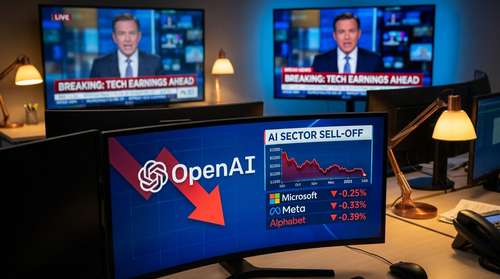
A bombshell report revealing a massive OpenAI sales miss has sent shockwaves through Wall Street, triggering a significant tech sector sell-off. On Tuesday, April 28, 2026, artificial intelligence equities cratered following news that the ChatGPT maker failed to meet internal user growth and revenue goals. This sudden stumble comes at the worst possible moment for institutional investors, intensifying fears of an artificial intelligence bubble just 24 hours before critical quarterly reports from Microsoft, Alphabet, Meta, and Amazon.
The OpenAI Sales Miss That Spooked Wall Street
According to a recent Wall Street Journal report, OpenAI fell short of its internal OpenAI revenue targets earlier this year and missed a major milestone to reach one billion weekly active users by the close of 2025. The shortfall has reportedly sparked severe internal tension at the world's most valuable private AI startup. Chief Financial Officer Sarah Friar warned other executives that the company might struggle to fund future computing contracts if revenue growth does not rapidly accelerate.
The board of directors is now heavily scrutinizing CEO Sam Altman's strategy to secure enormous computing power as operating costs surge. With monthly losses reportedly hovering around $200 million and overall operational expenses up 70%, the fundamental economics of the generative AI boom are facing a harsh reality check. If the poster child of the industry is struggling to monetize its products amid stiffening competition from rivals like Anthropic and Google Gemini, investors are questioning the viability of the entire ecosystem.
Nvidia Stock Price Drop and the Broad AI Infrastructure Slump
The fallout from the revenue shortfall was immediate across the market, contributing to an emerging AI stock market crash 2026 narrative. Companies heavily leveraged in providing data center infrastructure took the brunt of the damage. Oracle, a major data center partner holding a massive $300 billion compute agreement with OpenAI, saw its shares plummet by 7% in early trading. Cloud provider CoreWeave and hardware giant AMD followed suit, wiping out billions in market capitalization.
Even the undisputed leader of the hardware rally was dragged down. The Nvidia stock price drop pushed shares lower by roughly 3% from Monday's record close of $216.61. While a 3% pullback might initially seem like a healthy pause after a parabolic run that brought Nvidia's market cap to nearly $5.3 trillion, the timing is deeply unsettling for retail and institutional traders alike. If OpenAI scales back its projected $600 billion data center buildout by 2030, demand for Nvidia's GPUs and server infrastructure from adjacent firms like Vertiv and GE Vernova will inherently soften.
Assessing the Artificial Intelligence Bubble
For months, financial skeptics have warned that Wall Street was inflating an artificial intelligence bubble. The core argument hinges entirely on return on investment (ROI). Hyperscalers are buying hardware at unprecedented rates, but enterprise and consumer adoption must eventually pay for those servers. OpenAI's stumble provides the first concrete evidence that user adoption and willingness to pay premium subscription fees may not be keeping pace with the astronomical infrastructure costs.
High Stakes for Big Tech Earnings in April 2026
The market's visceral reaction to the tech sector sell-off sets up a high-wire act for the Big Tech earnings April 2026 super-week. Microsoft, Alphabet, Meta, and Amazon are collectively projected to spend between $600 billion and $645 billion in AI capital expenditures (CapEx) this year. As these giants prepare to report their quarterly results on Wednesday, April 29, Wall Street is no longer satisfied with promises of future AI dominance; they are demanding proof of immediate, bottom-line profitability.
Microsoft, Alphabet, and Meta Under the Microscope
Each major player faces unique pressure to justify its massive infrastructure investments:
- Microsoft: Investors expect Azure cloud growth to hit or exceed 38%. Crucially, the market needs to see that AI services account for a significant portion of that growth to validate Microsoft's estimated $145 billion annual CapEx.
- Alphabet: Google Cloud must demonstrate expanding profit margins alongside a growing $70 billion backlog of enterprise AI contracts, proving that its Gemini models are successfully taking market share away from OpenAI.
- Meta: Having guided up to $135 billion in AI infrastructure spending, Mark Zuckerberg's empire must deliver spectacular ad revenue growth—expected near 16%—to keep shareholders from rebelling against the spending spree.
What's Next for the AI Market?
The macroeconomic backdrop is only amplifying the tension. With U.S. Treasury yields creeping higher and geopolitical friction keeping oil prices elevated above $90 a barrel, there is little appetite for risk in unprofitable tech ventures. The coming days will likely dictate the trajectory of equities for the remainder of 2026.
If the hyperscalers can report robust cloud growth and actual AI monetization, Tuesday's pullback will be remembered as a mere blip. However, if executives announce higher capital expenditure guidance without a corresponding surge in cloud and software revenue, the current anxiety could easily accelerate into a deeper structural market correction. The era of blind faith in generative AI has officially ended, replaced by an era demanding immediate and sustainable results.