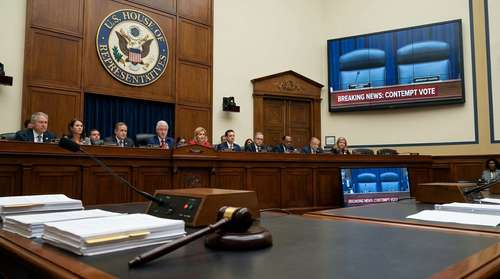
In a historic and unprecedented move that has sent shockwaves through Washington, the House Oversight Committee voted on Wednesday, January 21, 2026, to recommend holding former President Bill Clinton and former Secretary of State Hillary Clinton in contempt of Congress. The charges stem from their refusal to comply with subpoenas related to the committee's ongoing investigation into the sex trafficking network of Jeffrey Epstein. The vote against Bill Clinton passed 34-8, with nine Democrats crossing party lines to join Republicans, marking a rare and significant display of bipartisan frustration with the former first couple's defiance.
Bipartisan House Oversight Vote Signals New Era of Accountability
The Wednesday session on Capitol Hill was charged with tension as lawmakers debated the merits of holding a former commander-in-chief in contempt—a first in United States history. While political observers might have expected a strict party-line split, the final tally revealed a different story. The resolution to hold Bill Clinton in contempt passed with a decisive 34-8 vote, while the measure against Hillary Clinton passed 28-15.
"Subpoenas are not mere suggestions, they carry the force of law and require compliance," said House Oversight Committee Chairman James Comer (R-Ky.) following the vote. "The response we received was not cooperation, but defiance, marked by repeated delays, excuses, and obstruction." Comer emphasized that the committee had attempted to negotiate in good faith for months, but the Clintons' demand for an unrecorded, private meeting was a "red line" the committee would not cross.
Democrats Break Ranks to Demand Answers
Perhaps the most striking aspect of the proceedings was the support from the Democratic side of the aisle. Nine Democrats, including prominent progressives, voted to hold the former president in contempt. This group included Representatives Maxwell Frost (FL), Raja Krishnamoorthi (IL), Summer Lee (PA), Stephen Lynch (MA), Ayanna Pressley (MA), Emily Randall (WA), Lateefah Simon (CA), Melanie Stansbury (NM), and Rashida Tlaib (MI).
Rep. Rashida Tlaib, typically a staunch critic of Republican initiatives, explained her vote with a focus on the victims. "We should hold anybody connected to Epstein in contempt who will not give us information," Tlaib stated. "The survivors deserve transparency and justice." This sentiment was echoed by Rep. Summer Lee and Rep. Melanie Stansbury, who also voted to hold Hillary Clinton in contempt, further cementing the bipartisan nature of the rebuke.
Bill Clinton Contempt of Congress: The Core of the Dispute
At the heart of this historic confrontation is the committee's demand for sworn, transcribed depositions regarding the Clintons' knowledge of Jeffrey Epstein's operations. The committee issued subpoenas in August 2025, following the release of Department of Justice documents that placed the former president in proximity to Epstein on multiple occasions.
The Clintons' legal team has fiercely resisted these demands, labeling the subpoenas as "legally invalid" and a product of "partisan politics." In a letter to the committee, they argued that they had already provided written statements and that further testimony was unnecessary. They offered a compromise: a private, off-the-record meeting with Chairman Comer and Ranking Member Robert Garcia, but they explicitly refused a transcribed deposition.
Chairman Comer rejected this offer outright, stating, "The Clintons' latest demands make clear they believe their last name entitles them to special treatment." He insisted that for an investigation of this magnitude, an official transcript is non-negotiable to ensure accuracy and transparency for the American public.
Jeffrey Epstein Subpoena Defiance Creates Legal Standoff
The refusal to testify about the Jeffrey Epstein investigation has placed the Clintons in legal jeopardy. Contempt of Congress is a serious offense that can carry a penalty of up to one year in prison and a fine of up to $100,000. While it is rare for such charges to lead to jail time for high-profile figures, the bipartisan backing in the committee adds significant weight to the referral.
Ranking Member Robert Garcia (D-Calif.), while voting against the measure himself, acknowledged the gravity of the situation during the hearing. "No one is above the law," Garcia noted, though he also criticized the Republican majority for what he termed an "obsession" with the Clintons while other subpoenas, such as those for Attorney General Pam Bondi, have faced different hurdles.
The resolutions now move to the full House of Representatives for a floor vote, which Chairman Comer expects to take place in approximately two weeks. If passed by the full House, the matter will be referred to the Department of Justice for potential prosecution, creating an unprecedented constitutional and legal showdown involving a former president.
What Happens Next?
As the clock ticks toward the full House vote, political maneuvering is expected to intensify. The Clintons have indicated they will continue to fight the subpoenas, potentially taking the battle to federal court. Meanwhile, the bipartisan nature of the committee vote suggests that the full House may also see defections from the Democratic caucus, complicating the narrative that this is purely a partisan exercise.
For now, the message from the House Oversight Committee is clear: the investigation into Jeffrey Epstein's network is far from over, and congressional authority will be asserted, regardless of a witness's former title or political stature.