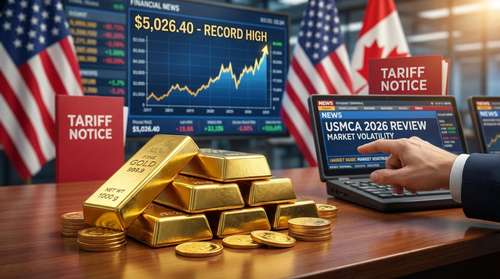
Gold prices surged past the psychological $5,000 barrier on Monday, hitting an all-time high of $5,026 per ounce as global markets reacted violently to President Donald Trump’s weekend threat to impose a blanket 100% tariff on all Canadian imports. The unprecedented surge in the precious metal reflects deepening investor anxiety that the North American trade alliance is on the brink of collapse just months before the critical USMCA joint review.
The Trigger: A "Backdoor" Trade Deal with China
The catalyst for the historic market volatility was a series of posts by President Trump on Truth Social over the weekend, targeting Canadian Prime Minister Mark Carney. Trump accused Canada of becoming a "drop-off port" for Chinese goods after Ottawa announced a preliminary agreement to reduce tariffs on Chinese imports—a move intended to stabilize Canada’s inflation-weary economy.
In his statement, Trump revived his moniker for the former central banker, referring to the Prime Minister as "Governor Carney," and warned that Canada would face "immediate 100% tariffs" if the deal with Beijing proceeds. "If Canada wants to sell out to China, they won’t be selling to the USA," Trump wrote, effectively threatening to sever the world’s largest bilateral trade relationship.
Markets in Tailspin: The Rush to Safe Havens
The reaction on global trading floors was instantaneous. As Asian markets opened on Monday, panic buying drove gold up over 4% in a single session, shattering the $5,000 ceiling that analysts had viewed as a distant target just weeks ago. Silver also rallied, crossing the $100 threshold to trade at $102 per ounce.
The US Dollar Index (DXY) slid against the Euro and Yen as currency traders hedged against the inflationary implications of a full-blown North American trade war. "This isn't just about tariffs anymore; it's about the disintegration of the North American economic block," said Elena Rodriguez, Chief Global Strategist at Apex Capital. "Gold at $5,000 is the market telling us that the USMCA might not survive 2026."
Automotive Supply Chains at Risk
The threat of 100% tariffs is viewed as a "nuclear option" for the highly integrated North American automotive sector. Manufacturers like Ford and GM, which rely on the seamless movement of engines and chassis across the border, saw their stocks plummet in pre-market trading. Key production hubs, such as Windsor, Ontario—which supplies engines to assembly plants in Kentucky and Michigan—could face immediate shutdowns if the tariffs are enacted.
Industry experts warn that a 100% levy would effectively make cross-border manufacturing impossible, potentially costing tens of thousands of jobs in the US Midwest. "You cannot build an American car without Canadian aluminum and parts," noted automotive analyst Marcus Thorne. "A 100% tariff doesn't just hurt Canada; it paralyzes Detroit."
The Shadow of the USMCA 2026 Review
The timing of the escalation is particularly precarious. The United States, Mexico, and Canada are scheduled to begin the mandatory "Joint Review" of the USMCA agreement on July 1, 2026. This review mechanism allows any party to signal intent to terminate the deal if dissatisfaction isn't resolved.
With President Trump’s rhetoric escalating from last year's 25% tariff threats to a total blockade, the likelihood of a successful renewal is fading. Investors are now pricing in a scenario where the USMCA—formerly NAFTA—is allowed to expire, fundamentally rewriting the rules of global commerce and driving capital into tangible assets like gold.
What’s Next for Investors?
As the standoff intensifies, volatility is expected to remain the only constant. With the Canadian government holding emergency cabinet meetings in Ottawa today, the market will be hyper-sensitive to any retaliatory language from Prime Minister Carney. For now, gold remains the primary beneficiary of the geopolitical chaos, with some technical analysts already eyeing $5,200 as the next resistance level.