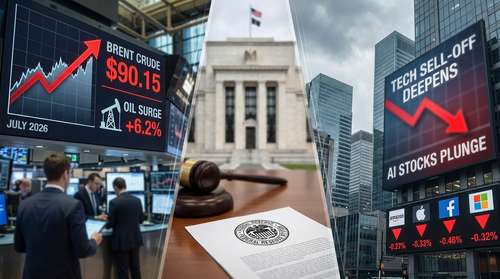
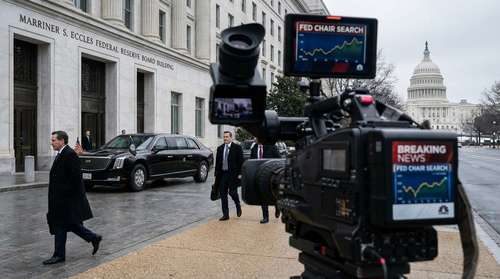
WASHINGTON — The Federal Reserve convened its first policy meeting of 2026 on Tuesday, facing a paradox that has come to define the central bank’s recent tenure: relative economic calm masked by an unprecedented political storm. While the Federal Open Market Committee (FOMC) is widely expected to hold interest rates steady in the 3.50% to 3.75% range this Wednesday, the real action is unfolding just blocks away at the White House and the Supreme Court.
A Rate Pause With 2026 Implications
Markets have priced in a near-certainty that the FOMC will maintain the status quo this week. Following a series of cuts in late 2025 that brought the federal funds rate down from its post-pandemic highs, the data suggests the "soft landing" is largely intact but fragile. Inflation, while cooling, remains sticky; recent projections see PCE inflation ending 2026 around 2.4%, slightly above the Fed’s 2% target.
"The data suggests we should pause," said one analyst note from J.P. Morgan, pointing to unemployment stabilizing at 4.4%. However, Wall Street is increasingly disconnected from the Fed’s "dot plot" projections. While traders are betting on two additional quarter-point cuts later this year, Fed officials have signaled a more hawkish hesitation, wary of reigniting price growth.
The "Two Kevins" and the Race to Replace Powell
looming larger than the rate decision is the expiration of Chair Jerome Powell’s term in May 2026. President Trump, who has publicly disparaged Powell as a "stubborn mule" and "Mr. Too Late" for his cautious approach to rate cuts, hinted this week that a nomination is imminent. Sources close to the administration suggest the shortlist has narrowed to the "Two Kevins": Kevin Warsh, a former Fed Governor, and Kevin Hassett, the current National Economic Council Director.
Speculation reached a fever pitch after President Trump told reporters in Davos that "He is the one," referring to his final pick. While Hassett is seen as the loyalist choice who aligns with the President’s pro-growth, low-rate philosophy, Warsh is viewed by markets as a more traditional institutionalist. A "dark horse" candidate, BlackRock executive Rick Rieder, has also seen his odds surge on prediction markets, offering a potential middle ground.
Treasury Secretary Scott Bessent, leading the search, has reportedly emphasized that the next Chair must be willing to coordinate more closely with fiscal policy—a requirement that has alarmed independent economists.
Supreme Court Showdown: Trump v. Cook
The meeting also takes place under the heavy shadow of Trump v. Cook, the landmark case currently before the Supreme Court. The legal battle stems from the administration's attempt to remove Fed Governor Lisa Cook in late 2025, citing "cause" related to disputed mortgage filings—a move critics argue was a pretext to punish dissent against looser monetary policy.
During oral arguments on January 21, Justices appeared skeptical of the administration's broad claim of removal power, with legal experts warning that a ruling in Trump's favor could shatter the Fed’s century-old independence. "If the President can fire a Governor for a clerical error, the wall between politics and monetary policy is effectively gone," noted legal scholar Michael Dorf.
Adding to the tension, the Department of Justice recently issued subpoenas regarding renovations at the Fed’s headquarters, a move Chair Powell described as "intimidation" designed to influence rate decisions. As Powell presides over what may be one of his final meetings, the message from the markets is clear: the interest rate is stable, but the institution itself is anything but.