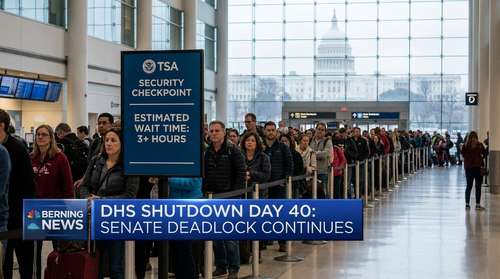
The ongoing funding lapse has stretched into its 40th day, and the latest DHS shutdown 2026 updates offer little hope for weary travelers. On Thursday, the U.S. Senate once again failed to pass competing funding bills, leaving the Department of Homeland Security shuttered and throwing the nation's travel infrastructure into chaos. With essential workers missing paychecks since mid-February, staffing shortages have triggered record-breaking TSA wait times today. The crisis has escalated beyond simple travel inconveniences, transforming into a bitter Senate immigration bill stalemate that threatens to redefine key 2026 midterm election issues.
Record-Breaking TSA Wait Times Across US Airports
Air travelers are currently enduring unprecedented delays. During a House homeland security committee hearing this week, Acting TSA Administrator Ha Nguyen McNeill confirmed that airports are suffering the 'highest wait times in TSA history'. With the shutdown keeping officers from receiving nearly $1 billion in paychecks, attrition has skyrocketed. Over 480 TSA officers have quit, and mass call-outs reached a peak on Sunday when more than 3,400 officers—roughly 12% of the scheduled workforce—failed to report for duty.
The ground reality is staggering. At George Bush Intercontinental Airport in Houston, passengers have faced security lines lasting up to six hours, with queues snaking through basement subway corridors and baggage claim areas. Major hubs like JFK and LaGuardia have temporarily suspended online wait-time reporting due to the extreme unpredictability of passenger processing. The frustration has driven desperate travelers to alternative solutions. Clear Secure, a biometric screening firm that allows passengers to bypass standard security queues, reported a 625% spike in app downloads this week. Yet, even expedited screening services are feeling the strain as overall airport infrastructure buckles under the pressure of reduced staffing.
The ICE at Airports Controversy and National Guard Plans
To mitigate the severe bottleneck, the Trump administration took unprecedented executive action by deploying federal immigration agents to 14 major airports. However, this stopgap measure has quickly ignited an ICE at airports controversy.
Critics and union representatives have voiced skepticism regarding the effectiveness of using agents trained for immigration enforcement to manage complex aviation security protocols. The deployment generated further backlash when President Trump urged ICE personnel not to wear protective face masks while assisting at checkpoints. As delays persist, the White House is weighing even more drastic measures. Trump recently floated a National Guard airport deployment, suggesting that military personnel could soon join the security lines if lawmakers fail to resolve the crisis.
Senate Immigration Bill Stalemate Deepens
The root of the airport chaos lies on Capitol Hill, where negotiations over Department of Homeland Security funding have completely deteriorated. Senate Majority Leader John Thune and Minority Leader Chuck Schumer remain deadlocked after rejecting each other's counteroffers on Wednesday. Adding a surreal backdrop to the crisis, newly appointed DHS Secretary Markwayne Mullin was sworn in by President Trump on Tuesday, spending his first full week leading an agency where most employees are working without pay.
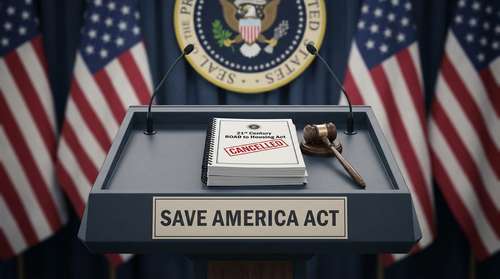
Democrats are flatly refusing to fund ICE without sweeping accountability reforms. Following a controversial enforcement incident in Minnesota, progressive lawmakers are demanding that ICE agents wear identification and body cameras, and that enforcement actions be restricted in sensitive locations. Republicans have dismissed these demands as 'unserious' and proposed funding the entirety of DHS while excluding ICE's deportation arm from the current bill. Trump, however, indicated he would reject any compromise that does not also include the passage of the 'Save America Act,' a sweeping voting bill unanimously opposed by Democrats.
Long-Term Security Impacts and Midterm Fallout
The political standoff is beginning to jeopardize long-term national security planning. DHS officials have warned lawmakers that the staffing crisis could severely disrupt security preparations for the upcoming 2026 FIFA World Cup. Because new TSA officers require four to six months of training, the sheer number of resignations means replacements will not be ready before the tournament brings a surge of international visitors.
As both parties dig in, the government shutdown is rapidly becoming one of the most volatile 2026 midterm election issues. Trump has publicly accused Democrats of creating 'chaos at the airports' and warned they will pay a steep political price. Meanwhile, Democrats continue to blame the administration for holding federal workers' livelihoods hostage over hardline immigration tactics. With neither side willing to concede, travelers are advised to arrive at least four hours early for flights as the nation braces for an indefinite continuation of the travel crisis.