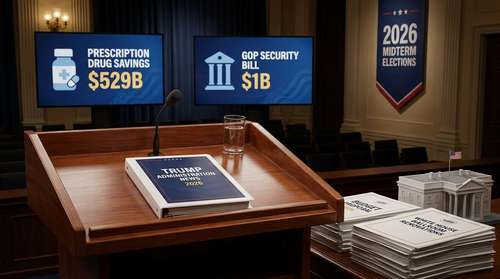
In a defining moment for Trump administration news 2026, two massive financial proposals are shaping the political battlefield in Washington. White House economists announced projections today that recent agreements with pharmaceutical manufacturers will generate $529 billion in drugmaker deals savings over the next decade. Concurrently, Senate Republicans unveiled a contentious $1 billion White House security bill designed to overhaul the perimeter and underground defenses of the executive mansion. The security legislation, largely driven by a recent assassination attempt, has immediately sparked a partisan fight over its connection to ongoing White House ballroom renovations. As the 2026 midterm elections approach, these parallel developments highlight the administration's dual focus on voter pocketbooks and executive protection.
Overhauling Prescription Drug Prices Under Trump
President Donald Trump's latest healthcare initiative centers on agreements struck with 17 leading pharmaceutical companies. The core mechanism requires manufacturers to align their domestic prices with the substantially lower rates charged in other affluent nations—a "most favored nation" approach to prescription drug prices Trump has championed throughout his tenure.
According to the White House Council of Economic Advisers, the policy could result in a $529 billion economic windfall by 2036. Department of Health and Human Services Secretary Robert F. Kennedy Jr. indicated that his agency will soon release more details regarding the agreements, carefully avoiding the disclosure of proprietary trade secrets. Federal and state governments are also projected to see a combined $64.3 billion reduction in Medicaid spending.
Projected Economic Impact
One model within the White House report tallied possible savings at an astonishing $733 billion over the decade, depending on how many new medications fall under the framework. A previous Congressional Budget Office assessment from October 2024 predicted that adopting such international pricing indices could reduce costs by more than 5%, although they cautioned that drugmakers might eventually adjust global distribution to compensate. With Americans having spent an estimated $467 billion on prescription medications in 2024 alone, any substantial price reduction presents a powerful message for voters concerned about the rising cost of living.
Senate Advances $1 Billion White House Security Bill
While the administration touts savings on healthcare, it is facing fierce opposition over executive spending. Late Monday, Senate Republicans introduced a sweeping GOP budget proposal that allocates $1 billion to the United States Secret Service. This funding is explicitly earmarked for "security adjustments and upgrades" at the White House.
The legislative push arrives just weeks after a severe security breach. On April 25, Cole Tomas Allen allegedly stormed the Washington Hilton during the White House Correspondents' Association dinner, armed with guns and knives in an attempt to assassinate the president. Following the incident, Republicans argue that the executive complex requires immediate and comprehensive hardening.
The financial maneuver is structurally complex. The $1 billion is bundled into a broader spending package intended to fund Immigration and Customs Enforcement (ICE) and Customs and Border Protection (CBP). Democrats have blocked funds for both agencies since mid-February without significant systemic reforms. By attaching executive security funds to border enforcement dollars, the GOP is utilizing a partisan budget strategy designed to force a difficult vote.
The Controversy Over White House Ballroom Renovations
The crux of the partisan dispute lies in the "East Wing Modernization Project," the administration's official designation for a planned 90,000-square-foot presidential ballroom. After the demolition of the old East Wing last year, the proposed ballroom became a flashpoint. Initially, the construction cost was estimated at $400 million, which the president promised would be entirely covered by private donors.
Now, the $1 billion security rider has raised alarms across the aisle. The legislation specifies that taxpayer funds cannot be used for "non-security elements" of the ballroom. However, the White House has previously argued in court documents that the facility will be heavily fortified, featuring subterranean military installations, a medical facility, and bomb shelters. President Trump has also insisted the structure must include bulletproof glass and defenses capable of repelling drone attacks.
White House spokesman Davis Ingle praised the inclusion of the funds, calling the fortifications "long overdue" and emphasizing that the Secret Service requires resources to completely harden the complex. Despite this, an attempt to unanimously authorize the ballroom project in the U.S. Senate last week was blocked by Senator Elizabeth Warren, who dismissed the plan as frivolous without further congressional review. The National Trust for Historic Preservation has also actively sued to halt the project, though a federal appeals court recently permitted national security-related construction to continue.
Setting the Stage for the 2026 Midterm Elections
As lawmakers navigate the spring legislative session, both the healthcare savings and the infrastructure spending are becoming central campaign issues. During a recent rally in Florida, the president framed the pharmaceutical deals as a decisive victory. "Now you have the lowest drug prices anywhere in the world, and that alone should win us the midterms," he told supporters.
Conversely, Democrats are weaponizing the proposed security expenditure. Senator Jacky Rosen and others have publicly contrasted the administration's willingness to allocate a billion dollars for a ballroom complex with other pressing domestic needs. The sheer volume of the proposed budget—more than double the original construction estimate—has left critics questioning where the line between security infrastructure and luxury event space is drawn.
Whether the projected half-trillion in healthcare savings will offset voter frustration over executive spending remains the defining question for the upcoming election cycle. Both parties are betting heavily that their respective narratives will resonate most effectively when Americans head to the polls this November.