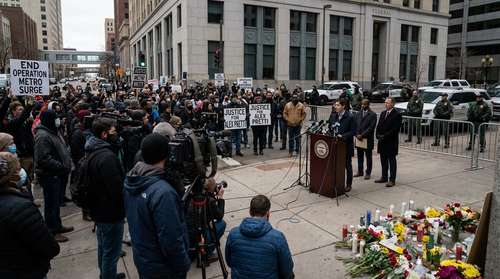
A deadly confrontation between federal agents and a local resident in South Minneapolis has plunged the city into a constitutional crisis, intensifying the standoff between local leaders and the Trump administration. On Saturday, 37-year-old ICU nurse Alex Pretti became the second person killed by federal officers this month under the controversial Operation Metro Surge, a massive federal immigration crackdown that Mayor Jacob Frey has denounced as an "invasion." As Minneapolis protests today swell in size and intensity, the White House and Department of Homeland Security (DHS) are doubling down on their defense of the operation, sparking a fierce national debate over federal overreach and public safety in 2026.
Conflicting Accounts of the Fatal Encounter
The shooting occurred shortly after 9 a.m. on Saturday near the intersection of 26th Street and Nicollet Avenue. While the Department of Homeland Security claims Pretti "approached" agents with a 9mm handgun, bystander video verified by multiple news outlets appears to contradict this narrative. The footage shows Pretti, a registered nurse who cared for veterans, filming agents with his phone and directing traffic before being pepper-sprayed and tackled by a swarm of tactical officers.
Kristi Noem DHS Secretary defended the agents' actions in a press briefing early Sunday, stating that the officers were "under siege" by "violent anarchists" and asserting that Pretti posed an immediate lethal threat. "Our agents have a right to return home safely," Noem said. However, Minneapolis Police Chief Brian O'Hara confirmed that while Pretti was a lawful gun owner with a concealed carry permit, there is no video evidence suggesting he brandished a weapon during the altercation. Family members describe Pretti as a "kindhearted soul" and a dedicated healthcare professional, rejecting the characterization of him as an aggressor.
'Operation Metro Surge' and the Battle for Minneapolis
Launched in late 2025, Operation Metro Surge was billed by the administration as a necessary intervention to combat violent crime and illegal immigration in sanctuary cities. However, local officials argue the operation has evolved into an unaccountable occupation. The initiative has deployed over 3,000 federal agents—including ICE and Border Patrol tactical units—into the Twin Cities, a move that Mayor Jacob Frey says has done more to destabilize the community than protect it.
"This is not law enforcement; this is an invasion of our city by its own federal government," Frey said in an impassioned speech on Sunday. "How many more Americans need to die before this administration realizes that a political narrative is not worth human lives?" The mayor's comments reflect a growing sentiment among city leaders that the surge is less about public safety and more about Trump administration politics 2026, using Minneapolis as a stage for a broader culture war.
Legal and Constitutional Showdown
The fallout has moved swiftly from the streets to the courts. Minnesota Attorney General Keith Ellison announced he will seek an emergency injunction on Monday to halt the operation, arguing that the federal presence violates the 10th Amendment and infringes on state sovereignty. "This is an illegal and unconstitutional occupation," Ellison stated, echoing the sentiments of Governor Tim Walz, who has demanded the immediate withdrawal of federal troops.
A City on Edge: Protests and Public Outcry
The Minneapolis shooting Alex Pretti has served as a flashpoint for a city already reeling from the January 7 killing of Renee Good by federal agents. Thousands gathered at Whittier Park on Saturday night for a vigil that turned into a massive march, with chants of "Feds Go Home" echoing through the Whittier neighborhood. Unlike previous unrest, these demonstrations have seen a broad coalition of residents, including healthcare workers wearing scrubs in solidarity with their fallen colleague.
Community organizers report that the atmosphere is tense but determined. "We are seeing a level of federal aggression that is unprecedented," said a local activist. "They are treating South Minneapolis like a war zone." As the National Guard stands by—deployed not by the President, but by Governor Walz to protect residents from federal overreach—the potential for further conflict remains high.
What Comes Next?
As the investigation into Pretti's death is handed over to the FBI—a move criticized by local leaders who want an independent state probe—the political ramifications are spreading to Washington. Congressional Democrats are calling for emergency hearings on the DHS's use of force, while administration allies argue that resistance to Operation Metro Surge is tantamount to aiding criminals. With the midterm elections looming, the events in Minneapolis are shaping up to be a defining moment in the struggle over the future of American policing and federal power.