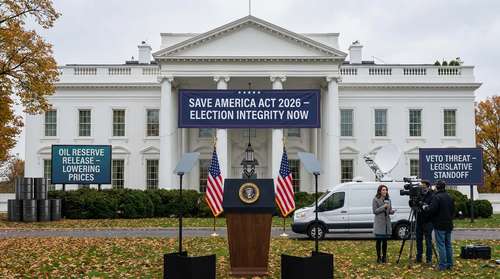
President Donald Trump has escalated his political agenda ahead of the November elections, issuing a sweeping White House legislative ultimatum. In a bold move that is already dominating 2026 midterm primary news, Trump announced he will refuse to sign any new legislation until Congress passes the controversial SAVE America Act 2026. This uncompromising stance on election integrity legislation arrives at a tumultuous moment for the administration, coinciding directly with a massive Strategic Petroleum Reserve release 2026 aimed at combatting surging fuel costs driven by the ongoing war with Iran.
The White House Legislative Ultimatum
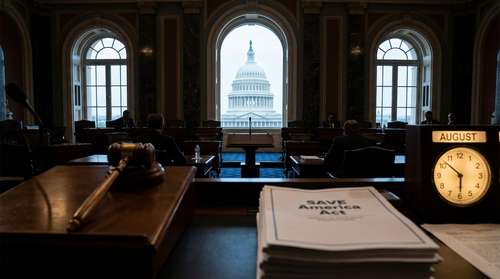
Trump’s demand places extreme pressure on a divided Congress. During a recent address to House Republicans in Florida, the president designated the SAVE America Act as his "No. 1 priority". The bill, which has already cleared the House, essentially functions as a Trump national voter ID law. It requires voters to provide documentary proof of United States citizenship—such as a passport or birth certificate—and a valid photo ID to register and cast a ballot.
"I’m not going to sign anything until this is approved," Trump declared, warning GOP lawmakers that failure to pass the bill would mean "big trouble" for their prospects in the upcoming midterms. While the White House indicated a narrow exception for funding the partially shuttered Department of Homeland Security, the freeze effectively grinds other federal legislative business to a sudden halt.
Senate Pushback on the National Voter ID Law
While the House managed to pass a version of the bill, the legislation faces a steep uphill battle in the Senate. Senate Majority Leader John Thune has been clear that Republicans lack the 60 votes required to overcome a Democratic filibuster, bluntly stating that they do not have the numbers to sustain a talking filibuster either. "We don't have the votes... That's just a function of math," Thune told reporters, positioning himself as a "clear-eyed realist" regarding the chamber's capabilities.
Complicating matters further, Trump is not satisfied with the House’s current draft. He is demanding that the Senate "go for the gold" by adding strict prohibitions on universal mail-in voting—allowing exceptions only for the severely ill or overseas military—alongside unrelated, highly contested provisions targeting transgender athletes and gender-affirming medical care for minors.
These added demands have alienated even some moderate Republicans, such as Senator Thom Tillis, who expressed disapproval of banning mail-in ballots. Voting rights advocates have heavily criticized this push for new election integrity legislation. Civil rights groups warn that stringent documentary requirements could disenfranchise millions of eligible citizens, particularly lower-income voters and married women whose current legal names may not match their original birth certificates.
Strategic Petroleum Reserve Release: Economic Relief
The intense standoff over federal voting laws is playing out against a backdrop of severe international and economic turbulence. With the United States actively engaged in a military conflict with Iran following strikes on oil facilities and commercial shipping lanes, global energy markets have been heavily disrupted. In response to these soaring domestic fuel costs, Energy Secretary Chris Wright announced a historic Strategic Petroleum Reserve release.
The Department of Energy has authorized the discharge of 172 million barrels of crude oil from the underground caverns in Texas and Louisiana over the next 120 days. This domestic action is part of a larger, coordinated maneuver by the International Energy Agency (IEA). Together, 32 allied nations are releasing a record-breaking 400 million barrels from their emergency stockpiles to offset the supply chain shocks in the Strait of Hormuz.
"For 47 years, Iran and its terrorist proxies have been intent on killing Americans," Secretary Wright stated during the announcement, accusing Tehran of manipulating and threatening the energy security of the free world. By aggressively flooding the market with emergency reserves, the administration hopes to rapidly neutralize the US Iran war gas prices that have driven crude oil past $92 per barrel and threatened to heavily tax American consumers at the pump. Wright noted that the administration plans to replenish the stockpile with 200 million barrels within the next year, pending market stabilization.
Implications for 2026 Midterm Primary News
These parallel developments—a hardline legislative blockade over voting mechanics and a massive economic intervention in the energy sector—highlight a high-stakes strategy from the Oval Office. Lawmakers are feeling the heat as they attempt to navigate these dual crises while fighting to hold onto a razor-thin House majority. The combination of wartime economic anxieties and sweeping electoral reforms has generated a fiercely volatile political climate.
If the administration successfully stabilizes oil markets through the emergency reserve release, it could deliver critical financial relief to American households just as primary season accelerates. However, the uncompromising presidential stance on the SAVE America Act 2026 threatens to completely paralyze the federal government if the Senate cannot find a workable bipartisan compromise.
As November rapidly approaches, the collision of wartime energy policy and fierce domestic legislative battles will heavily dictate the national trajectory. Voters and lawmakers alike are now bracing for a protracted partisan showdown—one that will test the absolute limits of executive influence and congressional resolve during an unprecedented election year.