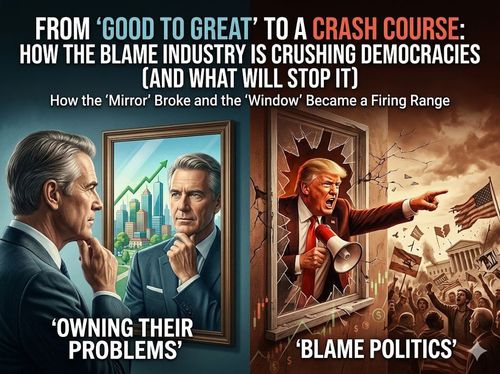
In his classic book Good to Great, management researcher Jim Collins coined the concept of the "Window and the Mirror." Leaders who take organizations to greatness share one critical trait: when there is a crisis, they look in the mirror and take full ownership of their problems. When there is success, they look out the window and give credit to others.
Looking at the political and social arena in the West today, the factual conclusion is chilling: the mirror is broken, and the window has become a firing range. We are witnessing an accelerated transition from a state of "Good to Great" to "Good to Bad." Instead of rational policy management, Western democracies have been hijacked by a destructive business and political model: Blame Politics.
The Anatomy of the Fall: From Denial to Scapegoating
In his follow-up book, How the Mighty Fall, Collins identifies the third and critical stage in the collapse of systems: Denial of Risk and Peril. This is the moment when leadership stops facing objective reality, refuses to take responsibility, and begins explaining away failures through "external circumstances" or hostile forces.
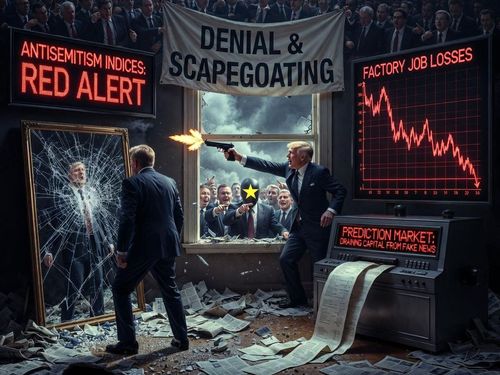
This is exactly where the fine line between factual policy management and populism is drawn, and it can be seen in the numbers. Take the loss of manufacturing jobs in the US, for example. Economic data clearly shows that most factory jobs were lost due to automation, robotics, and the lack of government programs to retrain workers for a new era. That is the reality, and dealing with it requires "looking in the mirror" and investing heavily in education. But instead, politics chose a scapegoat: "China stole our jobs" or "Immigrants are taking our livelihoods." The focus shifts from fixing a failing mechanism to targeting a group identity that must be fought. This allows leaders to dodge solving the actual problem while society continues to sink.

Antisemitism as a Barometer of Economic and Institutional Collapse
When a society loses the ability to solve complex problems, it will always look for the most available scapegoat. Economic history proves this over and over again: societies addicted to blame politics doom themselves to degeneration. Studies show how the persecution of minorities, primarily Jews, erased human capital and crushed trade networks (such as the expulsion of Jews from southern Italy, or the economic decline in Russian regions where Holocaust persecution was most intense).
Today, the antisemitism index is flashing a bright red warning. According to the Anti-Defamation League (ADL) 2025 data, 46% of the global adult population holds clear antisemitic views, a figure that has doubled over the last decade.
But why does antisemitism act as the primary barometer, and why now?
Jews have historically served as the system's "canary in the coal mine." Antisemitism is the most flexible conspiracy theory: it easily adapts to economic anxieties (the Jew as the exploiting banker) or social anxieties (the Jew as the privileged "oppressor"). The current surge is the result of a perfect storm over the last decade:
The loss of the economic horizon and the middle-class crisis: An entire generation experiencing the fallout of the 2008 crisis, inflation, and the housing crisis realizes the economic system isn't working for them. Instead of governments taking responsibility for monetary failures and poor planning, mass frustration is channeled outward.
The collapse of gatekeepers and the rise of identity politics: The institutions meant to mediate reality (the press, academia) have lost the public's trust. Into this vacuum stepped an academic framework that divides the world into "oppressors" versus "oppressed," recategorizing relative economic success as a moral crime.
The attention economy model: Algorithms reward the spread of fake news six times more than real news. Lies and polarization have become the most profitable products in the world.
The rise in antisemitism is therefore not just a danger to Jews; it is a hard indicator that democracies are refusing to confront their economic and social realities.
The End of the "Free Lie" Era: Pricing Reality
Human nature's tendency to look for culprits and avoid responsibility will not change. Empires and superpowers will always use force to secure resources, and politicians will always look for the easy way out of a crisis. The question isn't how to change human nature, but how to build a system that makes lying too expensive.
Just as the insurance market exacts a heavy price from someone building a house on a fault line, even if that person denies the existence of earthquakes, we need a system that prices populism. The emerging solution is not moral, but coldly financial: Prediction Markets.
Under the current media model, a politician, journalist, or content creator can spread an antisemitic or economic conspiracy ("The banks are crashing the economy on purpose") and reap pure political profit and viral reach at zero personal risk. But the moment a decentralized prediction market turns this claim into a tradable contract requiring real money (Skin in the game), the rules change. Rational traders, who analyze macro-economic data instead of tweets, execute ruthless arbitrage on the fake news. The market simply drains the capital from the emotional mob betting on racism, and transfers it into the hands of those reading the data.
The 1% That Determines Reality for the 99%
How does such a mechanism affect the average citizen who will never trade futures contracts? The answer lies in how the traditional stock market works.
Most of the public doesn't read the financial reports of corporate giants or analyze price-to-earnings ratios. The ones who do are a small percentage of analysts and institutional investors ("Smart Money"). They are the ones who determine the stock price through trading. This stock price then becomes a public signal of reality for the remaining 99%. If a CEO lies in an interview about the company's profits, the smart money will short the stock, the price will crash, and the public will immediately know the CEO lied, without the average citizen needing to read a single line of code or a financial report.
Prediction markets will do to blame politics what the stock market does to corporate fraud. The moment a false political claim is priced by the market at a 1% probability, that number becomes a factual signal. Funding bodies will distance themselves from a politician the market values at zero, social networks could algorithmically downgrade the exposure of the fake news based on the financial metric, and the business model of hate manufacturers will be completely dried up.
Conclusion: When Truth Becomes a Tradable Asset
Societies that survive and thrive over time owe their resilience to a culture of taking ownership and looking bravely in the mirror. Today, the historic spike in antisemitism indices and social polarization proves that our democracies are deep in the denial stage, a stage where blame politics has replaced the management of reality.
The hope of surviving this crisis and returning from "Bad" to "Good" does not lie in the expectation that politicians, content creators, or the general public will suddenly stop surrendering to the instinct of scapegoating. The correction will only come when the system changes and begins exacting a price for deceiving the public. The future belongs to decentralized market systems that will turn lies and racism into a devastating economic liability for anyone spreading them. Reality, it turns out, will not be determined by whoever shouts the loudest online, but by whoever is willing to pay the price when they are wrong.