In a bold maneuver that highlights the porosity of global technology restrictions, TikTok's parent company is establishing a massive artificial intelligence hub outside Chinese borders. Facing a strict ByteDance NVIDIA chip ban, the tech giant has successfully secured access to tens of thousands of next-generation processors by setting up operations in Southeast Asia. This strategic workaround allows the company to continue its aggressive expansion into the generative AI space without directly violating Washington's stringent trade rules.
The $2.5 Billion Malaysian Computing Hub
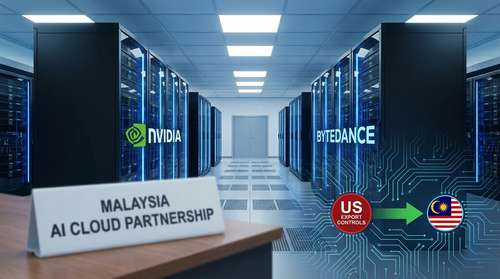
To keep pace with American rivals like OpenAI and Google, ByteDance is orchestrating a monumental hardware deployment in Malaysia. The project centers around an estimated 500 high-performance computing systems, fully equipped with roughly 36,000 Blackwell B200 AI processors. Financial analysts and industry insiders estimate the total hardware expenditure for this initiative will exceed $2.5 billion once fully operational.
By establishing this NVIDIA B200 Malaysia footprint, the company effectively sidesteps the limitations placed on importing top-tier computing power directly into mainland China. The Blackwell architecture represents NVIDIA's most powerful class of AI accelerators to date. Even recent regulatory relaxations from the U.S. government explicitly banned these specific processors from being exported to Chinese data centers. However, U.S. regulations do not currently prohibit Chinese corporations from leasing offshore compute capacity.
Malaysia has rapidly emerged as the premier destination for companies seeking a neutral zone in the escalating US-China tech conflict. With favorable business frameworks, stable power grids, and an established digital infrastructure, the nation has attracted billions in foreign tech investments, transforming into a vital hub for Asian computing dominance.
Decoding the ByteDance Aolani Cloud Partnership
The mechanics of this AI chip sanctions bypass rely entirely on third-party facilitators. Rather than purchasing the hardware directly—a move that would trigger immediate regulatory blockades—ByteDance is leasing the capacity through the ByteDance Aolani Cloud partnership.
Aolani Cloud, a rapidly growing Southeast Asian service provider, acts as the crucial intermediary. As a recognized Tier-1 NVIDIA cloud partner, Aolani holds certification for priority access to the silicon manufacturer's highly coveted supply lines. Aolani procures its hardware through Aivres, a specialized assembly firm that integrates the NVIDIA chips into functional server units. Aolani then hosts the physical infrastructure in its Malaysian facilities and leases the computing power back to ByteDance.
The scale of this new arrangement is unprecedented for the regional cloud provider. Up until this point, Aolani was operating with an estimated $100 million in total hardware inventory. Initial payments for the massive Blackwell expansion have reportedly already been processed. According to Aolani representatives, the company operates in strict compliance with international trade laws. Because the physical hardware never crosses into Chinese territory, the arrangement remains legally sound under current frameworks.
Scaling the TikTok AI Infrastructure
This multibillion-dollar investment is a critical component of the broader TikTok AI infrastructure. ByteDance already generates roughly a quarter of its revenue outside of China and operates five of the world's 50 most popular consumer AI applications. These include the educational homework assistant Gauth, video creation tool Dreamina, and the conversational chatbot Dola. Most recently, the company's video-generation model, Seedance, captured widespread attention for its ability to convert script prompts into high-quality short films.
A Global R&D Footprint
To leverage this newly acquired computing power, ByteDance relies on an expanding global workforce. The company maintains significant clusters of AI researchers and engineering teams in Singapore, Seattle, and San Jose, with over 100 new AI-related vacancies recently listed in the United States alone. By utilizing offshore data centers, these international teams can train sophisticated foundational models without the latency or regulatory hurdles associated with mainland Chinese facilities.
Once an AI model finishes the resource-heavy training phase on Malaysian Blackwell servers, the resulting algorithms can be legally transferred back to China. From there, lighter inference workloads can run on domestically produced hardware, such as Huawei's proprietary Ascend processors.
The Reality of US Semiconductor Export Controls
This sophisticated cloud-leasing strategy highlights a significant loophole in current US semiconductor export controls. While Washington has successfully choked off the direct supply of cutting-edge hardware to Beijing, policing borderless cloud computing has proven remarkably difficult. Previous attempts by the Commerce Department to implement Know Your Customer procedures for overseas cloud vendors have slowed some access but failed to completely halt offshore leasing.
For its part, NVIDIA maintains that these offshore cloud deployments are operating exactly as the legislation intended. An NVIDIA spokesperson recently clarified that the export rules were specifically designed to allow clouds to be built outside controlled countries. The chipmaker argues that winning global cloud contracts brings tens of billions of dollars and high-paying jobs back to the American economy, warning that overly restrictive policies could forfeit the entire Asian commercial market to foreign competitors.
As the geopolitical tug-of-war over silicon supremacy intensifies in early 2026, policymakers in Washington face a complex dilemma. Until new regulatory frameworks materialize to address overseas compute leasing, tech conglomerates will continue to leverage offshore data havens to secure the hardware necessary to dominate the global AI landscape.