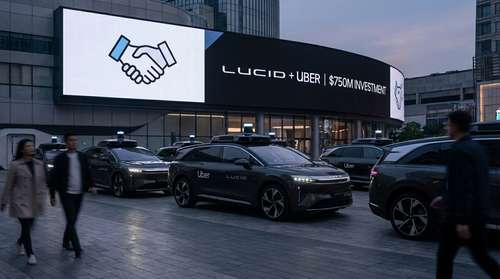
The race for autonomous ride-hailing dominance just shifted into a higher gear. In a massive expansion of their existing collaboration, Lucid Group and Uber Technologies have announced a staggering $750 million capital injection to deploy at least 35,000 custom-designed self-driving vehicles. This Lucid Uber Robotaxi initiative is set to reshape urban mobility, with commercial operations kicking off in the San Francisco Bay Area later this year. For Uber, the move secures a massive, scalable fleet of high-end electric vehicles. For Lucid, the fresh funding provides a critical financial lifeline to ramp up production and prove the viability of its advanced automotive architecture.
A $750M Strategic Investment to Accelerate Autonomous Mobility
Building advanced electric vehicles requires immense capital, and autonomous technology demands even more. The financial backbone of this expanded agreement comes from two deep-pocketed players. Ayar Third Investment Company, an affiliate of Saudi Arabia’s Public Investment Fund (PIF), is purchasing $550 million of Lucid’s convertible preferred stock. Simultaneously, Uber is committing an additional $200 million, bringing its total direct stake in the EV manufacturer to a substantial $500 million.
Solving the Manufacturing Capital Gap
This PIF Lucid investment 2026 is a highly targeted financial maneuver designed to bridge the gap between Lucid's current cash burn and future profitability. Over the past year, Lucid faced market headwinds, with its stock declining amid challenges in scaling up production. The fresh capital directly funds the manufacturing required to fulfill the expanded Uber driverless car partnership. It sends a strong signal to the market that both Saudi backers and Uber executives see a profitable roadmap ahead for the automaker.
Scaling the Autonomous Vehicle Fleet for 2026
When the two companies first aligned in July 2025, the initial pledge hovered around 20,000 vehicles. Now, that commitment has jumped by 75 percent. Uber plans to deploy at least 35,000 Lucid units globally over the next six years, marking one of the largest hardware commitments in the history of the ride-hailing industry.
The rollout strategy relies on two distinct vehicle platforms designed to maximize ride-hailing efficiency:
- The Lucid Gravity EV: A luxury SUV serving as the vanguard of the initial Bay Area launch. Engineered with superior interior space and advanced hardware, it is currently the primary focus of early street testing.
- The Lucid Midsize Platform: Expected to launch with a starting price under $50,000, these upcoming models will serve as the volume drivers. They offer the fast-charging capabilities and battery efficiency required for continuous commercial operation without the luxury markup.
Uber CEO Dara Khosrowshahi explicitly noted that integrating these midsize models creates a much clearer path to strong unit economics, ensuring the autonomous vehicle fleet 2026 is financially sustainable at scale.
The Software-Defined Vehicle Technology Navigating the Streets
Deploying 35,000 autonomous cars requires seamless integration between physical hardware and complex artificial intelligence. While Lucid handles the heavy manufacturing, the digital brain navigating San Francisco's notorious hills and fog belongs to Nuro. Uber has licensed Nuro's Level 4 autonomous system, cleverly integrating the hardware directly onto Lucid's production lines in Casa Grande, Arizona, rather than retrofitting the cars after assembly.
This streamlined approach highlights the true advantage of software-defined vehicle technology. Because Lucid's architecture was engineered from the ground up to support continuous over-the-air updates and heavy computational loads, adding Nuro’s driverless platform is a natural fit.
Road testing with real passengers is already underway. Currently, rides are limited to Uber employees accompanied by safety drivers in California. A fleet of nearly 100 engineering vehicles is gathering real-world data across multiple U.S. cities, aggressively refining the AI system ahead of a full public launch later this year.
What This Means for the Robotaxi Market News
The broader implications of this deal are sending shockwaves through the mobility sector. As you track the latest robotaxi market news, it becomes evident that Uber is no longer passively waiting for startups to perfect autonomous travel. By bringing its checkbook directly to an established manufacturer and an autonomous tech specialist, the ride-hailing giant is building a bespoke, self-driving network tailored entirely to its own platform.
This 35,000-vehicle agreement also signals a strategic shift. Uber will own and operate portions of this new fleet alongside third-party fleet partners, retaining tighter control over the passenger experience and profit margins. Khosrowshahi has publicly declared a clear path for Uber to become the largest facilitator of autonomous trips globally. If the San Francisco rollout proceeds smoothly, this massive Lucid Uber Robotaxi blueprint will rapidly expand to dozens of international markets, proving that the era of hailed, driverless electric vehicles is finally arriving on our local streets.