
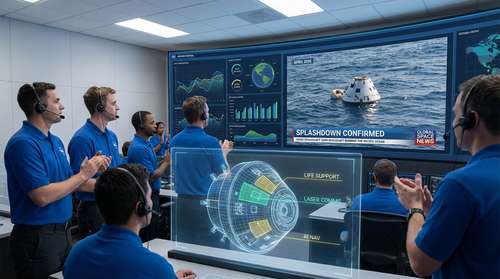
On April 10, 2026, the world watched as the Orion spacecraft parachuted into the Pacific Ocean, marking a triumphant end to humanity’s return to the moon. Following this historic NASA splashdown 2026, engineers and data scientists at mission control immediately shifted their focus from recovery to analysis. The Artemis II mission success is more than just a symbolic victory for space exploration; it represents a comprehensive validation of next-generation hardware and software. Now, mere days after commander Reid Wiseman, pilot Victor Glover, and mission specialists Christina Koch and Jeremy Hansen returned to Earth, NASA is meticulously unpacking the data to understand how their breakthrough systems performed in the harsh environment of deep space. Achieving an Artemis II mission success required seamless integration across international and commercial partners, setting a new standard for collaborative spaceflight.
A Historic Turning Point for NASA Orion Spacecraft Technology
During its nearly 10-day, 1.1-million-kilometer journey, the crew lived and worked inside a vehicle designed to push the boundaries of modern engineering. Every aspect of NASA Orion spacecraft technology was subjected to the ultimate test, operating far beyond the protective shield of low Earth orbit. Flight controllers are currently analyzing terabytes of Artemis 2 telemetry data to evaluate the structural integrity, thermal protections, and power consumption of the European Service Module. Early indicators show that the capsule not only met but exceeded its design parameters. This milestone in NASA Orion spacecraft technology provides a robust foundation for future missions, ensuring that the hardware can withstand the rigors of extended lunar operations. Ultimately, the validation of NASA Orion spacecraft technology proves the vehicle is ready for the upcoming Artemis III lunar landing.
Validating Deep Space Life Support Systems
A primary objective of this crewed flyby was the real-world testing of Orion’s Environmental Control and Life Support System. Unlike previous uncrewed test flights, having four astronauts on board required these deep space life support systems to function flawlessly. The architecture successfully managed cabin atmospheric pressure, continuously scrubbed carbon dioxide, and provided a steady supply of breathable air and clean water. Initial debriefs reveal that the regenerative components of the deep space life support systems operated with unprecedented efficiency. Proving the reliability of these deep space life support systems is a critical milestone for future long-duration missions, particularly for the planned Lunar Gateway station and eventual expeditions to Mars.
Revolutionary O2O Laser Communications
Perhaps the most visually stunning achievement of the flight was the transmission of live 4K video from lunar orbit. This was made possible by the Orion Artemis II Optical Communications System, or O2O, developed in collaboration with MIT Lincoln Laboratory. By utilizing infrared lasers rather than congested traditional radio frequencies, the MAScOT terminal achieved downlink speeds of up to 260 Mbps. This exponential leap in bandwidth allowed the crew to stream high-definition views of the Earth and Moon simultaneously. Engineers reviewing the communication logs report minimal packet loss, proving that optical links can reliably handle the massive data requirements of modern spaceflight. The Artemis II mission success heavily relied on maintaining this unprecedented level of connectivity.
Precision Maneuvers and Lunar Navigation AI
Traversing the void between Earth and the Moon requires pinpoint accuracy, especially during the critical free-return trajectory that brought the crew back home safely. To achieve this, Orion utilized advanced optical sensors paired with state-of-the-art lunar navigation AI. This autonomous system constantly analyzed star fields, planetary horizons, and lunar landmarks to verify the spacecraft's precise position, significantly reducing reliance on the Earth-based Deep Space Network. The integration of lunar navigation AI into flight software represents a paradigm shift in how spacecraft handle orbital mechanics, allowing the capsule to calculate course corrections natively. Moving forward, leaning on lunar navigation AI will ensure maximum safety even during prolonged communication blackouts.
Decoding the Artemis 2 Telemetry Data
As information continues to flow into NASA facilities, researchers are actively dissecting the Artemis 2 telemetry data to measure the exact response times of these guidance algorithms. The onboard computers demonstrated remarkable autonomy, calculating micro-adjustments to the flight path without requiring round-trip ground control intervention. Analyzing the Artemis 2 telemetry data gives engineers a transparent view of how the software reacted to minor thermal and gravitational shifts. This level of smart navigation is essential as missions venture further into the solar system, where communication delays make real-time human piloting physically impossible.
Shaping the Future of Space Technology
The implications of this lunar flyby extend far beyond the Artemis program itself. The successful NASA splashdown 2026 serves as a definitive proof-of-concept for the innovations that will drive the next century of cosmic exploration. From closed-loop atmospheric systems that can sustain crews indefinitely to artificial intelligence that can navigate by the stars, the hardware validated on this flight forms the backbone of interplanetary travel. The future of space technology has officially arrived, and as engineers continue their rigorous debrief following the NASA splashdown 2026, the vital lessons learned will directly shape humanity's next giant leap into the cosmos. Unlocking the future of space technology begins with fully understanding the remarkable achievements of this historic mission.