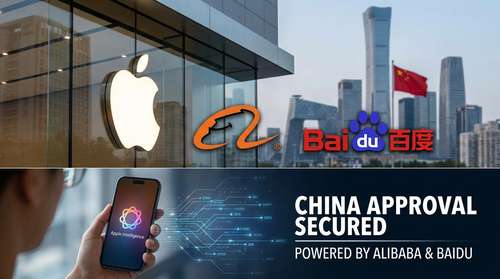
After navigating a labyrinth of strict regional regulations for two years, the much-anticipated Apple Intelligence China approval has finally become a reality. On July 15, 2026, the Cyberspace Administration of China officially granted the Cupertino tech giant a license to deploy its generative AI ecosystem across the mainland. Rather than utilizing its proprietary foundation models or Western partners like OpenAI, Apple has struck strategic agreements with local tech behemoths to power these tools. By integrating domestic AI frameworks, Chinese iPhone users will soon experience native, on-device text and image generation without having to bounce between different applications.
Navigating the China Cyberspace Administration Apple Mandate
Entering the Chinese generative AI space is notoriously complex for foreign technology companies. The government requires all public-facing large language models (LLMs) to undergo a rigorous registration process to ensure compliance with strict data security laws and localized ideological standards. This regulatory bottleneck created a significant China cyberspace administration Apple hurdle, forcing the iPhone maker to fundamentally rethink its software infrastructure for its second-largest market.
To overcome this, Apple abandoned the idea of importing its in-house models or its Western Google Gemini integrations. Instead, the company opted for a highly tailored, localized version of Apple Intelligence. Notably, Apple is now one of only two foreign smartphone AI providers officially approved in the country, standing alongside Samsung's localized Galaxy AI. This breakthrough grants Apple the regulatory green light it desperately needed to remain competitive against domestic rivals who have aggressively marketed their own integrated smart features over the last twenty-four months.
The Alibaba Qwen Apple Intelligence Integration
At the center of this localized software revolution is the Alibaba Qwen Apple Intelligence integration. Alibaba confirmed that its flagship Qwen large language model will serve as a foundational intelligence engine across Apple's entire hardware lineup in the region. This represents an unprecedented international deployment of a Chinese-developed LLM inside a globally dominant consumer device platform.
For everyday users, the shift will be seamless. Qwen will be baked directly into iOS, iPadOS, macOS, and visionOS. This deep ecosystem integration empowers users to leverage advanced AI capabilities natively within system apps. You won't need to download a separate Alibaba application; the intelligence layer will simply operate quietly in the background. The partnership guarantees that everything from text parsing to image comprehension remains fast, secure, and fully compliant with local digital sovereignty laws.
Unleashing New iPhone AI Features in China
The practical result of these partnerships is a massive upgrade to iPhone AI features China users have been waiting for. With the backend supported by local infrastructure, device owners will finally gain access to system-wide writing tools capable of rewriting, proofreading, and summarizing text within native applications like Mail and Notes. The integration also unlocks on-device image generation, allowing users to create custom visuals for messages or presentations instantaneously. Because the AI models are locally hosted and cleared by regulators, Apple can deliver the same low-latency, privacy-centric experience that Western consumers enjoy, without violating regional mandates.
Cementing the Baidu Apple AI Partnership
While Alibaba's Qwen handles heavy generative lifting across the operating systems, the Baidu Apple AI partnership fills another critical gap in the ecosystem. A Baidu spokesperson confirmed their engineering teams are working closely with Apple to develop specialized, localized AI tools tailored specifically for Chinese consumers.
By utilizing Baidu's robust search capabilities and established cloud infrastructure, Apple ensures that complex queries handed off by Siri meet both performance expectations and the nation's stringent legal frameworks. Financial markets reacted immediately to the news of these dual alliances. Following the regulatory announcement, Alibaba's U.S.-listed shares climbed roughly 6%, and Baidu surged over 4% in pre-market trading, reflecting immense investor confidence in the lucrative distribution channels Apple provides.
Defending Apple China Smartphone Market Share
This localized AI strategy arrives at a pivotal moment for Apple's hardware business. The tech giant has spent the last few years fighting an intense turf war against domestic champions like Huawei, whose Mate 60 series and self-developed silicon briefly threatened Apple's dominance in the premium sector. Offering parity in artificial intelligence capabilities is a necessary defensive maneuver to justify the high price tag of modern iPhones.
The underlying strategy appears to be paying massive dividends. According to recent quarterly data, Apple's shipments in China surged 24.4% year-over-year, alongside a 28% jump in Greater China revenue reaching $20.5 billion. Equipping these millions of new devices with an officially sanctioned, state-of-the-art AI suite eliminates the primary software advantage previously held by local competitors. Ultimately, this successful rollout proves that Apple is willing to systematically alter its product DNA across borders to secure its coveted Apple China smartphone market share in the world's most fiercely competitive consumer electronics arena.