
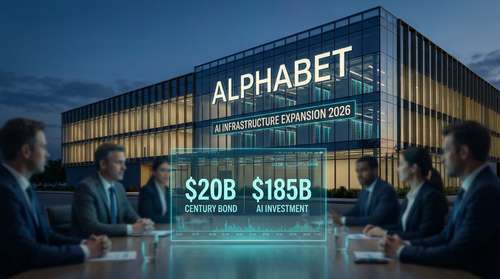
In a financial maneuver that signals a new era for Silicon Valley, Alphabet Inc. has executed a massive $20 billion bond offering, a strategic move designed to fuel its unprecedented Alphabet AI funding surge. On Monday, February 9, 2026, Google’s parent company tapped the debt markets with a seven-part U.S. dollar deal, while simultaneously preparing a rare century bond in British pounds—a financial instrument not seen in the tech sector for nearly three decades. This aggressive capital raise underpins a staggering forecast: Alphabet plans to pour between $175 billion and $185 billion into capital expenditures in 2026 alone, resetting the stakes in the global generative AI hardware race.
The $20 Billion Bond: A Historic Financial Milestone
The sheer scale of Alphabet's debt issuance has sent ripples through Wall Street. The company’s $20 billion offering was met with overwhelming demand, attracting over $100 billion in orders from hungry investors. This allowed Alphabet to tighten pricing significantly, securing cheaper borrowing costs than initially expected. The U.S. dollar portion of the deal includes maturities stretching out to 2066, but the true headline-grabber is the company’s foray into the sterling market.
Reports confirm that Alphabet is issuing a century bond—debt that won't mature until the year 2126—as part of a multi-currency strategy. This makes Alphabet the first major technology company to issue a 100-year bond since IBM and Motorola did so during the dot-com era of the 1990s. This century bond tech issuance serves a dual purpose: it locks in financing for ultra-long-term infrastructure while signaling to the market that Google intends to remain a dominant force for the next hundred years.
Fueling the $185 Billion AI Infrastructure Surge
Why does a company with over $120 billion in cash need to borrow billions? The answer lies in the colossal cost of AI infrastructure investment. Alphabet’s projected capital expenditure (CapEx) for 2026 is set to nearly double its 2025 spending of roughly $91.4 billion. This massive war chest is explicitly earmarked for the physical backbone of artificial intelligence.
The funds will accelerate a global Google data center expansion, financing the construction of next-generation facilities capable of powering energy-hungry AI models. A significant portion will also go toward custom silicon, specifically Google's Tensor Processing Units (TPUs) and newer Axion chips, which are critical for training and deploying models like Gemini. As 2026 technology trends shift toward agentic AI and real-time multimodal processing, the demand for compute capacity is outstripping supply, forcing hyperscalers to build at a breakneck pace.
Big Tech’s New Debt Strategy
Alphabet is not acting in isolation; it is leading a broader shift in Big Tech debt strategy. For years, tech giants relied on their fortress-like balance sheets and massive cash flows to fund growth. However, the AI revolution requires capital intensity comparable to industrial utilities or energy companies. By tapping into the bond market, Alphabet can preserve its cash for strategic acquisitions and stock buybacks while spreading the cost of long-term assets over decades.
Rivals Ramping Up
The move comes just days after Oracle raised $25 billion and Meta Platform’s recent $30 billion debt issuance, highlighting a synchronized rush for capital among the "Magnificent Seven." With Microsoft and Amazon also projecting record spending, the industry is collectively expected to issue hundreds of billions in debt this year. This fierce competition for generative AI hardware and energy resources is defining the economic landscape of the mid-2020s.
Investor Sentiment and Future Outlook
While bond investors clamped down on the offering, equity investors remain cautious. The prospect of a $185 billion annual spend has sparked debates about return on investment (ROI). However, the successful execution of this bond sale demonstrates that the credit markets have unwavering faith in Google’s long-term viability. By securing low-cost capital now, Alphabet is betting that its dominance in search, cloud, and AI will generate returns that far outweigh the cost of today’s historic borrowing.