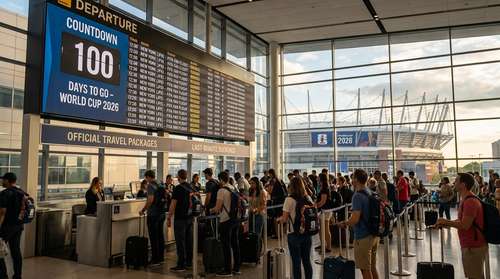
With the official 100-day countdown to the 2026 FIFA World Cup beginning tomorrow, March 3, a seismic shift is hitting the North American travel industry. As the June 11 kickoff approaches, a massive spike in 2026 FIFA World Cup travel bookings has triggered a race for accommodation, with host cities across the United States, Canada, and Mexico reporting that prime hotel inventory is vanishing at record speeds. What was a steady stream of reservations has turned into a tsunami of demand, effectively reversing recent slumps in the hospitality sector and setting the stage for the busiest summer of tourism in the continent's history.
The 100-Day Milestone: A Psychological Trigger for Fans
The transition from "months away" to the definitive "100 days to go" mark has acted as a powerful psychological trigger for millions of soccer fans worldwide. Historical data suggests that the 100-day window is when tentative plans solidify into confirmed bookings, and 2026 is shattering those norms. Cities like Toronto are capitalizing on this momentum with official celebratory events scheduled for March 3, serving as a beacon for the impending tournament.
Data from major booking platforms indicates that the 100 days to World Cup 2026 window has catalyzed a 37% surge in flight searches just in the last 48 hours. "This isn't just about securing a seat at the match anymore; it's about securing a bed within 50 miles of the stadium," says travel analyst Sarah Jenkins. The urgency is palpable, with fans from the UK, Argentina, and Japan leading the charge in locking down last-minute World Cup bookings before prices climb even further.
Host City Hotels: Occupancy Rates Nearing 95%
The most immediate impact of this booking frenzy is visible in the hospitality sector. World Cup host city hotels are seeing unprecedented occupancy numbers. In Vancouver, availability for match days has plummeted, with prime properties already reporting occupancy rates nearing 95%. Similarly, Mexico City and Guadalajara have seen year-over-year booking increases exceeding 300% for the tournament dates, driven by a mix of domestic enthusiasm and international visitors seeking the vibrant Latin American football culture.
US Cities Seeing Targeted Spikes
In the United States, the demand is highly targeted. Boston is experiencing a unique surge attributed to Scottish fans, while New York and New Jersey are becoming hubs for English supporters. Hotels in these metro areas are implementing strict minimum-stay requirements, often demanding 3-to-5-night commitments. This strategy has stabilized revenue for the tourism sector, which had previously faced a sluggish start to 2026. Properties near huge venues like AT&T Stadium in Dallas and Arrowhead in Kansas City are virtually sold out for knockout round dates, forcing fans to look at accommodation options up to two hours away.
Airlines Launch Massive "Fan Flight" Operations
Responding to the North America tourism surge, major carriers are aggressively adjusting their schedules. American Airlines, the Official North American Airline Supplier for the tournament, has announced the addition of approximately 27,000 seats across key routes. This includes new direct services connecting host cities that don't typically see high volume, such as a new link between New York LaGuardia and Kansas City.
These World Cup fan flights are designed to facilitate the complex logistics of a tournament spread across three vast nations. International carriers are also stepping up; Qatar Airways has launched comprehensive FIFA 2026 travel packages that bundle flights, hotels, and match tickets, aiming to simplify the logistical nightmare for fans traveling from the Middle East and Asia. Scandinavian Airlines (SAS) has similarly ramped up capacity to US gateways to serve the influx of Nordic fans.
Navigating the Booking Frenzy: Tips for Latecomers
For fans who have yet to book, the situation is critical but not hopeless. Experts advise looking for "shoulder dates"—flying in a day earlier or leaving a day later than the masses—to find available 2026 FIFA World Cup travel options. Additionally, alternative accommodations are playing a crucial role. Short-term rental bookings on platforms like Airbnb and Vrbo are up 110% year-over-year across all host cities, providing a vital release valve for the accommodation pressure.
Travelers should also monitor airline announcements closely over the next week. As demand models update with real-time data from this 100-day surge, airlines are expected to release additional waves of inventory to capture the market. However, price flexibility will be key; the days of bargain hunting for June 2026 are officially over.
A Historic Summer for North American Tourism
The economic implications of this surge extend far beyond the stadiums. The North America tourism surge fueled by the World Cup is projected to inject billions into local economies, benefiting everything from regional transit systems to local dining establishments. As the countdown clock ticks below 100 days, the region is bracing for a summer that will redefine sports tourism. The infrastructure is being tested, the bookings are confirmed, and the world is officially on its way.