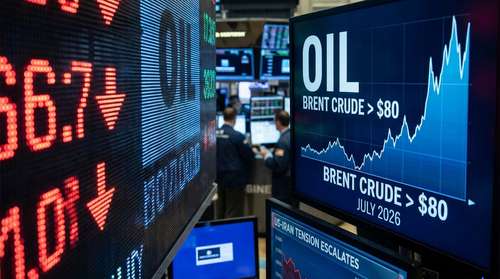
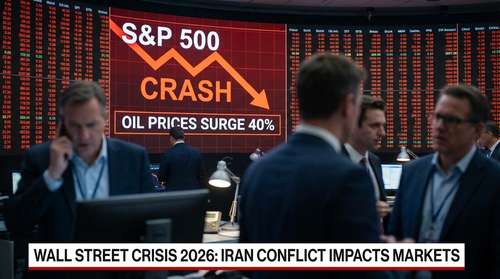
The global financial landscape is shaking as the Wall Street crisis 2026 intensifies. Equities took a massive beating on Friday, confirming that investors are rapidly losing hope for a swift diplomatic resolution in the Middle East. With geopolitical tensions boiling over, the S&P 500 worst week in nearly four years has officially materialized, leaving traders bracing for the very real possibility of a broader stock market crash 2026. At the heart of this financial storm is a historic oil price surge today, triggered by blockades in the Persian Gulf.
S&P 500 Worst Week Caps Off a Brutal Month for Stocks
Friday's trading session delivered punishing blows across the board, ending a week defined by erratic flip-flops between fleeting optimism and grim reality. The S&P 500 slumped 1.7%, dropping 108.31 points to close at 6,368.85. This sell-off officially marked the index's fifth consecutive losing week, an agonizing streak not seen in almost four years. During Friday's session, three out of every four stocks in the S&P 500 traded in the red.
The pain extended far beyond the broader market index. The Dow Jones Industrial Average plummeted 793.47 points to finish at 45,166.64, while the tech-heavy Nasdaq composite sank 459.72 points to 20,948.36. Both the Dow and Nasdaq are now down more than 10% from their recent all-time highs set just last month, confirming they have officially entered correction territory. As the Wall Street crisis 2026 accelerates, rising bond yields are adding to the pressure, with the 10-year Treasury yield climbing as high as 4.48% before pulling back to 4.43%.
The Iran Conflict Economic Impact: Oil Prices Surge 40%
The primary catalyst for this week's market meltdown is the severe Iran conflict economic impact. Brent crude, the international benchmark, surged 3.4% on Friday to settle at $105.32 per barrel. To put this oil price surge today into perspective, oil was trading near $70 just before the conflict began, representing a staggering spike of over 40%. Meanwhile, U.S. benchmark crude leaped 5.5% to $99.64 a barrel.
Market anxieties center heavily on the vital Strait of Hormuz, where roughly a fifth of the world's oil supply typically exits to reach global customers. Despite President Donald Trump extending a self-imposed deadline to April 6 to obliterate Iranian power plants if oil tankers aren't allowed to pass, fighting continues unabated. Analysts note that traders are widely dismissing the political posturing. Jim Bianco, macro strategist at Bianco Research, stated that any further statements from the U.S. administration are merely white noise, adding that only concrete progress verified by both sides will stabilize the markets.
Energy Market Volatility Raises Fears of $200 Oil
If the Persian Gulf blockade persists, the financial pain will only worsen. Strategists at Macquarie warn that if the war drags on until the end of June, crude prices could reach an unprecedented $200 per barrel. This extreme energy market volatility threatens to unleash a devastating wave of inflation throughout the global economy. Beyond drivers filling up their tanks, the surge impacts businesses that rely on aviation, trucking, and shipping to move products, inherently forcing widespread price hikes for consumer goods.
Gas Price Inflation News Weighs on the US Consumer
For everyday Americans, these macroeconomic indicators are translating directly into household financial hardship. Distressing gas price inflation news is already dampening the national mood. A March survey by the University of Michigan revealed that consumer sentiment fell more than economists anticipated, directly driven by soaring gasoline costs and wartime uncertainty. Since consumer spending constitutes the bulk of the U.S. economy, any pullback from cautious households could severely stall the nation's economic momentum.
The Federal Reserve now finds itself in a highly precarious position. Earlier in 2026, Wall Street broadly anticipated multiple interest rate cuts to juice the economy. However, the ongoing oil price surge today carries the massive risk of worsening underlying inflation. Elevated energy costs act as a tax on the consumer, keeping prices stubbornly high and effectively preventing the Fed from lowering borrowing costs.
Can Markets Recover From the Stock Market Crash 2026 Threat?
The toxic combination of higher borrowing costs, soaring energy expenses, and geopolitical instability makes the prospect of a severe stock market crash 2026 a growing concern for institutional and retail investors alike. Global equity strategist Doug Beath noted that diplomatic dissonance has thoroughly dismayed investors, ultimately proving that market risk appetite simply cannot withstand the fog of war.
As the conflict continues to dictate financial movements, all eyes will remain on the Middle East. With international indexes in Europe and Asia also closing down following Wall Street's dismal performance, the ripple effects are undeniably global. Until safe passage for international energy supplies is permanently guaranteed, energy market volatility will persist, and Wall Street is likely to remain firmly entrenched in an unforgiving state of crisis.