
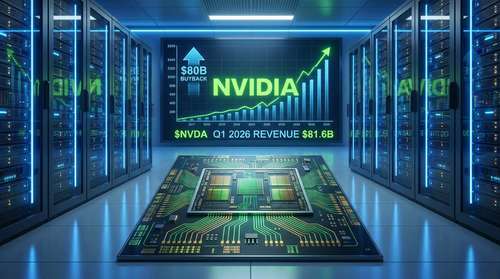
The artificial intelligence hardware boom shows absolutely no signs of cooling down. The highly anticipated Nvidia Q1 2026 earnings report has sent fresh shockwaves across financial markets, with the chipmaker posting a record-breaking $81.6 billion in revenue. This remarkable 85% year-over-year increase decisively beat Wall Street’s already elevated expectations, forcing analysts to rethink the ceiling of the AI cycle. Fueled by a massive global enterprise transition toward autonomous, agentic AI workloads, the company is generating unprecedented operational cash flow. Rather than simply hoarding this capital or attempting overpriced acquisitions, management authorized a historic $80 billion NVDA stock buyback program while simultaneously hiking its quarterly dividend by a staggering 2,400%. The results cement the company's status not just as a chip vendor, but as the foundational pillar of the modern digital economy.
Agentic AI Workloads Fuel Historic AI Infrastructure Demand
The undisputed engine powering this colossal growth remains Nvidia's Data Center business, which generated $75.2 billion in sales for the quarter—a staggering 92% jump compared to the previous year. To provide better visibility into this exploding market, the company recently restructured its reporting framework into two primary platforms: Data Center and Edge Computing.
Within the newly categorized Data Center division, growth is coming from all directions. Hyperscale customers—comprising major public cloud providers and global consumer internet platforms—accounted for $37.9 billion in revenue, up 115% year-over-year. The remaining $37.4 billion came from the ACIE segment, representing AI-focused cloud providers, industrial enterprises, and sovereign nations building out localized infrastructure.
During the earnings call, CEO Jensen Huang emphasized that the world is actively constructing "AI factories," describing it as the largest infrastructure expansion in human history. This relentless AI infrastructure demand is no longer just about conversational chatbots. Instead, the market is aggressively pivoting toward agentic AI workloads. These advanced AI systems operate as autonomous agents capable of executing complex, multi-step productive tasks, generating immediate, real-world value for enterprise adopters.
Rewarding Shareholders: The $80 Billion NVDA Stock Buyback
While top-line numbers typically steal the spotlight during earnings season, the sheer profitability of Nvidia's operation is equally staggering. Operating with gross margins holding firmly at 75%, the semiconductor leader is producing cash at a scale rarely seen in corporate history.
To put this immense cash generation to work, the board of directors approved a massive new capital return initiative. The cornerstone is the authorization of an additional $80 billion NVDA stock buyback program with no expiration date. Share repurchases of this magnitude signal intense leadership confidence that the company's valuation still has room to run, even at a multi-trillion-dollar market cap.
A Staggering Dividend Hike
Beyond the share repurchase authorization, income-focused investors received an unexpected windfall. Management increased the quarterly cash dividend from $0.01 to $0.25 per share. When a hyper-growth tech firm begins distributing substantial regular cash payments, it historically signals a maturing financial profile where the business generates more liquidity than it can realistically reinvest into supply chain expansion or research and development.
Reshaping Global Semiconductor Market Trends
The financial results offer critical insights into broader semiconductor market trends. While server racks and GPUs dominate the conversation, Nvidia is also making quiet but substantial progress at the endpoints. The newly defined Edge Computing segment—which encompasses automotive technology, robotics, workstations, and AI-RAN base stations—delivered $6.4 billion in quarterly revenue, growing 29% year-over-year.
This diversified strength indicates that the hardware cycle is broadening. As organizations transition from training massive foundation models to deploying inference applications locally, edge devices will become the next major battleground for silicon supremacy.
Sustaining Nvidia Revenue Growth and Dominating Tech Sector Market News
Looking ahead, the momentum appears entirely insulated from traditional macroeconomic headwinds. Management provided an astounding Q2 revenue guidance of approximately $91 billion, pointing to sustained, almost 100% year-over-year growth for the upcoming quarter. This aggressive forecast essentially forces institutional analysts to continuously revise their valuation models upward.
Sustaining this level of Nvidia revenue growth at such a massive scale is unprecedented in modern business history. It reflects a fundamental restructuring of how corporate IT budgets are being allocated, moving away from legacy CPU-based servers and toward accelerated computing infrastructure. Nvidia’s financial performance remains the ultimate scoreboard for the artificial intelligence economy. The sheer scale of its operations consistently dictates the flow of tech sector market news, instantly lifting the valuations of affiliated chip designers, hardware assemblers, and cloud service providers across global exchanges. As long as enterprises continue their aggressive race to build autonomous digital workforces, Nvidia’s impenetrable lock on the underlying computational hardware seems virtually unbreakable.