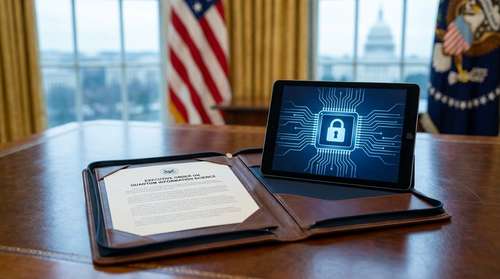
In a sweeping move to solidify American technological dominance, President Donald Trump signed two landmark directives on Monday, June 22, 2026, aimed at accelerating the nation's advanced computing capabilities. The highly anticipated Trump quantum executive order sets an aggressive timeline to develop a research-grade quantum computer by 2028. Simultaneously, the White House is drastically shortening the timeline for federal agencies to secure critical networks against next-generation cyber threats, while introducing a novel funding mechanism that ties federal money to direct equity stakes in private tech companies.
The directives—officially titled "Ushering in the Next Frontier of Quantum Innovation" and "Securing the Nation Against Advanced Cryptographic Attacks"—represent a cornerstone shift in the broader US quantum computing strategy. By demanding both immediate infrastructure development and rapid cybersecurity overhauls, the Trump quantum executive order positions this technology alongside artificial intelligence as a critical pillar of national security.
The Race for a Research-Grade Quantum Computer by 2028
The first directive establishes the Quantum Computer for Application Development and Discovery Science effort. Its primary objective is clear: task the Department of Energy with delivering a scientifically relevant quantum computer 2028 target. This timeline is notably ambitious, aiming to field a system powerful enough to drive new discoveries in materials science, chemistry, and complex logistics before the end of the decade.
Michael Kratsios, director of the White House Office of Science and Technology Policy, confirmed in a press briefing that the administration believes a fully operational, research-grade machine can realistically happen by 2028. While private companies have traditionally aimed for commercial viability by 2029, this federal push accelerates the interim steps. Achieving a functional quantum computer 2028 milestone will serve as a foundational stepping stone, accessible to the broader scientific community, to test and refine applications that traditional supercomputers simply cannot process.
Military and Sensor Applications
Beyond raw computing power, the new US quantum computing strategy requires the Department of Defense to deploy three new types of quantum sensors by the fall of 2028. Because subatomic particles are highly sensitive to outside interference, these next-generation sensors will allow military aircraft to navigate GPS-denied environments in war zones and detect underground infrastructure, such as missile silos, directly from space.
Accelerating the Post Quantum Cryptography Deadline
The second executive order addresses the looming cybersecurity threat known as "Q-Day"—the theoretical point when a machine becomes powerful enough to break modern RSA-2048 encryption. To mitigate the "harvest now, decrypt later" strategy currently employed by foreign adversaries, the White House has significantly accelerated the federal post quantum cryptography deadline.
Initially targeted for 2035, federal agencies must now transition their high-value assets and critical infrastructure to post-quantum cryptography (PQC) by 2030, with a strict mandate to complete the migration of all digital signatures by December 31, 2031. Furthermore, the Department of Commerce is required to launch a pilot project to meet the new post quantum cryptography deadline by the end of 2027.
This massive cryptographic overhaul forces a nationwide infrastructure upgrade. Every federal agency has 30 days to designate a migration lead, setting off a chain reaction that will likely force private sector contractors, blockchain networks, and the broader financial industry to match the government's accelerated timeline.
$2 Billion in Government Equity Tech Grants Sparks Market Rally
Perhaps the most unprecedented aspect of the updated US quantum computing strategy is its funding mechanism. Breaking from the traditional model of zero-strings-attached research subsidies, the administration is rolling out $2 billion in government equity tech grants. In exchange for massive capital injections, the federal government will take direct equity stakes in the recipient companies.
Industry reports indicate the government equity tech grants will be distributed among nine leading hardware and software developers. IBM is slated to receive the largest allocation at roughly $1 billion, with GlobalFoundries earmarked for $375 million. Other key players, including Rigetti Computing, D-Wave Quantum, and Infleqtion, are expected to receive approximately $100 million each. By acting as a shareholder alongside private backers, the government aligns its financial interests directly with the commercial success of the private sector.
Following the Oval Office announcement, quantum computing stocks experienced a massive surge in extended trading. Infleqtion jumped over 13% to reach its highest level in weeks, while Rigetti Computing saw a nearly 6% boost. The market reaction underscores renewed investor confidence, often dubbed "quantum FOMO," as federal backing drastically reduces the financial risk of developing these capital-intensive systems. Analysts expect quantum computing stocks to remain highly volatile but well-supported as firms compete for upcoming infrastructure contracts.
Securing the American Technological Future
The twin directives under the Trump quantum executive order mark a definitive pivot in how the United States handles emerging deep tech. By reconstituting the National Quantum Initiative Advisory Committee and mandating the creation of workforce development institutes, the administration is proactively addressing both the hardware and human capital required to win the global technology race against China.
As the aggressive target for a quantum computer 2028 and the strict 2031 post quantum cryptography deadline close in, the ripple effects will be felt across every sector of the digital economy. Organizations that rely on secure data transmission must now accelerate their own quantum-resistant roadmaps to keep pace with the newly established federal standard.