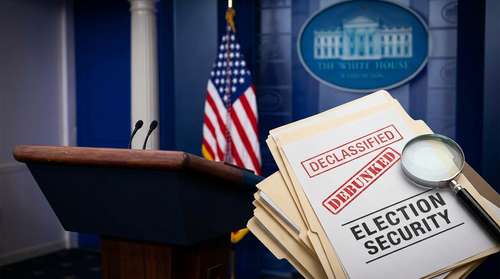
During a highly anticipated White House address 2026 on Thursday evening, President Donald Trump attempted to reignite his long-standing voter fraud claims with a dramatic release of newly declassified election documents. Speaking from the East Room, the president promised a staggering revelation regarding foreign interference and deep-state coverups. However, intelligence analysts, media outlets, and nonpartisan election experts have swiftly labeled the Trump election security speech a resounding failure. The heavily redacted records provide zero fresh evidence of altered election outcomes or stolen votes, instead consisting largely of recycled intelligence files and data already residing in the public domain.
The Declassified "Bombshell" That Wasn't
In his nearly 30-minute primetime address, the president insisted that foreign entities, primarily China, compromised American election infrastructure in unprecedented ways. The White House Government Transparency Taskforce published four tranches of intelligence files meant to validate these assertions. Yet, an immediate review of the materials revealed that they mostly outline well-documented system vulnerabilities rather than actual exploitation.
Election experts attending a pre-speech briefing were left puzzled by the administration's claims. David Becker, executive director of the Center for Election Innovation & Research, noted that the White House promised a smoking gun but delivered a dud, confirming the documents contain absolutely nothing new to call past election results into question. While the files detail China's theoretical cyber capabilities and large-scale data acquisition efforts, critics quickly pointed out that the foreign data gathering referenced by the president primarily involved publicly accessible voter rolls.
Missing Evidence and Media Backlash
A critical distinction remains between theoretical system vulnerability and compromised election results. The released paperwork fails to bridge that gap, offering no confirmation that Beijing successfully manipulated ballot counts to swing an election.
The address also sparked a fierce media battle. An evidently frustrated president took aim at major television networks, including ABC and NBC, that declined to carry the event live. Arguing they were part of a plot to suppress the truth, Trump demanded the revocation of their broadcast licenses. Networks that did air the speech, such as CBS and Fox News, appended their broadcasts with real-time fact-checks and post-speech disclaimers acknowledging the lack of verifiable evidence supporting the core allegations.
DHS Secretary Markwayne Mullin Issues Severe Warnings
The administration’s messaging campaign extended far beyond the presidential podium. Almost simultaneously, Homeland Security Secretary Markwayne Mullin—who was confirmed to the position just months earlier in March—held a tense press conference issuing unprecedented ultimatums to state election officials. In a move that aggressively escalates federal pressure ahead of the November midterms, Mullin threatened top state administrators with funding cuts, fines, and potential prison time if they resist turning over sensitive voter data to the Department of Homeland Security.
Mullin is demanding states run their voter rolls through the federal Systematic Alien Verification for Entitlements (SAVE) program database. However, state officials and voting rights advocates argue this system is fundamentally flawed and inappropriate for mass voter roll purges. Reports have demonstrated that the SAVE database is plagued with errors, frequently misclassifying naturalized U.S. citizens as noncitizens. In fact, last month, federal judge Sparkle Sooknanan blocked the administration's recent overhaul of the SAVE database, ruling that the federal government knowingly repurposed unreliable data in a manner that tramples on privacy rights.
Despite this judicial hurdle, Mullin claimed his department identified 28,000 noncitizens registered to vote across two dozen states that utilized the database. Nonpartisan experts quickly pointed out that this figure represents a microscopic fraction of registered voters and that there is zero evidence any of these individuals actually cast a ballot, which remains a federal crime.
Furthermore, the DHS is aggressively tying essential grant funding to stringent new compliance measures. States must transition away from electronic voting systems relying on bar codes, adopt hand-marked paper ballots, and execute mandatory 5% manual audits after federal elections to access over $1 billion in FEMA election security grants. States are already pushing back against Mullin's aggressive timeline, warning that rapid system transitions just months before an election increase the likelihood of administrative errors.
The Legislative Endgame: Pressuring Congress on the SAVE Act
The synchronized release of the declassified election documents and DHS threats serves a distinct legislative purpose. Trump capped his address by aggressively pressing lawmakers to pass the SAVE Act (Safeguard American Voter Eligibility Act). This legislation would fundamentally alter the registration process nationwide by mandating documentary proof of citizenship—such as a passport or birth certificate—and government-issued photo IDs for all federal elections.
Currently stalled in the Senate, the bill faces intense scrutiny from civil rights advocates who warn it imposes steep financial and logistical hurdles on legitimate voters. Lawmakers pushing back on the administration’s narrative, such as Rep. Raja Krishnamoorthi, argue the White House is laying the groundwork for a federal takeover of the upcoming elections under the guise of security.
For voters, the immediate future remains uncertain. If the SAVE Act forces its way through Congress, millions could find themselves scrambling for requisite citizenship documentation. Meanwhile, the relentless focus on foreign interference and voter data access guarantees that election integrity will remain the most explosive issue on the ballot. As the pivotal November 3 vote rapidly approaches, the collision course between federal mandates and state-run elections will only accelerate. While the newly publicized documents completely failed to deliver the promised smoking gun, the accompanying policy shifts engineered by the administration are already transforming the battlefield of American election administration.