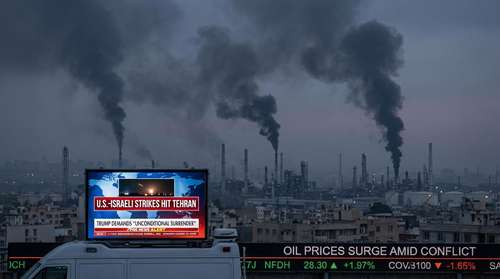
President Donald Trump has doubled down on his aggressive military strategy against Iran, explicitly rejecting ceasefire calls and demanding nothing short of "unconditional surrender" from the regime. The ultimatum comes as Operation Epic Fury intensifies, with U.S. and Israeli forces launching unprecedented airstrikes on major oil storage facilities in the heart of Tehran. The escalation has sent shockwaves through global energy markets, fueling a gas price surge in 2026 that analysts warn could cripple Western economies if the conflict drags on.
Direct Strikes on Tehran Oil Infrastructure
In a dramatic shift of tactics on the ninth day of the war, joint U.S. and Israeli air forces targeted civilian industrial infrastructure within the Iranian capital for the first time. Precision strikes hit four major oil depots and a petroleum products transport center in Tehran and the neighboring Alborz province. The resulting explosions sent massive pillars of fire into the night sky, visible across the entire city.
By Sunday morning, residents of Tehran woke to a dystopian scene. Thick, toxic black smoke blanketed the skyline, blocking out the sun. Reports confirmed that it was literally "raining oil" in parts of the city, with black, hydrocarbon-saturated droplets coating cars and buildings. The Iranian Red Crescent has issued urgent warnings, advising citizens to stay indoors to avoid severe respiratory damage and skin burns from the acidic precipitation.
"This is a calculated move to dismantle the regime's economic lifeline and its ability to fuel its military machine," a Pentagon official stated on condition of anonymity. However, the strikes have drawn sharp criticism from international observers who argue that targeting dual-use infrastructure in a dense urban area crosses a dangerous red line.
Trump's Ultimatum: "No Deal" Without Surrender
As smoke billowed over Tehran, President Trump took to Truth Social to clarify his administration's endgame. dismissing diplomatic overtures from third-party mediators. His message was blunt and uncompromising, effectively shutting the door on any immediate negotiated settlement.
"There will be no deal with Iran except UNCONDITIONAL SURRENDER!" Trump wrote in a widely shared post. He further elaborated that following a surrender, the U.S. and its allies would oversee the selection of a "GREAT & ACCEPTABLE Leader" to replace the current regime. This rhetoric signals a clear intent for regime change, moving the goalposts far beyond the initial stated aims of curbing Iran's nuclear capabilities.
The "Make Iran Great Again" Doctrine
Trump's comments also included a promise to rebuild the nation post-conflict, using his signature campaign phrasing. "We will work tirelessly to bring Iran back from the brink of destruction, making it economically bigger, better, and stronger than ever before," he claimed. This approach mirrors post-WWII reconstruction promises but has done little to assuage fears of a prolonged and bloody occupation or a power vacuum in the Middle East.
Global Economic Shockwaves and Gas Price Surge
The Trump Iran war scenario has triggered immediate and severe consequences for the global economy. With the Strait of Hormuz effectively closed to tanker traffic due to the hostilities, crude oil prices have spiked above $90 per barrel, the highest level in years.
Consumers are already feeling the pinch at the pump. The national average for a gallon of gas in the U.S. jumped 14% in a single week, hitting $3.41, with analysts predicting it could breach $4.00 if the Tehran oil strikes continue. "The market is pricing in a total disruption of Persian Gulf supply," noted energy analyst Sarah Jenkins. "If this isn't resolved in weeks, we are looking at a global recession."
Operation Epic Fury: A New Phase of Conflict
Operation Epic Fury, launched on February 28, 2026, began with the targeted assassination of Supreme Leader Ali Khamenei and has since evolved into a comprehensive campaign to degrade Iran's military and state apparatus. While U.S. Central Command reports that Iranian ballistic missile attacks have decreased by 90% since the operation began, the regime continues to launch retaliatory drone strikes against U.S. bases in Kuwait and desalination plants in Bahrain.
Israeli Prime Minister Benjamin Netanyahu has promised "many surprises" for the next phase of the conflict, suggesting that the strikes on Tehran's oil infrastructure may just be the beginning. With Trump's demand for unconditional surrender now public policy, the window for de-escalation appears to have slammed shut, setting the stage for a potentially protracted and devastating struggle in the Middle East.