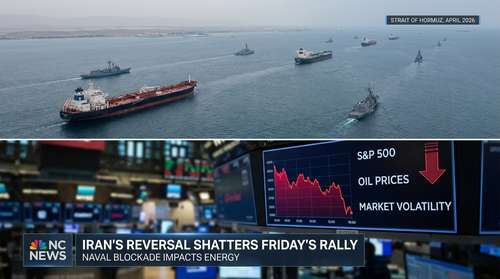
The global economy is facing a severe case of whiplash this weekend. Just hours after an announced reopening triggered a historic sigh of relief across financial sectors, Iran violently reimposed strict control over the critical Middle Eastern shipping lane on Saturday. For those tracking the Strait of Hormuz status April 2026, the situation has deteriorated rapidly, with alarming reports confirming commercial tankers were fired upon in the narrow passageway. The sudden reversal threatens to completely obliterate Friday's staggering financial gains and renew terrifying prospects of an energy-driven global recession.
Euphoria Crushed: Reversing the Friday Relief Rally
Wall Street had barely finished celebrating before the geopolitical ground shifted again. On Friday, the mere promise of maritime traffic resuming pushed the Dow and Nasdaq upward, while securing an S&P 500 record high 2026. This immense market optimism was largely fueled by a precipitous 9% plunge in global crude prices, as traders bet that the worst of the regional standoff was finally over following weeks of gridlock.
That fleeting optimism evaporated by Saturday afternoon. Now, analysts are warning that the oil price volatility today will pale in comparison to what awaits when futures trading resumes on Sunday evening. Financial institutions had baked a de-escalation into their risk models, assuming both sides were stepping back from the brink. Traders who bet big on a sustained stock market rally April 18 are now facing catastrophic losses as the sudden barrage of live fire on civilian tankers introduces a chaotic new variable into global markets.
Live Fire and the Escalating Iran US Naval Blockade
The situation in the 21-mile-wide waterway has been fraught since peace talks in Islamabad collapsed earlier this week. In response to the breakdown, the U.S. Navy's Fifth Fleet—headquartered in Manama, Bahrain—has maintained a heavy posture in an attempt to secure commercial transit. However, Saturday's aggression marks a significant and dangerous escalation, proving the waterway remains an active combat zone.
Commercial shipping operators, who had cautiously begun routing vessels back toward the Persian Gulf, are now ordering immediate diversions. The reality of a sustained Iran US naval blockade is settling in for maritime insurers and shipping conglomerates alike. Over 30,000 vessels normally pass through this vital choke point annually, but the current security environment has effectively zeroed out that traffic. With live munitions striking civilian logistics ships, the risk of collateral damage has simply become too high for commercial fleets to tolerate.
Bracing for Massive Energy Supply Chain Disruption
The stakes could not be higher for the global economy. Before the conflict ignited, the Strait of Hormuz accommodated roughly 20.9 million barrels of crude oil and petroleum liquids every single day. This accounts for over 20% of global petroleum consumption and roughly a quarter of all maritime oil trade. Removing that volume from the global pool cannot be easily mitigated by strategic reserves or alternative infrastructure.
This prolonged closure guarantees a devastating energy supply chain disruption. Existing alternative pipelines from Saudi Arabia and the UAE can only offset a fraction of the daily exports. We are looking at a scenario where replacement supertanker shipments must be moved via overland routes—an incredibly inefficient process requiring tens of thousands of trucks and burning immense amounts of secondary fuel. For nations heavily reliant on Middle Eastern crude, particularly in Asia, the prospect of immediate shortages is shifting from theoretical to imminent reality.
The Global Energy Crisis Business Impact
The ripple effects of this maritime chokehold extend far beyond the fuel pump. The broader global energy crisis business impact is expected to touch nearly every sector of the international economy. Logistics companies are already recalculating freight rates based on longer routes around the Cape of Good Hope, which will inevitably drive up the cost of consumer goods worldwide.
Heavy manufacturing, aviation, and petrochemical industries are highly exposed. Disruptions to the flow of liquefied petroleum gas (LPG) and naphtha—both critical for plastics, packaging, and residential heating—will force factories to scale back production or pass aggressive price hikes down to buyers. Additionally, nearly 20% of the world's liquefied natural gas (LNG) trade relies on this exact passage. As the trading week approaches, businesses are scrambling to secure whatever forward contracts they can, bracing for a Monday morning where the cost of doing business may fundamentally change.