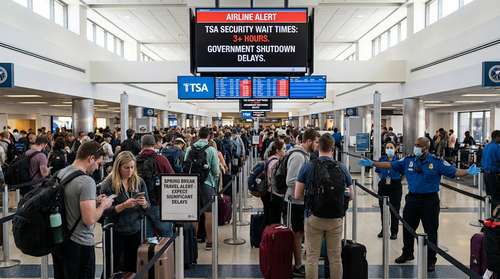
If you are heading to the airport this week, prepare for unprecedented bottlenecks. TSA security wait times today are stretching past the three-hour mark at several major domestic hubs, throwing Spring Break travel 2026 into absolute chaos. The sweeping delays are the direct fallout of a partial government shutdown that has left roughly 50,000 Transportation Security Administration officers working without a paycheck since mid-February. With millions of vacationers descending on terminals nationwide, aviation officials are pleading with passengers to arrive at least three to four hours before their scheduled departures.
Government Shutdown Airport Delays Reach Breaking Point
While the broader federal government remains fully funded, the Department of Homeland Security (DHS) has been operating under a funding lapse since February 14. Because the TSA sits under the DHS umbrella, its screening agents are classified as essential workers. They are legally required to report to checkpoints, but they are not taking home any compensation.
The TSA staffing crisis 2026 is rapidly escalating. Workers received a partial paycheck at the end of February, but the financial cliff hits this week: March 14 marks the first entirely missed pay period for the agency's dedicated workforce. Facing mounting bills and childcare costs, a growing number of officers are taking unscheduled time off to seek alternative income, leaving remaining crews severely understaffed during one of the year's most demanding travel windows.
Adding to the agency's instability, the Department of Homeland Security is simultaneously navigating an abrupt leadership vacuum. A recent cabinet shakeup resulted in the departure of Secretary Kristi Noem, with Oklahoma Senator Markwayne Mullin tapped to take the helm at the end of the month. This top-level uncertainty leaves the DHS navigating its most severe operational crisis of the year without permanent, confirmed leadership at the wheel.
Houston Hobby Airport Wait Times and Other Major Bottlenecks
The operational crunch is highly visible across the American South and major transit hubs. Over the weekend, Houston Hobby airport wait times skyrocketed to over three hours by late morning, prompting officials to call in TSA National Deployment Officers for emergency relief. At George Bush Intercontinental Airport (IAH), severe staffing deficits forced the complete closure of the Terminal D security checkpoint.
These severe government shutdown airport delays are not isolated to Texas. Louis Armstrong New Orleans International Airport reported massive lines snaking out of the terminal, while Hartsfield-Jackson Atlanta and Charlotte Douglas International experienced intense weekend gridlock. In response, airport authorities are urging domestic flyers to arrive three hours prior to departure, while international travelers are advised to allocate four hours.
Record Airline Passenger Numbers Complicate the Crisis
Timing could not be worse for the aviation industry. Trade group Airlines for America projects record airline passenger numbers this season, with an estimated 171 million people expected to fly between early March and the end of April, which represents a 4 percent jump from the previous year.
Industry leaders are sounding the alarm over the compounding operational threat. U.S. Travel Association CEO Geoff Freeman warned that the multi-hour queues demonstrate how rapidly these disruptions ripple through the broader aviation system, potentially costing the economy nearly $1 billion in lost productivity and missed connections. Airlines for America CEO Chris Sununu echoed this frustration, calling the hours-long wait times unacceptable and demanding immediate congressional action to fund the DHS.
How to Navigate Airline Travel Alerts Today
If you are tracking airline travel alerts today, you will notice widespread adjustments to trusted traveler programs. Global Entry has been entirely suspended nationwide, meaning U.S. citizens returning from international destinations cannot use expedited automated kiosks and must wait in standard customs lines.
Fortunately, TSA PreCheck lanes remain operational for now. However, travelers should note that checkpoint supervisors may temporarily consolidate PreCheck queues into standard screening lines if staffing drops to critical levels during peak morning rushes.
Strategic Tips for Surviving the Checkpoint Chaos
While you cannot control the congressional standoff, you can protect your itinerary. Keep these proactive strategies in mind:
- Ditch the Checked Bag: Fly with only a carry-on if possible. By skipping the baggage drop counter, you eliminate an entire line from your departure routine.
- Monitor Local Updates: Check your specific departure airport's social media accounts the morning of your flight for real-time queue estimates.
- Pad Your Connections: If you have a layover, particularly one requiring re-clearing security or customs, ensure you have a buffer of at least two to three hours.
With the March 14 missed paycheck looming just days away, the turbulence at airport checkpoints will likely intensify before it subsides. Pack your patience, arrive earlier than you think is necessary, and plan for delays to be the new normal this spring.