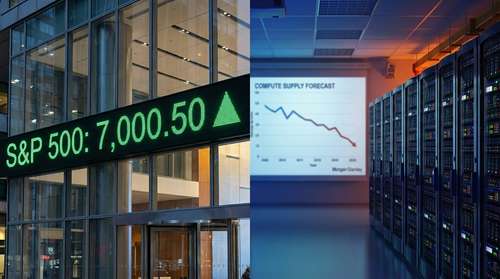
The S&P 500 breached the historic 7,000-point threshold for the first time today, marking a psychological and financial zenith for the post-pandemic bull market. Wall Street's trading floors erupted in applause as the index crossed the line shortly after the opening bell on Friday, February 13, 2026, driven by an insatiable appetite for technology stocks. However, amidst the champagne popping, a sobering new report from Morgan Stanley has cast a long shadow over the celebration. The investment bank's 2026 economic forecast warns that the global economy is barreling toward a "compute supply crisis"—a systematic mismatch between the demand for artificial intelligence processing power and the physical infrastructure available to support it.
The 7,000 Milestone: A Tech-Driven Triumph
Reaching 7,000 is a testament to the resilience of the U.S. economy and the explosive growth of the tech stock market rally that has defined the last two years. Led by the "AI heavyweights"—NVIDIA, Microsoft, and emerging infrastructure giants—the index has defied gravity, shrugging off inflation concerns and geopolitical tensions. Investors have poured billions into the belief that generative AI will rewrite corporate profitability. "This isn't just a number; it's a validation of the AI thesis," said a floor trader at the NYSE. Yet, as the S&P 500 charts new territory, the fundamentals supporting this growth are facing a physical reality check.
Morgan Stanley's Warning: The 47-Gigawatt Shortfall
While the market celebrates Wall Street record highs 2026, Morgan Stanley’s latest research, released this week, outlines a precarious future. The report, spearheaded by strategists Michelle Weaver and Stephen Byrd, identifies a looming "compute supply crisis" that could stifle the very growth driving today's rally. The core of the problem is not a shortage of silicon, but a shortage of power.
The bank's analysis reveals a staggering 47-gigawatt power shortfall for data centers projected through the end of the year. To put that in perspective, that is roughly the equivalent of the entire power generation capacity of a mid-sized nation, missing from the grid just when the AI industry needs it most. "The demand for compute is going to be systematically much higher than the supply," Weaver noted in the report. "Compute becomes a very precious resource, both at the company level and at the national level."
The 'Time-to-Power' Bottleneck
The report introduces a critical new metric for investors: "time-to-power." In 2026, the competitive advantage has shifted from those who have the best chips to those who can plug them in. Traditional grid connections are bogged down by years of regulatory red tape and aging infrastructure. Morgan Stanley warns that this AI compute supply shortage is creating an "energy barrier" that even financially robust tech giants cannot easily vault. As a result, artificial intelligence infrastructure bubble fears are pivoting from software valuations to physical utility constraints.
Geopolitical Stakes: The Global Compute Demand Mismatch
The crisis extends beyond corporate balance sheets into the realm of national security. The Morgan Stanley 2026 economic forecast highlights a widening divergence between U.S. and Chinese AI capabilities. While American developers currently hold a 10x advantage in raw compute capacity, the report warns that China may leverage its dominance in the rare earth minerals supply chain to choke off U.S. hardware production. This geopolitical tug-of-war turns processing power into a strategic national asset, akin to oil in the 20th century.
Furthermore, a critical political shift is emerging domestically. The report cites growing consumer backlash as ordinary Americans blame data centers for rising electricity bills. This "ratepayer revolt" is causing local governments to cancel or delay planned facilities, further exacerbating the global compute demand mismatch.
Investment Implications: Beyond the Chipmakers
For investors looking past the S&P 500 7000 milestone, the guidance is clear: look for the "bottleneck alleviators." The report suggests that the next wave of winners won't necessarily be the model developers, but the companies providing off-grid power solutions. Firms that can deploy natural gas turbines, fuel cells, or nuclear reactors directly on-site—bypassing the congested public grid—are poised to capture immense value. As the market digests this news, the euphoria of 7,000 may soon give way to a more pragmatic hunt for the energy infrastructure required to keep the lights on in the AI age.