Industry insiders are calling it the “Pre-ChatGPT” moment for quantum technology. In a shift that has stunned analysts and silenced skeptics, quantum computing has officially transitioned from a theoretical research field into a commercially viable utility for over 100 major global enterprises. The last 48 hours have been pivotal, marked by Nvidia CEO Jensen Huang’s public admission that the timeline for commercial quantum computing has accelerated far faster than predicted, slashing the “30-year” horizon down to the present day. With D-Wave’s quantum cloud services now powering critical operations for industry giants, the question is no longer if quantum will work, but how quickly the rest of the world will catch up.
The ‘Pre-ChatGPT’ Era: A Tipping Point for Utility
Just as artificial intelligence existed for decades before ChatGPT made it accessible to the masses, quantum computing has been simmering in laboratories, dismissed by many as a distant dream. That narrative collapsed this week. The term “Pre-ChatGPT phase” refers to this specific inflection point: the technology is now stable, accessible via the cloud, and solving narrow but high-value problems that classical supercomputers simply cannot touch.
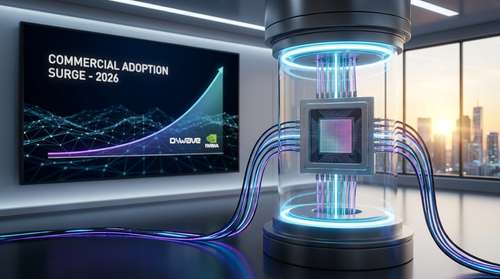
This shift was cemented when D-Wave, a leader in the sector, confirmed that over 100 enterprise customers—including heavyweights like Mastercard, Deloitte, and Ford—are actively using its systems for live production workloads. These aren't science experiments; they are optimization tasks for logistics, battery chemistry, and financial modeling. The industry consensus is that we are standing on the precipice of a mass adoption event similar to the AI explosion of 2023.
Breakthroughs in 2026: Hardware and Consolidation
The surge in adoption is driven by tangible quantum computing breakthroughs in 2026, specifically in hardware reliability and error correction. The most significant development came earlier this month with D-Wave’s $550 million acquisition of Quantum Circuits Inc. This strategic move creates a “dual-platform” powerhouse, combining D-Wave’s commercial annealing systems with Quantum Circuits’ error-corrected gate-model technology.
Next-Gen Computing Hardware
The launch of the Advantage2 system has been a game-changer for next-gen computing hardware. Offering higher coherence times and vastly improved connectivity, this system allows businesses to tackle complex variables in real-time. Unlike previous iterations, which required PhD-level expertise to operate, the new wave of quantum-as-a-service (QaaS) platforms allows developers to access quantum power via standard APIs, democratizing access just as cloud computing did in the 2010s.
Why Enterprises Are Buying In Now
The “100 enterprises” milestone is significant because of who is buying. Financial institutions are using quantum advantage to optimize portfolios in microseconds, while logistics companies are rerouting global shipping fleets to save millions in fuel costs. The ROI is no longer theoretical.
“We aren't waiting for a perfect universal computer,” said a CTO from a major logistics firm during the Davos 2026 summit. “We are using the quantum systems available today to solve optimization problems that were previously intractable. The competitive advantage is real.”
The Security Imperative: Preparing for the Post-Quantum World
As commercial utility grows, so does the urgency around security. The rise of practical quantum systems brings the “Q-Day” threat—the day quantum computers can crack standard encryption—closer to reality. In response, a parallel industry for post-quantum security is booming. Companies are scrambling to upgrade their cryptographic standards to NIST-approved algorithms, ensuring that the data they process today remains secure against the quantum decryption capabilities of tomorrow.
This dual-track growth—offensive capability in processing power and defensive capability in cybersecurity—signals a mature, healthy market ecosystem. The arrival of the ‘Pre-ChatGPT’ phase implies that while the technology is currently specialized, a general-purpose “browser moment” is imminent.