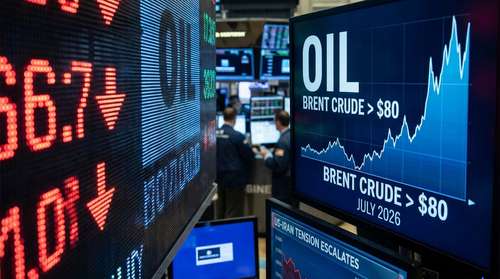

When tracking oil prices today, traders and consumers alike are witnessing unprecedented turbulence. In a shock to global markets, U.S. crude futures catapulted by more than 11% to settle at a staggering $111.54 per barrel. This massive crude oil spike marks the largest single-day dollar increase since the infamous market collapse of early 2020. The immediate catalyst behind the surge is escalating military action and aggressive rhetoric from President Donald Trump regarding strategic operations in Iran, which has thrown the international supply chain into a tailspin.
The Historic Crude Oil Spike Explained
The dramatic settlement at $111.54 for U.S. oil futures reflects deep-seated anxieties across trading desks. Investors are bracing for a worst-case scenario: a prolonged, complete blockade of Middle Eastern exports. The sharp 11% rally eclipses standard energy market volatility and signals a fundamental shift in how the industry is pricing geopolitical risk.
Trump's recent declarations regarding military objectives in the region, specifically aimed at neutralizing Iranian threats and securing vital waterways, triggered immediate buying frenzies. Energy analysts warn that if military operations broaden, the risk premium attached to North American crude will continue to swell. Institutional investors are rapidly liquidating short positions, forced to cover at a premium as supply anxieties dominate the tape.
Strait of Hormuz Disruption Fuels Energy Market Volatility
At the core of this crisis is the Strait of Hormuz, a critical 21-mile-wide maritime chokepoint that normally handles roughly 20 million barrels of petroleum every day. That volume equates to roughly 20% to 25% of global maritime oil trade. However, since the regional conflict escalated in late February, commercial tanker traffic through the corridor has effectively ground to a halt. Recent assessments indicate that more than 90% of maritime traffic has been diverted or anchored outside the strait to avoid potential strikes.
Regional producers are scrambling to utilize alternative infrastructure. Saudi Arabia has diverted significant crude volumes to the Red Sea port of Yanbu via the East-West Pipeline. Simultaneously, the United Arab Emirates is maximizing throughput on the Abu Dhabi Crude Oil Pipeline to the port of Fujairah on the Gulf of Oman. Yet, these overland routes have a combined capacity of less than 10 million barrels per day—falling drastically short of the 20 million normally transiting the strait. The resulting supply vacuum has fundamentally disrupted the global energy architecture.
Analyzing the Iran War Economic Impact
The broader Iran war economic impact extends far beyond the commodities exchange. As energy input costs multiply, manufacturers, agricultural producers, and logistics providers are being forced to pass these expenses down the supply chain. This dynamic is rapidly becoming the dominant headline in global inflation news, complicating the economic outlook for central banks worldwide that were previously focused on achieving a soft landing.
Asian markets, particularly heavy importers like China and India, are facing immediate supply shortages and unprecedented price volatility. Normally, 80% of the oil transiting the Strait of Hormuz is destined for Asian economies. Meanwhile, Europe and the Americas are contending with the secondary effects of rerouted shipments and skyrocketing freight insurance premiums. The effective removal of millions of barrels of Middle Eastern crude from the daily global pool creates a devastating ripple effect. It threatens to stall global economic growth by directly impacting several key sectors:
- Transportation and Logistics: Immediate spikes in diesel and jet fuel prices are forcing carriers to implement emergency fuel surcharges.
- Agricultural Production: Surging costs for petroleum-based fertilizers and farming equipment operation threaten to inflate food prices globally.
- Industrial Manufacturing: Heavy industries reliant on stable energy inputs are scaling back production to mitigate runaway operational costs.
What This Means for Gas Prices April 2026
For the everyday consumer, the fallout from this geopolitical standoff will be felt immediately at the pump. The outlook for gas prices April 2026 is increasingly grim, with national averages expected to surge past the $4.50 to $5.00 per gallon threshold in several key American markets over the coming weeks. Some West Coast regions, where fuel taxes and unique refining requirements already elevate baseline costs, could soon see signs approaching the $6.00 mark.
Retail gasoline prices typically lag crude futures by a few days to a week. Because domestic refineries must purchase this newly expensive crude to produce their mandated summer-blend gasoline, motorists will inevitably absorb the brunt of the cost. Industry experts advise drivers to budget for sustained higher transportation costs throughout the spring and early summer. Fleet operators and small businesses heavily reliant on transportation are particularly vulnerable, as fuel surcharges are likely to become standard practice across the delivery sector.
The Outlook for U.S. Oil Futures and Global Markets
The current geopolitical environment offers little hope for an immediate de-escalation. With military assets actively deployed and diplomatic channels severely strained, the fundamental drivers pushing prices upward remain firmly intact.
Market participants are keeping a close watch on U.S. strategic petroleum reserve inventory reports and any further announcements from the White House regarding the Middle East campaign. Additionally, the potential involvement of other OPEC nations could further complicate production quotas and global supply distribution. Until a definitive resolution secures safe passage through the Persian Gulf, the combination of restricted supply and unwavering demand will keep the energy sector in a highly defensive posture. The world is watching to see how the geopolitical map—and the global economy—will be reshaped in the critical weeks ahead.