
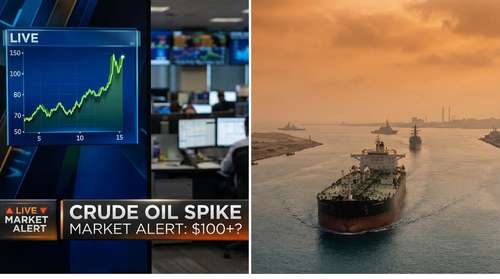
Global markets are bracing for a tumultuous opening on Monday as oil price surge today dominates headlines following a massive escalation in the Middle East. On Saturday, February 28, the United States and Israel launched joint airstrikes targeting key Iranian nuclear and military facilities, prompting Tehran to threaten a total blockade of the Strait of Hormuz. As the current time ticks towards market open, investors are scrambling to assess the Middle East conflict economic impact, with Brent crude poised to shatter resistance levels in what analysts are calling the most significant energy supply chain disruption of the decade.
The Weekend Escalation: "Major Combat Operations"
The geopolitical landscape shifted violently on Saturday when U.S. forces, alongside Israeli counterparts, initiated what President Donald Trump described as "major combat operations" against the Islamic Republic. The strikes reportedly targeted missile production sites and command centers, with unconfirmed reports from the region suggesting that high-ranking officials, including IRGC Commander Mohammed Pakpour, may have been killed in the bombardment.
In a swift retaliation, Iran launched missile barrages targeting U.S. bases in Bahrain, Jordan, and the UAE. However, the most economically damaging threat came Sunday morning, as Tehran issued a formal warning regarding the Strait of Hormuz—the world's most critical energy chokepoint. The Strait of Hormuz oil blockade threat has moved from theoretical risk to imminent reality, with tanker tracking data already showing vessels like the Eagle Veracruz halting operations in the Gulf of Oman, unwilling to risk the transit.
Strait of Hormuz: The $150 Barrel Nightmare
The strategic importance of the Strait of Hormuz cannot be overstated. Roughly 20% of the world's total oil consumption and a significant portion of global LNG pass through this narrow waterway. Energy analysts are now modeling global market volatility 2026 scenarios that were previously considered outliers. While Brent crude closed Friday near $73, pre-market indicators suggest a violent gap up when trading resumes.
"If the strait is closed, even partially, we are no longer looking at supply and demand fundamentals," notes Vandana Hari of Vanda Insights. "We are looking at a panic-driven repricing of risk." Investment banks are already revising their Brent crude price forecast. Goldman Sachs and JPMorgan have reportedly modeled a "doomsday scenario" where a prolonged blockade could push prices between $150 and $200 per barrel, a level that would effectively paralyze major economies.
Supply Chain Paralysis
The disruption extends beyond crude oil. Qatar, the world's top LNG exporter, relies entirely on the strait to reach global markets. A blockade would not only trigger an energy crisis in Europe and Asia but also sever complex chemical and manufacturing supply chains. Insurance premiums for vessels in the region have already skyrocketed, effectively creating a "soft blockade" as shipping firms suspend transits to avoid uninsurable risks.
Inflationary Shockwaves and Central Bank Dilemmas
For global central banks, this conflict represents the ultimate nightmare: a supply-side shock that drives inflation up while simultaneously crushing growth. The inflation risk March 2026 presents is stark. Just as inflation appeared to be cooling, a sustained spike in energy costs would force the Federal Reserve and ECB into an impossible corner—raising rates to fight inflation would deepen the recessionary cracks, while cutting them could let prices run wild.
Economists warn that every $10 increase in the price of a barrel of oil can shave 0.1% to 0.2% off global GDP growth. With the potential for a $50+ spike, the specter of stagflation has returned with a vengeance. Sectors heavily dependent on fuel—airlines, logistics, and manufacturing—are expected to lead the sell-off in equity markets this week.
Global Reaction and What to Watch
Diplomatic channels are in overdrive. The UN Security Council held an emergency session on Sunday, with Secretary-General António Guterres warning that the region risks "igniting a chain of events that nobody can control." Meanwhile, European leaders are urging restraint, acutely aware of their vulnerability to LNG disruptions.
As Monday's trading session approaches, all eyes are on the Asian market open. If oil futures breach the psychological $80 barrier in early trading, it could trigger algorithmic sell-offs across equity indices. Investors are advised to monitor official statements from Tehran regarding the specific mechanics of their threatened blockade, as the difference between a "threat" and a "naval mine deployment" could mean the difference between a recession and a global depression.