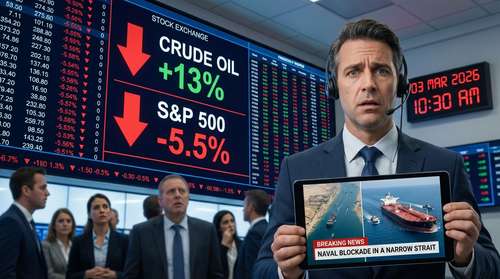
Global financial markets are in freefall this Monday morning, March 2, 2026, as oil prices skyrocketed over 13% in a single trading session. The unprecedented surge follows the confirmed closure of the Strait of Hormuz by Iranian forces, a retaliatory move sparking fears of a catastrophic global energy crisis. Brent crude has shattered the $82 per barrel ceiling, triggering panic selling across the Dow Jones, Nifty, and other major indices while investors rush toward safe-haven assets like gold.
Strait of Hormuz Closure: The Global Chokepoint Snaps
The catalyst for today's financial meltdown is the verified closure of the Strait of Hormuz, the world's most critical oil artery. Following a weekend of intensifying military strikes between the U.S., Israel, and Iran—culminating in the reported death of Iran's Supreme Leader Ali Khamenei—the Islamic Revolutionary Guard Corps (IRGC) has enforced a total maritime blockade. This narrow waterway handles approximately 21 million barrels of oil daily, accounting for roughly 20% of global petroleum consumption.
"This is the scenario energy analysts have feared for decades," said Sarah Jenkins, Chief Energy Strategist at Global Insight. "Removing 20% of the world's oil supply overnight is not a pricing adjustment; it is a supply shock of historic proportions. We are seeing Brent crude surge past $82, and if the blockade holds for more than 48 hours, triple-digit oil prices are a mathematical certainty."
Stock Market Meltdown: Dow and Nifty Plunge
The shockwaves from the Middle East have decimated equity markets worldwide. The stock market crash today is being led by energy-dependent sectors, with the Dow Jones Industrial Average dropping over 900 points in pre-market trading. In India, the Nifty 50 suffered its sharpest intraday fall in three years, shedding nearly 4% as importers braced for a ballooning current account deficit.
Panic in Asian and European Indices
Asian markets were the first to react to the news of the blockade, with Tokyo's Nikkei and Hong Kong's Hang Seng erasing months of gains. European bourses followed suit, with the DAX and FTSE 100 opening deep in the red. Conversely, defense stocks and energy giants have seen their valuations spike, creating a disjointed and volatile market environment.
US-Iran Conflict Escalation: How We Got Here
Tensions reached a breaking point on Saturday, February 28, when U.S. and Israeli forces launched devastating air strikes targeting Iranian nuclear infrastructure and military command centers. The operation, described by Pentagon sources as a necessary preemptive measure, resulted in significant casualties among Iran's top leadership. Tehran's response was swift and absolute: a barrage of missile strikes against regional targets and the immediate closure of the Strait.
Military experts warn that the US-Iran war economic impact could dwarf the fallout from the 2022 Russia-Ukraine conflict. With the U.S. Fifth Fleet now maneuvering to challenge the blockade, the risk of direct naval confrontation is at its highest level since the 1980s.
Shipping Chaos: Maersk and Global Trade Disrupted
The maritime logistics network is already buckling. Major shipping giant Maersk has announced an immediate halt to all vessel transits through the Persian Gulf, citing "unacceptable security risks." Insurance premiums for vessels entering the region have surged by over 400% in the last 24 hours, effectively rendering the route commercially unviable even if physically passable.
This disruption extends beyond oil. Liquefied Natural Gas (LNG) shipments from Qatar, essential for Europe and Asia's power grids, are now trapped behind the blockade. Energy ministers from the G7 nations are scheduled to hold an emergency summit later today to discuss strategic reserve releases, though analysts warn that reserves alone cannot bridge the gap left by a prolonged Strait of Hormuz closure.
Outlook: Gold Rallies as Investors Seek Shelter
As equities crumble, capital is fleeing to safety. Gold prices have surged to new highs, breaking resistance levels as institutional investors hedge against prolonged geopolitical instability. The U.S. dollar has also strengthened significantly against emerging market currencies, further straining economies heavily reliant on energy imports.
For now, the world watches the Strait. The length of this closure will determine whether this is a temporary market panic or the beginning of a prolonged global energy crisis in 2026. With diplomatic channels straining and military assets deploying, the next 24 hours will be critical for the global economy.