
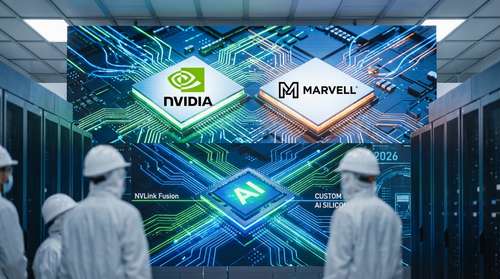
On Tuesday, the landscape of global technology manufacturing underwent a seismic shift as NVIDIA announced a strategic $2 billion investment in Marvell Technology. This blockbuster NVIDIA Marvell partnership is engineered to aggressively accelerate the construction of hyper-connected, next-generation compute hubs worldwide. With global tech giants racing to secure processing power, this latest NVIDIA investment news sent immediate shockwaves through financial markets, propelling Marvell’s stock up more than 11% following the morning announcement. At the heart of the deal lies a singular ambition: transforming how the world processes data by building specialized, massively scalable environments.
The agreement goes far beyond a simple capital injection. By weaving Marvell directly into NVIDIA’s expanding ecosystem, the two companies are effectively lowering the barrier to entry for cloud providers and enterprises developing custom hardware. It is a defining moment for AI infrastructure 2026, marking a transition from off-the-shelf processor purchases to heterogeneous, bespoke compute environments.
Fueling the Unprecedented AI Factory Expansion
The demand for continuous, generative token creation is reshaping data centers into industrial-scale production engines. NVIDIA CEO Jensen Huang framed the moment plainly during the announcement, noting that the "inference inflection has arrived". As token generation demand surges globally, organizations are locked in a race to secure hardware capability to support these specialized workloads.
This AI factory expansion requires more than just graphical processing units (GPUs). It demands an intricate ballet of networking gear, memory architecture, and specialized processors working in absolute unison. By integrating Marvell’s industry-leading data infrastructure with NVIDIA’s master architecture, the tech behemoths are providing a blueprint for massive compute facilities that can handle the crushing workloads of autonomous agents and multimodal models.
Empowering Developers with Custom AI Silicon and NVLink Fusion
A cornerstone of this mega-deal is the integration of NVIDIA's NVLink Fusion ecosystem. This rack-scale platform gives hyperscalers the ability to develop semi-custom infrastructure without abandoning the robust NVIDIA technology stack. Under the agreement, Marvell will manufacture custom AI silicon, specifically specialized XPUs, alongside scale-up networking gear that is fully compatible with NVLink Fusion.
In return, NVIDIA supplies the foundational supporting technologies. This includes their newly advanced Vera CPUs, ConnectX network interface cards (NICs), Bluefield data processing units (DPUs), and the ultra-fast Spectrum-X switches. The resulting synergy allows developers to seamlessly mesh proprietary hardware with NVIDIA’s proven rack-scale platforms, yielding a heterogeneous infrastructure that balances peak performance with tailored engineering.
Breaking Boundaries with Silicon Photonics and 6G
Beyond the walls of traditional data centers, the collaboration takes aggressive aim at global telecommunications. The companies unveiled plans to co-develop silicon photonics—a cutting-edge technology that uses light rather than electrical signals to transmit massive volumes of data across microchips. For hyperscale cloud providers, the physical limits of traditional copper networking have become a primary roadblock. As compute clusters scale to tens of thousands of processors, the data bottlenecks shift from the chip itself to the wires connecting them. Silicon photonics bypasses this limitation, effectively future-proofing the architecture for a high-bandwidth era where instantaneous data transfer is non-negotiable.
Marvell Chairman and CEO Matt Murphy highlighted this technical leap, emphasizing that the partnership reflects the growing importance of high-speed connectivity, optical interconnects, and accelerated infrastructure in scaling artificial intelligence. The joint initiative will transform existing telecom networks into decentralized compute hubs utilizing NVIDIA’s Aerial AI-RAN for 5G and emerging 6G networks. By processing data at the extreme edge of telecom networks, carriers can offer instantaneous inference capabilities to mobile and enterprise users without routing traffic back to a centralized cloud.
The Expanding Circular Economy of Compute
This $2 billion injection is not an isolated maneuver for the chipmaking giant. It represents NVIDIA’s third investment of this magnitude this month alone, following similar strategic ties forged with telecom and optical components makers like Lumentum and Coherent. Market analysts point to an increasingly circular economy within the tech sector, where dominant players finance the ecosystem's buildout to ensure long-term demand for their proprietary architectures.
While some financial analysts at firms like Morgan Stanley caution that these circular investments could artificially inflate market valuations, the industrial realities on the ground tell a story of sheer capacity constraints. NVIDIA’s strategy is clear: secure the supply chain and interconnectivity standards before competitors can establish a stronghold. By directly funding the companies responsible for the connective tissue of these data centers, NVIDIA ensures its proprietary NVLink standards remain the undisputed backbone of the industry.
The integration of Marvell’s high-performance analog and digital signal processing into NVIDIA's supply chain directly addresses the physical bottlenecks of scaling accelerated compute. As these custom-built facilities begin to come online throughout the year, the technology sector will be watching closely to see how quickly this multi-billion dollar bet translates into deployable, world-class networks.