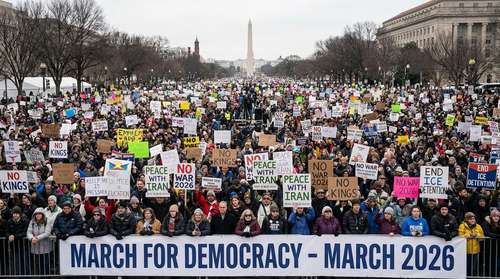
On Saturday, March 28, an estimated eight million Americans flooded city streets and suburban parks for the No Kings protests 2026. Sparked by escalating overseas conflicts and deadly domestic immigration crackdowns, the nationwide mobilization spanned all 50 states and spilled into international territories. As the political fallout from these weekend demonstrations dominates the national conversation this Sunday, organizers and historians alike are evaluating the sheer scale of the movement.
Driven by fierce opposition to recent military actions in the Middle East, the demonstrations have generated a steady stream of Trump Iran war news. With over 3,300 officially registered events across the globe, grassroots organizers are officially recognizing Saturday's massive turnout as the largest protest in US history.
Nationwide Outrage Fuels Record-Breaking Turnout
The 50501 movement and the No Kings Coalition coordinated the weekend's events, building upon earlier marches held last June and October. Those previous rounds drew five million and seven million participants, respectively, but Saturday shattered prior benchmarks. The resulting anti-authoritarian demonstrations showcased widespread public anger. Organizers emphasized that this weekend's grievances extended across several key issues:
- Opposition to the unapproved military bombing campaign in Iran.
- Protests against aggressive ICE enforcement and fatal shootings.
- Frustration over soaring gas and grocery prices.
Rather than concentrating solely in deep-blue coastal hubs, roughly two-thirds of the registered gatherings took place outside major urban centers. Protesters marched in reliably conservative strongholds across Idaho, Utah, South Dakota, and Kansas. In Topeka and Washington, D.C., demonstrators mocked political leadership using theatrical costumes, emphasizing a grassroots strategy that organizers like Seattle's Bill Jarcho refer to as "mock and awe". Participants utilized humor and satire to defuse tension while pointedly critiquing federal overreach.
The Flagship Stand in Minnesota
While massive crowds paralyzed traffic in New York, Los Angeles, and Denver, the flagship event took place at the State Capitol in St. Paul, Minnesota. The location was chosen to honor Renée Good, a mother of three, and Alex Pretti, a VA nurse—two individuals recently killed by federal agents during controversial Immigration and Customs Enforcement (ICE) operations in the Twin Cities.
Bruce Springsteen headlined the Minnesota rally, debuting his song "Streets of Minneapolis" to a crowd of tens of thousands. He commended the state's residents for pushing back against federal incursions. Senator Bernie Sanders, Jane Fonda, and Joan Baez also addressed the massive crowd, demanding accountability for the civilian casualties and urging voters to sustain their momentum through the upcoming legislative battles.
Foreign Conflict and the Demand for De-escalation
A central catalyst for this weekend's surge in attendance is the administration's recent military intervention. Following the bombing campaign launched by the US and Israel in late February, Americans have grown increasingly anxious about a prolonged overseas entanglement. People marching down the National Mall in Washington, D.C., carried signs reading "Regime change begins at home," directly critiquing Trump administration foreign policy.
The frustration is palpable among military families and everyday civilians who feel the sting of rising fuel prices triggered by the conflict. Many protestors emphasized that funds spent on foreign bombings should be redirected toward domestic relief and lowering the cost of groceries. International solidarity marches echoed these sentiments, with thousands gathering in Rome, London, and San Francisco to demand a world free from unchecked militarism and unpredictable maneuvers.
Political Fallout and 2026 Midterm Election Trends
As the dust settles on Sunday morning, political strategists are already analyzing the impact of these March 2026 political rallies. The fact that registrations surged in electorally competitive swing states like Pennsylvania, Georgia, and Arizona suggests a shifting tide among suburban voters. These suburban demographics are heavily influencing 2026 midterm election trends, signaling that opposition to current policies is no longer confined to progressive bases.
Recent polling indicates the administration's approval rating has dipped to roughly 36%, its lowest point since the second term began. White House spokespeople dismissed the demonstrations as the product of "leftist funding networks," but the sheer geographic diversity of the No Kings protests 2026 challenges that narrative.
Clashes and Escalations
While the vast majority of the 3,300 events remained entirely peaceful, localized tensions did boil over. In Los Angeles, a post-march clash near the Metropolitan Detention Center prompted the LAPD to declare a tactical alert. Federal officers deployed tear gas into the crowd, leading to multiple arrests and raising fresh concerns about law enforcement's response to civilian assemblies. Ultimately, with millions of energized voters proving their willingness to organize, the weekend's historic mobilization has redefined the boundaries of civic action, leaving lawmakers in Washington to navigate a deeply mobilized electorate.