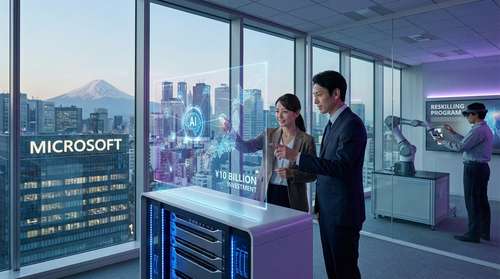
The stakes in the global AI race have just been dramatically raised. In a sweeping move that redefines the Asian technology landscape, Microsoft has officially announced a record-breaking Microsoft Japan AI investment totaling $10 billion (approximately ¥1.6 trillion). Unveiled in early April 2026 following a high-profile strategic meeting between Microsoft Vice Chair and President Brad Smith and Japanese Prime Minister Sanae Takaichi, this unprecedented capital injection is set to comprehensively modernize the nation's digital backbone. By funding a monumental 10 billion dollar data center expansion, launching a cutting-edge Tokyo AI research lab, and spearheading an aggressive artificial intelligence worker reskilling initiative, the tech giant is positioning itself as the primary architect of Japan’s sovereign AI strategy.
Powering the Future: A 10 Billion Dollar Data Center Expansion
At the heart of this four-year financial package is a massive upgrade to the Microsoft cloud infrastructure 2026 footprint. As demand for generative AI tools accelerates—with 94% of Nikkei 225 firms already utilizing Microsoft 365 Copilot—enterprise customers are increasingly demanding robust, localized computational resources. Microsoft is addressing this by partnering directly with domestic tech heavyweights, including Sakura Internet and SoftBank Group, to dramatically increase local GPU capacity.
This localization strategy directly tackles one of the most critical concerns in modern enterprise computing: data sovereignty. Historically, the reliance on overseas servers created regulatory and security hurdles for sensitive industries. Now, government agencies, financial institutions, and healthcare providers can securely train and deploy proprietary large language models (LLMs) without their protected data ever leaving the domestic grid. The financial markets recognized the magnitude of this shift instantly, with Sakura Internet shares surging by more than 20% following the announcement.
Merging Software and Hardware: The Tokyo AI Research Lab
Capital infrastructure requires cutting-edge research to reach its full potential, which makes the newly enhanced Tokyo AI research lab a crown jewel of this initiative. While traditional artificial intelligence development has focused heavily on digital software interfaces and chatbots, the Japanese market presents a distinct opportunity to blend cognitive software with physical hardware.
Operating under the Microsoft Research Asia umbrella, the Tokyo facility is prioritizing "embodied AI". This interdisciplinary field focuses on creating intelligent systems that can understand, navigate, and interact within physical environments. By leveraging Japan’s historically unmatched dominance in industrial robotics, high-end manufacturing, and automotive engineering, the lab intends to move autonomous agents off the screen and onto the factory floor.
Furthermore, the research facility is deeply committed to "societal AI" and neuroscience-inspired interfaces, addressing the country's socio-economic priorities such as elderly care and demographic shifts. This perfectly aligns with the Japanese government's ambitious mandate, backed by ¥1.23 trillion in state funding for the 2026 fiscal year, to capture a 30% global market share in physical AI over the next two decades.
Bridging the Talent Gap: Artificial Intelligence Worker Reskilling
Building warehouse-scale data centers is only one part of the technological equation; cultivating the human capital required to manage and innovate upon these systems is equally vital. According to recent forecasts highlighted during the summit, Japan faces a severe demographic and technological hurdle, with a projected shortfall of 3.26 million AI and robotics specialists by the year 2040.
To proactively avert this economic bottleneck, Microsoft is rolling out a massive artificial intelligence worker reskilling program aimed at training three million Japanese workers. By forming strategic training alliances with a coalition of domestic enterprise leaders—including Fujitsu, Hitachi, NEC, and NTT Data—Microsoft is democratizing access to crucial technological resources. This educational initiative focuses on several core competencies:
- Advanced Machine Learning: Equipping developers with the skills to build and deploy localized AI models on domestic servers.
- Cybersecurity Protocols: Training IT professionals to defend against next-generation, AI-driven cyber threats alongside national institutions.
- Embodied AI Integration: Preparing mechanical and software engineers to merge cognitive systems with physical industrial robotics.
By closing the skills gap, Microsoft is effectively building a highly capable user base that will drive enterprise adoption of its Azure and Copilot ecosystems for generations to come.
Redefining Japan Digital Transformation News
This historic financial commitment is currently dominating Japan digital transformation news, largely because it signals a profound shift in how multinational technology conglomerates interact with sovereign nations. Beyond server racks and algorithms, the package includes deeply integrated public-private cybersecurity partnerships. Microsoft will be working directly with the Japanese National Police Agency to facilitate threat intelligence sharing, serving as a collaborative defensive arm against state-sponsored cyber threats.
As the tech titan aggressively battles competitors across the Asia-Pacific theater, this localized approach serves as a definitive blueprint for international technology diplomacy. By delivering immense computing power, establishing localized research hubs, and investing directly in human capital, Microsoft isn't just selling software—it is embedding itself into the very fabric of Japan's economic future. The fusion of these initiatives firmly cements the nation's position at the vanguard of the modern AI era.