
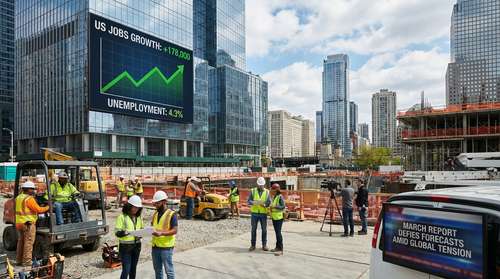
The American economy delivered a stunning upside surprise on Friday, shaking off the gloom of a dismal winter. Employers added a massive 178,000 jobs, marking a sharp turnaround from the prior month's steep losses. The highly anticipated March jobs report 2026 reveals a complex economic landscape where domestic hiring resilience is colliding head-on with mounting global anxieties. Despite looming geopolitical threats and rising input costs, the US unemployment rate 4.3% was slightly better than consensus estimates of 4.4%.
Analyzing the Labor Department Hiring Data
Wall Street forecasters had braced for a modest gain of just 60,000 positions. Instead, the final Labor Department hiring data nearly tripled those expectations, demonstrating unexpected stamina across private industries. However, analyzing the March jobs report 2026 in depth shows that headline numbers mask significant internal turbulence. The revised data from February showed a deeper contraction than initially believed, with a finalized loss of 133,000 jobs. When factoring in an upward revision for January, the net employment for the two-month period was actually 7,000 lower than previously estimated.
Sector Winners and Losers
Healthcare providers accounted for the lion's share of the growth, adding 76,400 roles. This surge was heavily influenced by the resolution of a major Kaiser Permanente strike, which brought 31,000 workers back to active payrolls. Construction firms also capitalized on unseasonably warm weather, bringing on 26,000 new workers. Manufacturing managed a slight bump of 15,000 jobs, breaking a protracted streak of persistent losses. Transportation and warehousing also added a solid 21,000 jobs.
Conversely, the public sector and finance industries faced notable headwinds. The federal government eliminated 18,000 positions as part of ongoing budget trimming, bringing total losses to nearly 12% since peak levels in late 2024. Financial services followed closely behind, shedding 15,000 jobs in March alone.
Labor Force Shifts and Demographic Disparities
While the drop in the national jobless rate paints a rosy picture on the surface, the underlying mechanics tell a slightly different story. The dip was primarily driven by a shrinking pool of available workers. The labor force participation rate fell to 61.9%, the lowest level recorded since late 2021. Nearly 400,000 Americans dropped out of the workforce entirely in March, meaning fewer individuals were actively competing for open roles. Analysts point out that long-term unemployment remains elevated, with sidelined workers struggling to transition into the few growing sectors.
Beneath the headline figures, the recovery remains uneven across demographic groups. While the overall job market tightened, the Black unemployment rate stood at 7.1%, significantly higher than the 3.6% rate for white workers and 4.8% for Hispanic workers. However, there were bright spots for younger demographics. The unemployment rate for young Black workers dropped sharply from 14.7% to 12.3%. Overall youth unemployment also decreased to 8.2%, suggesting that entry-level service positions are slowly absorbing newer entrants to the workforce.
Navigating an Economic Rebound Wartime
The central question occupying boardrooms and trading floors is how long this nonfarm payrolls March 2026 momentum can last under current geopolitical strains. Maintaining an economic rebound wartime presents unique challenges, particularly as the ongoing conflict with Iran threatens global supply chains. The data released Friday is largely backward-looking and captures a period before the severe global supply shocks had fully taken hold in domestic markets.
Energy price volatility 2026 is rapidly becoming the primary variable for corporate budget planning. Crude oil surges directly impact operational overhead, forcing transportation and logistics companies to rethink their expansion strategies. Economists warn that the ripple effects are inescapable. Higher fuel costs inevitably eat into profit margins, typically leading to hiring freezes or preemptive layoffs in subsequent quarters as executives act to preserve capital.
Future US Labor Market Trends and Inflation Risks
Looking ahead, the labor market remains precariously balanced. Broad US labor market trends indicate that while employers are willing to backfill essential roles, they are highly hesitant to approve speculative expansion projects due to the geopolitical uncertainty. The hiring rate has slowed overall, and job openings have vanished at an alarming pace, dropping from 7.2 million to 6.9 million in recent surveys.
Wage growth also showed signs of cooling, which will heavily factor into upcoming monetary policy. Average hourly earnings increased by 3.5% year-over-year. This moderation aligns closer to the Federal Reserve's inflation targets but leaves everyday consumers with less purchasing power to offset rising household expenses.
Federal Reserve policymakers now find themselves walking a tightrope. Friday's unexpectedly robust hiring figures ease the immediate pressure to slash interest rates to save the job market. This grants the central bank crucial breathing room to assess how the Middle East conflict impacts overall consumer price inflation before altering monetary policy. Ultimately, the March jobs report 2026 demonstrates that as the year progresses, the true test of this economic resilience will be whether the American workforce can continue to absorb the shockwaves of an increasingly volatile global stage.