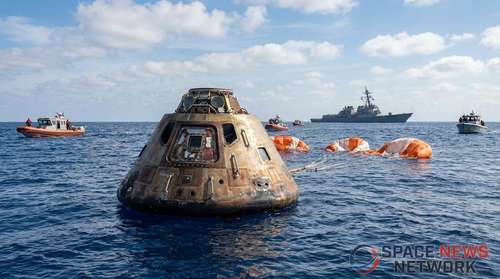
After a breathtaking 10-day journey orbiting the Moon, the historic Artemis II splashdown occurred successfully in the Pacific Ocean off the coast of San Diego on April 11. Capping off the most ambitious human spaceflight in more than fifty years, the return of the four-person crew marks a monumental triumph for the global space program. This mission served as the ultimate stress test for next-generation systems, clearing the most significant hurdles standing between humanity and a sustained presence on the lunar surface.
Validating NASA Orion Spacecraft Technology
Launching from Kennedy Space Center on April 1, this flight was far more than an exercise in altitude records or spectacular earthset photography. It functioned as a rigorous, high-stakes shakedown cruise. The primary objective was to push NASA Orion spacecraft technology to its absolute limits with a human crew aboard.
For nearly ten days, NASA astronauts Reid Wiseman, Victor Glover, Christina Koch, and Canadian Space Agency astronaut Jeremy Hansen evaluated the European Service Module's life support systems, manual piloting capabilities, and communication arrays in the harsh environment of deep space. The crew itself represented a massive leap forward for inclusivity in spaceflight: Glover made history as the first person of color to travel near the Moon, Koch as the first woman, and Hansen as the first non-American.
Navigating more than 4,600 miles beyond the far side of the Moon, they proved the capsule’s habitation controls could comfortably sustain human life during extended operations. Those systems performed flawlessly, providing the critical data engineers needed to greenlight upcoming surface landings.
The Verdict on Orion Heat Shield Performance
Perhaps the most closely watched aspect of the entire mission was the Orion heat shield performance during the fiery plunge through Earth's atmosphere. Following the uncrewed flight in 2022, engineers discovered that the Avcoat material protecting the capsule hadn't eroded smoothly. Instead, trapped gases caused large chunks of the charred layer to break away, raising serious safety concerns for future crews.
Rather than fundamentally redesigning the capsule’s thermal protection system—a move that would have delayed the program by years—mission planners opted to adjust the spacecraft's reentry trajectory.
A Calculated Reentry Strategy
To mitigate thermal strain, the flight dynamics team developed a modified reentry profile. This adjustment slightly reduced the distance Orion could fly to avoid localized weather patterns in the recovery zone, but crucially, it managed the intense heat buildup. The outer char layer remained permeable enough to vent trapped gases, preventing the dangerous pressure pockets seen on the previous flight.
As the capsule slammed into the atmosphere at 25,000 miles per hour, generating temperatures near 5,000 degrees Fahrenheit, the heat shield held firm. The modified trajectory worked exactly as engineered, keeping the cabin temperature stable in the mid-70s and ensuring the astronauts remained perfectly safe through the intense forces of the NASA crewed flight return.
Accelerating Deep Space Exploration Tech
With the mission safely in the books, the agency can pivot fully toward the highly anticipated Artemis III landing. The resounding success of this lunar mission 2026 is already dominating space technology news, as the flawless Artemis II splashdown verifies the foundational architecture required for interplanetary travel.
We are no longer dealing with theoretical models or uncrewed simulations. The hardware works. From the massive Space Launch System (SLS) rocket that delivered the crew into orbit to the intricate deep space exploration tech that brought them home, the infrastructure for the next era of discovery has been proven in flight.
Paving the Way for Artemis III
The success of the Artemis II flight directly impacts the timeline for NASA's next major milestone. Now that the core transport vehicle has proven its reliability, focus shifts to the Human Landing System (HLS) and the construction of the Gateway space station. These upcoming elements rely heavily on the foundational data gathered over the past ten days, proving our deep space exploration tech is maturing rapidly.
Looking Ahead to the Lunar Surface
As recovery teams from the USS John P. Murtha secure the Orion capsule and medical personnel conduct their initial evaluations, the spaceflight community breathes a collective sigh of relief. This mission required immense courage from the crew, who staked their lives on the ingenuity of thousands of engineers and scientists back on Earth.
Engineers will spend the coming months tearing down the capsule to analyze every sensor and data point related to the NASA Orion spacecraft technology. The immediate takeaway is undeniable: the calculated risks paid off. By pushing the boundaries of what our modern hardware can handle, the astronauts have officially bridged the gap between the Apollo era and our multi-planetary future. Following today's spectacular Artemis II splashdown, the Moon is no longer a distant destination—it is an operational frontier.