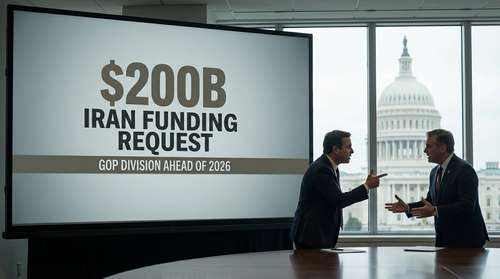
The Republican Party is careening toward a fractured primary season as the staggering costs of the ongoing Middle East conflict ignite fierce internal divisions. The Iran War 2026 political fallout has rapidly become the defining litmus test for conservative candidates nationwide. With the Pentagon officially signaling a need for an unprecedented $200 billion in supplemental funding, the simmering tension between the party's hawkish establishment and its populist base has boiled over, transforming marquee races into ideological battlegrounds.
The $200 Billion Question Fracturing the Republican Party
In a move that caught several lawmakers off guard, Defense Secretary Pete Hegseth recently confirmed the Defense Department is seeking a colossal $200 billion emergency package to sustain the intensifying air and missile campaign. Defending the steep price tag, Hegseth bluntly told reporters, 'It takes money to kill bad guys'. President Donald Trump echoed this sentiment, categorizing the Trump Iran war funding request as 'a small price to pay to make sure that we stay tippy-top'.
However, the sheer scale of the request is triggering severe sticker shock on Capitol Hill. Administration officials have briefed lawmakers that the conflict drained over $11 billion in just its first six days. With national debt soaring and domestic economic concerns top of mind for voters, rubber-stamping a massive foreign military expenditure is proving to be a toxic proposition for vulnerable incumbents preparing for tight electoral contests.
America First Isolationism vs Interventionism
The funding debate has exposed a deep GOP internal civil war. For years, the party has straddled the line between traditional neoconservative defense strategies and the populist, anti-interventionist rhetoric championed by the MAGA movement. Now, the clash of America First isolationism vs interventionism is no longer theoretical—it is playing out on the House floor.
Conservative hardliners are already drawing a line in the sand. Representative Lauren Boebert explicitly rejected the Pentagon's request, stating she is a 'no' on any war supplemental. Citing economic pressures in her home district, she added, 'We need America first policies right now'. Even reliable defense hawks are demanding answers. Representative Chip Roy noted his desire for consistency, demanding to know the exact 'game plan' and expected results before authorizing more capital.
Across the aisle, Democrats are leveraging the GOP's hesitation. Representative Rosa DeLauro flatly labeled the $200 billion ask 'outrageous', while Senate Minority Leader Chuck Schumer argued the funds would be better spent lowering domestic healthcare premiums.
The Texas Senate Runoff 2026: A Proxy War for the GOP's Soul
Nowhere is this ideological schism more apparent than in the Lone Star State, which has become the epicenter of 2026 midterm election news. The highly anticipated Texas Senate runoff 2026 is officially set for May 26, pitting four-term incumbent Senator John Cornyn against state Attorney General Ken Paxton.
The March 3 primary failed to deliver a definitive mandate, with Cornyn securing roughly 41.9% of the vote to Paxton's 40.7%. The remaining conservative electorate, heavily influenced by Representative Wesley Hunt's 13.5% share, will now decide the nominee in a smaller, activist-driven May contest.
Paxton has routinely criticized Cornyn as insufficiently conservative, and the $200 billion Iran supplemental offers a potent new weapon. As the runoff approaches, the spending package acts as a proxy for the broader identity crisis within the GOP. A vote to fund the military campaign risks alienating the hard-right base, while opposing it risks breaking rank with a sitting Republican president during wartime.
The Cost of Delayed Decisions
Political analysts warn that this runoff could be a nightmare scenario, draining crucial party resources. With state Representative James Talarico having handily secured the Democratic nomination outright with over 52% of the primary vote, Democrats are already marshaling their forces for November while Republicans endure another three months of bitter, costly infighting.
US Military Spending Inflation and Midterm Vulnerabilities
Beyond the Texas borders, the ripple effects of US military spending inflation are putting Republicans on the defensive. The economic fallout of the conflict is already hitting American wallets, with global oil prices recently surging above $119 a barrel following retaliatory strikes that severely damaged energy infrastructure in the Middle East.
The administration's prior push for a record-breaking defense budget, compounded by the soaring, multi-billion dollar weekly costs of the current engagement, presents a massive political liability. Voters are increasingly sensitive to the stark contrast between overseas expenditures and kitchen-table economic realities at home.
As the primary season accelerates, Republican candidates are forced to navigate a treacherous path. They must balance loyalty to the administration's military objectives against a vocal, mobilized base demanding an end to foreign adventurism. How the party reconciles this $200 billion dilemma will not only determine the fate of candidates in races like the Texas runoff but will ultimately dictate the GOP's viability heading into the November midterms.