
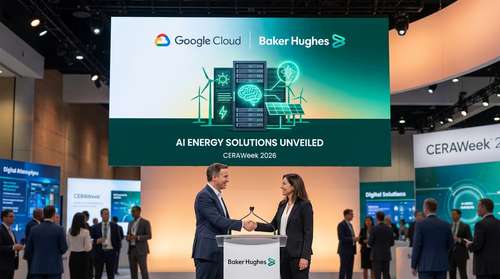
The exponential rise of generative artificial intelligence has brought an unprecedented challenge to the technology sector: a staggering increase in electricity consumption. To address this escalating bottleneck, a major collaboration was unveiled on Tuesday at CERAWeek 2026 in Houston. Energy technology giant Baker Hughes (NASDAQ: BKR) has officially joined forces with tech titan Google Cloud to deploy advanced AI-enabled power optimization and sustainability tools. This strategic alliance aims to tackle the massive Google Cloud AI energy footprint, ensuring that the facilities powering tomorrow's digital economy do not overwhelm today's power grids.
The Critical Intersection of AI and Energy Demand
The rapid expansion of artificial intelligence capabilities requires computational power that pushes existing infrastructure to its absolute limits. According to industry projections, surging data center consumption could equal the entire electricity load of Japan by 2030. As tech companies race to build massive computing facilities, AI infrastructure energy demand has become a central concern for environmental advocates, policymakers, and local grid operators alike. Energy availability and resiliency are now the primary strategic enablers for global technology growth.
Speaking at the premier energy conference, Baker Hughes Chairman and CEO Lorenzo Simonelli highlighted the gravity of the situation. "Infrastructure that powers the growing demand for AI and cloud computing is becoming one of the most critical drivers of global electricity needs," Simonelli noted. By integrating world-class power technologies with digital capabilities, the newly formed Google Baker Hughes partnership provides a critical lifeline to operators struggling to balance compute demands with stark grid realities.
Unpacking the Technical Integration
The collaboration effectively merges two distinct areas of corporate expertise. Baker Hughes brings a century-long heritage of industrial energy systems, specifically its proven turbomachinery and power management technologies. When combined with Google's advanced data analytics and artificial intelligence platforms, these Baker Hughes data center solutions offer a comprehensive, end-to-end approach to managing industrial electricity consumption.
Turbomachinery, which includes advanced gas turbines and compressors, plays a pivotal role in localized power generation and thermal management. In massive computing hubs where grid power is either unreliable or insufficient, on-site power generation is becoming increasingly common. By integrating Google Cloud's predictive algorithms directly into industrial controls, facilities can dynamically shift between grid power and on-site generation based on real-time pricing, grid stability, and carbon intensity metrics.
Optimizing Underutilized Data
A core component of the initiative involves identifying and analyzing underutilized industrial and operational data within existing facilities. By applying digital intelligence to these constant data streams, operators can unlock new pathways for efficient power generation and consumption. This is the essence of AI power optimization 2026—using machine learning to predict load spikes, adjust advanced cooling systems in real-time, and ensure that every megawatt is deployed with maximum efficiency. The enterprise-scale delivery of these tools will leverage Google Cloud's broad ecosystem of digital partners.
A Strategic Blueprint for Green Data Centers
Efficiency is only half the equation; sustainability is the other. The technology sector remains under intense public and regulatory pressure to decarbonize its operations, and this partnership is explicitly designed to accelerate progress toward lower carbon footprints. Creating genuinely green data centers requires moving beyond simply purchasing carbon offsets or renewable energy credits. It demands structural modernization and a fundamental rewriting of what Baker Hughes calls "The Energy Equation"—the dynamic interdependence between industrial outcomes and energy sources.
Matt Renner, president and chief revenue officer at Google Cloud, emphasized the complementary nature of the alliance. By matching proprietary energy technology with advanced Google Cloud AI energy analytics, the initiative provides the exact tools companies need to build the highly efficient, sustainable facilities of the future. This holistic approach to building sustainable tech infrastructure ensures that asset life is extended while maximizing operational returns for facility owners.
Financial and Broader Industry Impact
The market has already responded positively to Baker Hughes' strategic positioning within the high-growth technology sector. Shares of the energy technology company recently traded near their 52-week high of $62.53, reflecting a robust 37.8% year-to-date gain. Operating in over 120 countries, the firm is uniquely positioned to scale these energy innovations globally alongside Google's cloud infrastructure.
As the theme of CERAWeek 2026—"Convergence and Competition: Energy, Technology and Geopolitics"—suggests, the lines between traditional energy conglomerates and Silicon Valley are rapidly blurring. Resolving the global computing power crisis cannot be achieved in corporate silos. By bridging the gap between heavy industrial power generation and advanced software analytics, this collaboration sets a new standard. For operators worldwide, implementing these Baker Hughes data center solutions is no longer just a futuristic concept; it is an immediate operational necessity.