
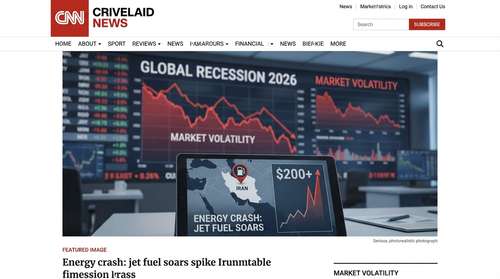
The sirens of a Global Recession 2026 are growing deafening across Wall Street and international trading floors. Following four grueling weeks of military escalation, the Iran conflict has officially triggered an unprecedented global energy shock, with the economic fallout crystallizing rapidly over the past 48 hours. Jet fuel prices have shattered previous thresholds, surging past the historic $200 mark this weekend and throwing international commerce into a tailspin. As logistics networks freeze and markets retreat, economists are warning that the current trajectory mirrors the worst stagflation crises of the late twentieth century, demanding immediate intervention.
Jet Fuel Price Records Force Emergency Surcharges
Airlines and global freight carriers are reeling as the reality of the Middle Eastern theater sets in. With the Persian Gulf airspace effectively shuttered due to ongoing hostilities, the aviation industry faces an existential operational hurdle. The immediate consequence has been the establishment of severe jet fuel price records, prompting nearly every major international carrier to implement emergency fuel surcharges since Thursday.
The global operational map has been completely redrawn overnight. Traditional Middle Eastern Gulf transit hubs—which routinely serve as the critical connecting tissue between East and West—remain indefinitely closed. By severing these vital arteries, the global aviation network has lost a massive chunk of its long-haul efficiency, forcing carriers into lengthy, fuel-heavy reroutes that add hours to standard flight times.
While certain airlines like United, Air Astana, and Air Transat are currently capturing displaced passenger traffic via alternative routes, the soaring operational costs are mounting universally. Cathay Pacific, an airline that recently celebrated three consecutive years of robust post-pandemic profits fueled by premium demand, issued a stark warning to investors on Friday regarding extreme fuel price volatility. Industry executives, still unpacking the grim projections from this month's JPM Industrials conference in Washington, concede that cargo and ticket prices will likely double on key international routes within weeks.
The Iran Conflict Economic Impact on Supply Chains
The extreme turbulence in the sky is merely the leading edge of a broader macroeconomic storm. The Iran conflict economic impact has rapidly bled into maritime shipping, ground freight, and everyday consumer goods. Energy serves as the invisible tax on every physical product moved across the globe, and a $200-plus jet fuel benchmark guarantees a devastating trickle-down effect on vulnerable global supply chains.
Manufacturers who rely on just-in-time logistics are suddenly unable to absorb the exponential leap in air freight costs. Critical components, ranging from semiconductor chips to heavy industrial machinery and pharmaceuticals, are now marooned in warehouses or incurring transport fees that obliterate corporate profit margins. The agricultural sector is particularly exposed, with perishable exports facing extreme delays as shippers refuse to pay exorbitant emergency rates.
Analysts warn this compounding dynamic makes a severe inflation surge 2026 practically inevitable. The consumer price index, which had shown signs of stabilizing earlier this year, is projected to reflect these new structural transport costs by the end of the second quarter, eroding consumer purchasing power at a staggering rate.
Equities Tumble Amid Stock Market Volatility 2026
Unsurprisingly, the financial sector has aggressively priced in the heightened geopolitical risk. Wall Street closed out the week in deeply negative territory, punctuated by rampant stock market volatility 2026. Major indices registered their sharpest consecutive daily declines of the year as institutional traders hit the panic button on transport and logistics equities.
The Architecture of an Energy Market Crash
Investors are actively fleeing growth stocks and consumer discretionary sectors, rotating capital into defense contractors and domestic commodities. The broader energy market crash—characterized right now by the utter collapse of energy-dependent corporate equities rather than falling crude prices—has wiped out trillions in market capitalization over mere days. Institutional traders are dumping transportation holdings, fearing that demand destruction is the only logical outcome when basic fuel inputs become this severely detached from historical pricing norms. Without stabilization, margin calls could trigger further liquidity crises.
Trump Economic Policy Shifts to Crisis Management
With corporate America sounding the alarm, Washington is moving into aggressive damage control. Over the last two days, the Trump administration has convened emergency closed-door sessions with logistics giants, airline executives, and domestic energy producers to map out a massive containment strategy to shield the broader economy.
Observers anticipate that the core of the evolving Trump economic policy will focus on an unprecedented deregulation push to maximize domestic oil extraction. However, the lead time for new production offers little immediate relief for the current aviation crisis. More immediately, the administration is reportedly finalizing an emergency executive order to tap deeper into the Strategic Petroleum Reserve and floating temporary tax holidays for commercial freight operators. The explicit goal is to establish a robust firewall against the rising costs of basic consumer goods before the economic damage becomes permanent.
Whether these swift interventions can neutralize the sheer scale of the disruption remains fiercely debated. If Middle Eastern airspace remains contested and fuel constraints persist into the upcoming summer travel and shipping season, the cascading bankruptcies within the logistics sector will likely cement the very global downturn policymakers are desperately fighting to avoid.