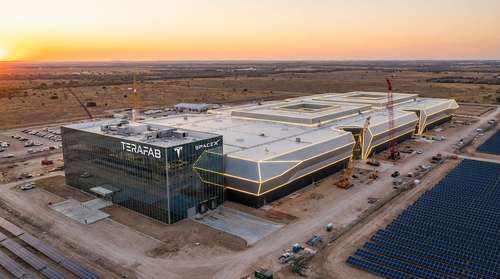
During a high-profile weekend event at the defunct Seaholm Power Plant in downtown Austin, technology billionaire Elon Musk unveiled a project that could fundamentally alter the global silicon supply chain. The initiative, officially named Elon Musk Terafab, is a colossal $25 billion semiconductor facility designed to power the next generation of autonomous vehicles, humanoid robots, and orbital infrastructure. Driven by an urgent need for massive computational power, this joint venture between Tesla, SpaceX, and xAI aims to produce up to one terawatt of computing capacity annually.
The Dawn of the Austin Tesla Terafab
Announced on March 21, the ambitious Austin Tesla Terafab will be constructed on the North Campus of Giga Texas in eastern Travis County. During his presentation, Musk framed the facility as an existential necessity for his interconnected empire, noting that existing suppliers simply cannot scale fast enough. "We either build the Terafab, or we don't have the chips, and we need the chips, so we build the Terafab," he told attendees, a crowd that included Texas Governor Greg Abbott.
The facility represents a radical departure from traditional hardware supply chains, establishing a new benchmark for semiconductor vertical integration. Rather than relying on a fragmented global network, the factory will consolidate every stage of production under one massive roof. This encompasses everything from initial chip design and lithography to advanced packaging, memory production, and rigorous testing.
Scaling Custom AI Silicon Manufacturing
The sheer scale of this endeavor dwarfs anything currently existing in the tech sector. Tesla and its partners are targeting state-of-the-art 2-nanometer process technology, an incredibly complex node that industry leaders like Taiwan Semiconductor Manufacturing Company (TSMC) have spent decades and hundreds of billions of dollars to master.
Production targets for this custom AI silicon manufacturing hub are staggering. Operations are slated to begin with an initial output of 100,000 wafer starts per month, eventually scaling to one million. For perspective, achieving that full-scale capacity would represent roughly 70% of TSMC's entire current global output from a single site. The end goal is to manufacture between 100 billion and 200 billion custom AI and memory chips every year.
Driving the Tesla Robotics Ecosystem
A significant portion of the terrestrial output from this Tesla AI chip factory will feed directly into the automaker's product lines. The facility will produce the upcoming AI5 and AI6 inference chips necessary for the Cybercab robotaxi fleet and the Optimus humanoid robot program. In a distinctly Musk-esque twist, the CEO claimed that millions of Optimus robots will actually help construct and operate the Austin fabrication plant.
The SpaceX Semiconductor Project: Computing in Orbit
While the automotive applications are massive, the most unexpected revelation from the weekend's presentation centered on aerospace. According to Musk, an estimated 80% of the facility's compute output will be allocated to a visionary SpaceX semiconductor project.
This initiative will utilize custom-designed D3 chips built specifically for orbital satellite constellations. The strategy capitalizes on the unique physics of space. Solar irradiance in low Earth orbit is roughly five times stronger than on the surface, providing abundant energy for compute-heavy workloads. Furthermore, the vacuum of space allows for highly efficient heat rejection, making thermal scaling viable in ways that are impossible in traditional, land-based server farms.
This development is the latest major piece of xAI hardware news following SpaceX's all-stock acquisition of the artificial intelligence startup in February. By blanketing low Earth orbit with AI mini-satellites launched by Starship, the conglomerate intends to build the world's largest decentralized data center. Musk described the effort as a necessary step to starting a "galactic civilization," envisioning a future where running AI workloads in orbit is cheaper than maintaining terrestrial facilities.
Market Realities and Financial Hurdles
Despite the futuristic optimism inside the Seaholm Power Plant, Wall Street reacted with noticeable caution. Tesla's stock slipped over 1% in overnight trading as analysts digested the immense capital requirements and technical risks of the endeavor. Tesla Chief Financial Officer Vaibhav Taneja confirmed that the estimated $20 billion to $25 billion cost of the facility has not yet been factored into the automaker's record capital expenditure plan for 2026, which already exceeds $20 billion.
Financial concerns are only part of the equation. Industry experts are deeply skeptical about the rapid timeline and the steep learning curve of chip fabrication. Producing 2nm silicon requires highly specialized equipment, an arena currently dominated by a handful of established global players.
Building a facility that rivals the output of sovereign nations from scratch is an unprecedented gamble. Analysts have warned that the plan relies heavily on technology controlled by just three major companies worldwide. To mitigate this bottleneck, the Austin site will reportedly operate two coordinated fabrication lines, enabling new chip versions to be produced daily with a turnaround time of less than a week for rapid prototyping.
Whether this massive infrastructural bet pays off remains to be seen. Pilot production is expected to commence by late 2027. If successful, this singular Texas megaproject will not only rewrite the rules of silicon manufacturing but permanently solidify Musk's control over the essential hardware powering the artificial intelligence revolution.