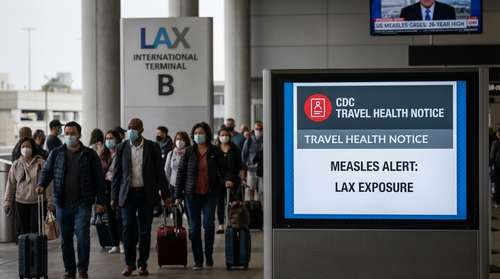
Health officials have confirmed a new measles exposure incident at Los Angeles International Airport (LAX) involving an international traveler, prompting the Centers for Disease Control and Prevention (CDC) to escalate its warnings as national cases surge. The exposure occurred in late January 2026 at the Tom Bradley International Terminal (Terminal B), a critical hub for global flights. This alert comes as the United States records 588 confirmed measles cases in January alone—the highest first-month total since the disease was declared eliminated in 2000. With the LAX measles exposure 2026 incident adding to a growing list of outbreaks, experts are urging travelers to verify their vaccination status immediately.
LAX Measles Exposure: Dates, Times, and Locations
The Los Angeles County Department of Public Health (LADPH) issued an urgent alert following confirmation that an infectious traveler passed through LAX on January 26, 2026. The individual arrived on Viva Aerobus Flight #518 and moved through Terminal B, potentially exposing thousands of fellow passengers and airport staff.
Health officials have pinpointed specific windows of exposure. Anyone present in Terminal B between 10:45 p.m. on January 26 and 1:00 a.m. on January 27 is considered at risk. Because measles is an airborne virus that can linger for up to two hours after an infected person leaves an area, the danger zone extends beyond direct contact. The traveler also visited popular Southern California destinations while infectious, including:
- Disneyland Resort: January 28, specifically at Goofy's Kitchen (10:30 a.m. – 1:30 p.m.) and both theme parks until closing.
- Dunkin' Donuts (Woodland Hills): January 30, between 3:00 p.m. and 4:45 p.m.
If you were at these locations during these times, officials advise monitoring for symptoms until February 16 for LAX exposures and February 20 for the later dates.
US Cases Hit 26-Year High: A Dangerous Surge
The situation at LAX is a microcosm of a much larger national crisis. Data released by the CDC reveals a startling trajectory for the virus in 2026. As of late January, the U.S. has recorded 588 confirmed cases. To put this in perspective, this single month accounts for nearly 26% of the entire case total for 2025, which itself was a high-transmission year.
Threat to Elimination Status
This surge represents the highest January case count in over two decades, threatening the United States' status as a country that has eliminated measles. The majority of these cases are linked to unvaccinated individuals and international travel. Significant outbreaks have been identified in South Carolina and Utah, contributing heavily to the national numbers. The measles outbreak US 2026 trajectory suggests that without immediate public health intervention and increased vaccination uptake, this year could surpass modern records.
CDC Travel Health Notice and Safety Warnings
In response to the escalating numbers and the Los Angeles airport health alerts, the CDC has reinforced its Global Travel Health Notice. This advisory explicitly warns international travelers of the heightened risk of measles in various global regions and emphasizes the necessity of the MMR (measles, mumps, rubella) vaccine.
For Americans planning travel abroad in February 2026, the guidance is strict:
- Infants (6–11 months): Should receive one dose of the MMR vaccine before international travel.
- Children (12 months+): Need two doses separated by at least 28 days.
- Adults: Those without evidence of immunity should receive two doses separated by at least 28 days.
The travel safety warnings February 2026 highlight that airports like LAX are mixing bowls for infectious diseases. Unvaccinated travelers are not only at risk of infection but also of importing the virus back into their communities, fueling local outbreaks.
What To Do If You Were Exposed
Measles is highly contagious, with a 90% infection rate for non-immune individuals exposed to the virus. Symptoms typically appear 7 to 21 days after exposure. If you believe you were at LAX Terminal B or other identified locations during the risk windows, take the following steps immediately:
First, review your vaccination records. Two doses of the MMR vaccine are 97% effective at preventing measles. If you are unvaccinated or unsure of your status, contact a healthcare provider immediately. Post-exposure prophylaxis (vaccination or immune globulin) can sometimes prevent illness if administered quickly.
Second, watch for symptoms, which include high fever, cough, runny nose, red watery eyes (conjunctivitis), and the tell-tale rash that starts on the face and spreads downward. If symptoms develop, do not go directly to an ER or clinic waiting room. Call ahead so medical staff can isolate you upon arrival to prevent infecting others. With international travel vaccine requirements becoming a focal point of discussion, staying informed and vaccinated remains your best defense.