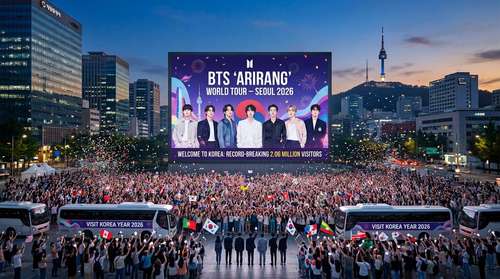
South Korea has officially welcomed more foreign visitors in a single month than ever before, logging a staggering 2.06 million arrivals in March 2026. According to the Ministry of Culture, Sports, and Tourism, this historic milestone coincides directly with the highly anticipated BTS 2026 comeback following the septet's years-long hiatus for mandatory military service. As millions of international fans poured into the country, what started as a pop culture moment quickly morphed into an unprecedented economic boom, vividly illustrating the sheer scale of the 'BTS Effect' on global travel.
Decoding the South Korea Tourism Record
The newly released international travel statistics 2026 paint a picture of a hospitality industry operating at maximum capacity. Total foreign arrivals for the first quarter of the year reached 4.76 million, representing a 23% year-over-year increase and marking the strongest first quarter on record.
Visitors from neighboring Asian countries led the influx. Chinese tourists accounted for the largest share with 1.45 million arrivals—a 29% jump compared to last year. Japanese and Taiwanese arrivals also saw significant boosts, increasing by 20.2% to 940,915 and 37.7% to 544,503 respectively. Meanwhile, travelers from the Americas and Europe grew by 17.1% to roughly 690,000.
Industry analysts credit this historic South Korea tourism record squarely to the global gravitational pull of the Hallyu (Korean Wave), which reached a fever pitch this spring. While geopolitical uncertainties and economic headwinds have challenged global travel elsewhere, South Korea's cultural magnetism proved unstoppable. The undeniable catalyst was the reunion of the world's biggest boy band and the massive migration of their dedicated global fanbase, ARMY.
The Phenomenon of the BTS Arirang World Tour
The cultural explosion began early in March with the release of the group's new studio album, ARIRANG, and a spectacular live concert event at Gwanghwamun. Titled 'BTS The Comeback,' the performance was streamed globally on Netflix on March 21, providing fans worldwide a front-row seat to one of the most anticipated moments in modern pop history. This digital momentum carried over into physical ticket sales as the group officially kicked off the BTS Arirang world tour with three massive shows in Goyang on April 9, 11, and 12.
Marking their permanent return to live stages, the tour is planned to span more than 80 shows across 34 regions worldwide. The ambitious production features an immersive 360-degree, in-the-round stadium design, allowing for maximum capacity and an unprecedented interactive experience. For international fans, however, merely waiting for the tour to reach stadiums in North America or Europe wasn't enough. Hundreds of thousands flocked directly to the source, eager to witness the group's historic return on Korean soil, effectively transforming the entire peninsula into a global festival ground.
Fueling a Fan-Driven Tourism Economy
The financial impact of this mass migration is setting a new benchmark for the fan-driven tourism economy. The influx of highly engaged, culturally motivated tourists brought massive economic windfalls. According to the Ministry, overall foreign credit card spending in the first quarter reached 3.21 trillion won (approximately $2.18 billion), a 23% rise from the previous year. Tourist satisfaction also saw an uptick, rising to 90.8 points from 89.7 a year ago.
Quantifying the 'BTS Effect'
Zeroing in on the direct impact of the band, South Korean financial firm Hana Card analyzed the spending patterns of 30,000 foreign nationals who purchased tickets for the initial Goyang performances. Between January 1 and April 12, these concertgoers spent an estimated 55.5 billion won ($37.7 million) inside the country.
On average, each visitor dropped approximately 1.85 million won on accommodations, dining, shopping, and domestic transport. This heavy local spending proves that the Seoul travel surge extended far beyond just concert ticket sales and venue merchandise. Fans are actively stimulating the local economy by visiting pop-up stores, themed cafes, and cultural landmarks associated with the members.
Beyond Seoul: Evolving K-Pop Travel Trends
Perhaps the most encouraging data point for government officials and local businesses is the changing nature of modern K-pop travel trends. Historically, cultural tourism in South Korea has been heavily concentrated in the Seoul metropolitan area. However, the latest statistics reveal a significant and healthy decentralization: arrivals through regional airports surged by an incredible 49.7% to 850,000 visitors in the first quarter.
Furthermore, the proportion of tourists exploring areas outside the capital region rose to 34.5%, up from 31.3% last year. The maritime sector also felt the boom; cruise tourism showed a strong 52.9% rebound, with 338 vessel calls at major regional ports including Jeju, Busan, and Incheon.
This regional spread suggests that international fans are engaging more deeply with the country. Rather than executing quick weekend trips to Seoul, visitors are executing extended itineraries, venturing out to explore music video filming locations, hometowns of the band members, and provincial cultural hubs.
As the tour prepares to head to the Tokyo Dome this week and eventually to mega-venues like Gillette Stadium and Stanford Stadium in North America, the initial domestic run has already etched itself into history. South Korea hasn't just successfully welcomed back its most famous cultural ambassadors; it has demonstrated the unparalleled, economy-shaping power of modern music tourism.