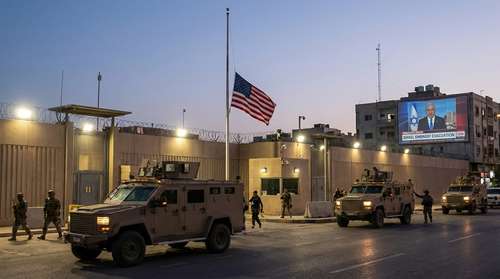
JERUSALEM — The United States has ordered the emergency evacuation of non-essential personnel from its embassy in Israel, a dramatic escalation signaling that the Trump administration may be arguably closer to a direct military confrontation with Iran than at any point since the "12-Day War" of June 2025.
The directive, issued late Thursday by the State Department, cites "imminent safety risks" following the collapse of back-channel nuclear negotiations in Geneva. President Donald Trump, facing a pivotal midterm election season, has declared that a joint military campaign with Israel remains a "live option" to prevent Tehran from reconstituting its nuclear program—a capability U.S. intelligence officials now fear is being rapidly rebuilt in underground bunkers.
Embassy Evacuation Signals Imminent Action
The order to draw down diplomatic staff in Jerusalem comes amid a flurry of activity at the Pentagon. Two U.S. carrier strike groups, the USS Abraham Lincoln and the USS Gerald R. Ford, have been repositioned within striking distance of the Persian Gulf, joining a massive armada that Defense Department officials describe as the largest American military buildup in the region since 2003.
"The safety of American personnel is our absolute priority," Secretary of State Marco Rubio said in a brief statement Friday. "Given the breakdown in talks and the aggressive posture of the Iranian regime, we are taking prudent steps to ensure we are not caught off guard."
Sources close to the administration confirm that the evacuation is not merely precautionary but a prelude to potential offensive operations. The White House has grown increasingly frustrated with Tehran's refusal to halt centrifuge installation at fortified sites near Natanz, which were damaged but not destroyed during the U.S.-Israeli airstrikes last summer.
Rubio and Huckabee Clash on Strategy
Behind the scenes, the Trump administration's national security team is grappling with internal divisions over the timing and justification for a strike. Secretary Rubio issued a stern classified cable to U.S. ambassadors in the Middle East this week, instructing them to "refrain from public statements that could inflame regional audiences."
The directive was widely interpreted as a rebuke of U.S. Ambassador to Israel Mike Huckabee, whose recent comments on a popular podcast regarding Israel's "biblical right" to annexation drew sharp condemnation from Arab allies and reportedly angered President Trump, who viewed the remarks as a distraction from his "maximum pressure" negotiation strategy.
Furthermore, conflicting intelligence assessments have spilled into the public view. While Special Envoy Steve Witkoff warned on Fox News that Iran is "a week away" from weapons-grade material, Secretary Rubio appeared to contradict this assessment during a press availability in St. Kitts and Nevis, stating, "They're not enriching right now, but they're trying to get to the point where they ultimately can."
The Shadow of the 2025 '12-Day War'
The current crisis is deeply rooted in the unresolved aftermath of the conflict in June 2025. That short but intense war saw Israeli jets, supported by U.S. logistics, target Iran's nuclear infrastructure. While initially hailed as a success, recent IAEA reports suggest the strikes merely delayed Tehran's ambitions rather than ending them.
"We are seeing a replay of last year, but with higher stakes," says Dr. Elena Kogan, a senior analyst at the Foundation for Defense of Democracies. "Iran has hardened its defenses and dispersed its nuclear assets. A new strike would require a sustained U.S. air campaign, not just a surgical operation."
2026 Midterms Reshaped by War Drums
The prospect of a new major war in the Middle East has upended the political landscape ahead of the November 2026 midterm elections. Vice President J.D. Vance has been dispatched to rally the base, framing the potential conflict as a necessary move to "finish the job" and secure American interests.
"We cannot allow the Ayatollahs to hold the world hostage," Vance told a rally in Pennsylvania on Wednesday. "President Trump promised peace through strength, and sometimes strength means showing you are willing to use it."
However, the administration faces skepticism from both isolationist wings of the GOP and Democrats who warn of mission creep. With the evacuation of the Jerusalem embassy now underway, the window for a diplomatic off-ramp appears to be closing rapidly, leaving the world bracing for what could be the defining foreign policy crisis of Trump's second term.