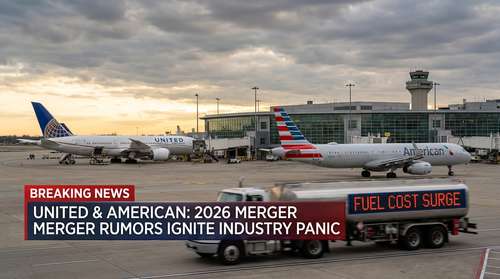
The commercial aviation sector is bracing for a potential earthquake. Following devastating disruptions in global energy markets and the closure of the Strait of Hormuz, the United American merger 2026 narrative has rapidly shifted from an improbable fantasy to a serious boardroom discussion. Leaked reports this week reveal that United Airlines CEO Scott Kirby directly pitched a combination with American Airlines to President Donald Trump in late February. If executed, the move would unite two of the world's most dominant carriers, creating an undisputed aviation behemoth and reshaping the future of domestic and international air travel.
Inside the United Airlines American Airlines Rumors
This latest wave of breaking aviation news has sent airline stocks soaring while consumer advocates sound the alarm. According to industry insiders, Kirby argued that combining the carriers would forge a U.S. operator large enough to aggressively compete against heavily subsidized foreign airlines on lucrative long-haul routes.
The sheer scale of a combined United-American entity would be staggering. Bureau of Transportation Statistics data indicates United controls roughly 16.7% of the domestic market, while American holds 17.4%. Together, they would command over a third of all U.S. passenger traffic and manage a global fleet of over 2,000 aircraft. This proposed combination would dwarf Delta Air Lines, effectively condensing the traditional Big Four carriers into a top-heavy Big Three.
The Catalyst: Skyrocketing Jet Fuel and Flight Cost Increases 2026
To understand why such a radical proposal is on the table, observers only need to look at the commodities market. Recent geopolitical conflicts, specifically the US-Israeli strikes on Iran and the resulting Strait of Hormuz closure, have decimated global energy supply chains. Jet fuel prices have virtually doubled since the conflict escalated in February, with some analysts tracking costs surging past $4.80 per gallon.
These staggering operational expenses are directly translating into severe flight cost increases 2026. Fuel typically represents the second-largest expense for any airline, right behind labor. However, carriers like American Airlines—which famously operates without a comprehensive fuel-hedging strategy—are deeply exposed to the sudden price spike. Market experts estimate that every single-cent rise in jet fuel increases American's annual operating costs by approximately $50 million.
With airlines already pulling back capacity and canceling off-peak flights to preserve cash, legacy carriers are scrambling for survival tactics. United Airlines has already signaled tactical pruning of unprofitable routes. This harsh economic reality is accelerating broader US airline industry trends, pushing vulnerable airlines to seek scale through consolidation just to offset hemorrhaging balance sheets and survive the global fuel squeeze.
Severe Airline Monopoly Concerns and Consumer Backlash
While Wall Street reacted favorably to the airline consolidation news—with both American and United shares climbing on the reports—consumer watchdogs and antitrust experts are fiercely pushing back. A merger of this magnitude immediately triggers massive airline monopoly concerns, particularly at major hub airports like Chicago O'Hare, Los Angeles, and major Texas markets where both airlines currently maintain dominant footprints.
"A potential United-American merger proves how broken the airline industry is in America—and would be an absolute disaster for the flying public," stated Ganesh Sitaraman, director of the Vanderbilt Policy Accelerator. Critics argue that reducing the number of legacy carriers will inevitably lead to diminished route options, reduced service quality, and even higher ticket prices for passengers who are already squeezed by inflation and fuel surcharges. William McGee of the American Economic Liberties Project went even further, calling it "undoubtedly the most absurd airline merger" he has seen in his 41-year career.
However, the proposal isn't facing universal opposition. Captain Dennis Tajer, spokesman for the Allied Pilots Association—the union representing 16,000 American Airlines pilots—recently noted that the merger idea is "certainly intriguing". He pointed to ongoing frustration with American's financial, operational, and customer service underperformance under its current management, signaling that labor might be open to a leadership shakeup.
Will Washington Greenlight the Mega-Merger?
The ultimate hurdle for a United-American integration lies at the Department of Justice. Under the Biden administration, federal regulators took a hardline stance against aviation consolidation, successfully blocking JetBlue's attempted $3.8 billion acquisition of Spirit Airlines in early 2024. But the regulatory weather is shifting under the second Trump administration, which has historically taken a more laissez-faire approach to corporate mega-deals.
Transportation Secretary Sean Duffy recently signaled a more permissive environment for airline operators. While acknowledging that a merger of this scale would require significant asset divestitures—likely forcing the new airline to surrender valuable gates and slots at key airports—Duffy indicated the administration is open to discussions. "President Trump, he loves to see big deals happen. Is there room for some mergers in the aviation industry? Yeah, I think there is," Duffy noted during a recent interview.
Kirby's strategy appears calculated. By pitching the merger directly as a tool to combat foreign, state-sponsored airlines on international routes, he is speaking directly to the administration's focus on trade deficits and global competitiveness.
What Travelers Should Expect Next
As these high-stakes merger discussions continue behind closed doors, passengers will likely feel the immediate impact of the ongoing energy crisis long before any corporate integration takes place. Travelers should anticipate elevated baseline fares, aggressive capacity cuts on less profitable routes, and climbing baggage fees through the upcoming summer travel season. Even if the United-American deal never officially takes flight, the mere fact that it is being negotiated at the highest levels of government confirms that the foundation of American commercial aviation is entering a volatile new era.