
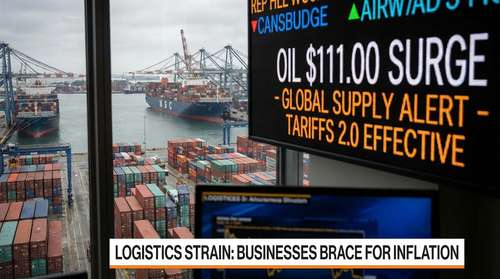
In early April 2026, a perfect storm of geopolitical conflict, sweeping trade policy changes, and spiking fuel costs triggered a massive global supply chain disruption. U.S. West Texas Intermediate (WTI) crude futures just recorded a staggering 11.4% single-day jump, closing at $111.54 a barrel. This historic oil price surge 2026 is leaving American businesses and consumers bracing for a profound inflationary shock. What started as military escalation in the Middle East has morphed into a multi-front economic battle. With raw materials, shipping, and fuel all skyrocketing simultaneously, businesses are racing to adapt.
The Catalyst: Strait of Hormuz Economic Impact and Energy Shock
The root of this latest global supply chain disruption stems directly from the Middle East. Following the prolonged blockade and recent U.S. military strikes against Iranian targets, energy markets are panicking. The Strait of Hormuz economic impact cannot be overstated—this critical maritime artery facilitates roughly 20% of the world's daily oil consumption. With major shipping lanes frozen, energy analysts at JPMorgan Chase have warned that if the disruption extends into mid-May, crude could soar toward $150 a barrel.
For the American consumer, the effects are immediate. U.S. gasoline prices have quickly bypassed the $4 per gallon threshold and are actively accelerating toward $5. The ripple effects of this energy bottleneck are drastically increasing operational overhead for every physical industry in the United States, threatening to derail the modest economic recoveries seen earlier in the year.
Raw Material Costs Rise: Tariffs 2.0 Business News
As if $111 oil wasn't enough, manufacturers are simultaneously dealing with severe policy-driven cost increases. The implementation of the administration's aggressive trade policies has dominated Tariffs 2.0 business news. Effective immediately, a blanket 25% duty on all imported steel and aluminum has been enacted. Unlike previous measures, this iteration leaves virtually no room for allied exemptions.
The immediate goal is to end foreign dumping and revitalize domestic production, but the short-term reality for businesses is a painful margin squeeze. Companies relying on foreign metals are finding themselves trapped between rising raw material expenses and consumers who are increasingly sensitive to price hikes.
Aluminum Price Forecast 2026 and Manufacturing Woes
Looking closely at the metals market, the aluminum price forecast 2026 looks exceptionally volatile. Analysts predict that the 25% universal tariff, compounded by the rising energy costs required for domestic smelting operations, will push aluminum prices to multi-year highs. Everything from automotive manufacturing and aerospace engineering to everyday consumer packaging will face double-digit production cost increases throughout the second quarter of the year.
Retail Squeeze: The Amazon Logistics Surcharge
The logistics sector is acting as a rapid transmission mechanism for this inflationary pressure. In direct response to the spiking fuel prices and broader operational bottlenecks, e-commerce giants are shifting the burden to sellers. Most notably, the newly announced Amazon logistics surcharge of 3.5% is sending shockwaves through the retail sector.
For the millions of third-party merchants relying on modern fulfillment networks, this surcharge represents a direct hit to profitability. Sellers who were already trying to absorb the costs of the global supply chain disruption must now decide whether to eat the 3.5% fee or pass it on to consumers at checkout. With transportation margins historically thin, most businesses will have no choice but to raise retail prices, further fueling the national inflation narrative.
Labor Market Context: March 2026 Jobs Report Defies Odds
Despite the mounting cost pressures from oil, tariffs, and logistics fees, the domestic labor market continues to show complex, yet resilient, indicators. The recently released March 2026 jobs report surprised forecasters by adding 178,000 jobs—triple the expected consensus. Furthermore, the national unemployment rate ticked down slightly to 4.3%, driven by solid gains in private sector employment.
However, business leaders are viewing these numbers with cautious optimism. While the strong March 2026 jobs report indicates that the American consumer still has purchasing power, it also suggests that wage inflation will remain high. Employers must now balance the need to attract skilled talent in a competitive labor pool against the crushing reality of escalating material and shipping expenses.
Ultimately, businesses that survive this unprecedented convergence of $111 oil, steep new tariffs, and supply chain constraints will be those that aggressively optimize their operational efficiencies. As the global economy navigates the remainder of 2026, agility and cost management will be the ultimate keys to corporate survival.