The global technology industry is facing an unprecedented emergency as the IRGC tech company threat 2026 materializes on an international scale. In a chilling escalation of hostilities across the Middle East, Iran's Islamic Revolutionary Guard Corps (IRGC) has officially designated 18 major American technology, finance, and aerospace corporations as "legitimate targets". With potential cyber and physical strikes scheduled to commence at 8:00 PM Tehran time on Wednesday, April 1, 2026, a historic Silicon Valley security crisis is actively unfolding, forcing corporate giants to navigate an active war zone.
The IRGC 18 Companies Hit List
The stark warning, initially broadcast via Iran's state-aligned Tasnim news agency and official Telegram channels on Tuesday, represents a radical departure from conventional military posturing. The IRGC 18 companies hit list reads like a roll call of the Nasdaq's most valuable and influential enterprises. Silicon Valley heavyweights such as Apple, Alphabet (Google), and Meta are explicitly named alongside enterprise software and hardware titans including Microsoft, Oracle, IBM, Dell, HP, and Cisco.
The targeting framework extends significantly beyond traditional consumer software. Semiconductor giant Nvidia, whose chips power the ongoing artificial intelligence revolution, is firmly in the crosshairs. The threat also encompasses aerospace, defense, and finance sectors, targeting Boeing, Palantir Technologies, General Electric, Tesla, and JPMorgan Chase. Furthermore, regional technology partners such as Spire Solutions and G42—a pivotal Abu Dhabi-based AI firm—were explicitly mentioned in the communiqué. The paramilitary organization has drawn a hard line, declaring that for every Iranian official or citizen assassinated, a U.S. corporate facility will face reciprocal destruction.
Unprecedented Middle Eastern Evacuation Orders
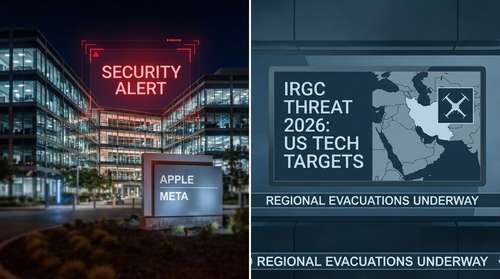
The immediate fallout from the statement has triggered an urgent Apple Meta Google regional evacuation. The IRGC issued a sweeping mandate urging all employees of the named institutions across the Middle East to abandon their workplaces immediately to "save their lives". Recognizing the potential for massive collateral damage, the military group also broadcast a chilling warning to civilians. Residents living within a one-kilometer radius of these corporate campuses, server farms, and data centers have been instructed to move to safe locations. Security teams across the Gulf region are currently scrambling to relocate personnel, shutter physical offices, and migrate sensitive data workloads to servers outside the immediate threat zone.
Why AI and Cloud Platforms Are the New Frontlines
This unprecedented development marks a terrifying evolution in modern conflict, heavily characterized by AI warfare targeting US tech. According to the IRGC's official statement, the United States and its regional allies have increasingly relied on commercial artificial intelligence, vast cloud computing networks, and satellite tracking systems to execute precise military operations and targeted assassinations inside Iranian territory. The IRGC explicitly stated that the main element in designing and tracking terrorist targets are American ICT and AI companies.
Because these ostensibly civilian technologies allegedly provide the logistical and analytical backbone for military intelligence, the IRGC now considers the corporations developing them to be active combatants rather than neutral commercial entities. The boundary between civilian enterprise and military infrastructure has effectively vanished. Technology firms that recently celebrated highly lucrative defense contracts during the artificial intelligence boom are now discovering the grave geopolitical risks associated with those partnerships. Companies perceived as too closely linked to the Pentagon or Israeli defense forces are facing the stark reality that their global physical footprint is now a military liability.
Geopolitical Fallout and the US-Iran Tech War
Following the latest US-Iran tech war news, global financial markets have experienced severe turbulence, with tech stocks tumbling in pre-market trading. The shift in Iranian strategy indicates that the broader regional conflict—which intensified significantly after reciprocal cross-border strikes throughout February and March—is no longer confined to traditional military bases, government buildings, or energy infrastructure. It has spilled over into the civilian economic sector.
Security analysts and intelligence officials warn that the 8:00 PM Tehran deadline could bring a devastating combination of kinetic drone swarms, ballistic missile strikes, and sophisticated, debilitating cyberattacks aimed at crippling corporate networks. Iran has already demonstrated its willingness to target civilian tech infrastructure, previously claiming successful drone strikes on facilities tied to Siemens and AT&T in the region, which Tehran framed as covert research hubs supporting adversarial military operations.
The Challenge of High-Tech Military Targeting in 2026
This sudden paradigm shift toward high-tech military targeting 2026 presents the U.S. Department of Defense and allied nations with a complex, perhaps insurmountable, logistical challenge. Defending highly dispersed corporate assets, sprawling data centers, and multi-national cloud regions across several allied nations requires an entirely different security architecture than protecting heavily fortified military bases.
As the final hours of the countdown tick away, Silicon Valley executives are reportedly in emergency coordinating sessions with the Pentagon, the National Security Agency (NSA), and regional allies. Corporate boardrooms are grappling with a new reality: the tools they built to connect the world and process its data have drafted them onto the front lines of a global conflict. The events of April 1, 2026, may ultimately be remembered as the moment the tech industry officially became a recognized theater of war.