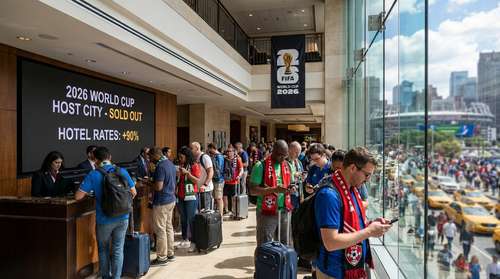
The kickoff is approaching, and the massive reality of 2026 FIFA World Cup travel is finally settling in. Over 6.5 million visitors are packing their bags to cross borders across the United States, Canada, and Mexico this summer. But as excitement peaks, so does the sticker shock. Host city hotel prices have exploded, with rates in Los Angeles and New York spiking by up to 90% this week alone. It is a gold rush for the hospitality sector, but for the everyday fan, it is rapidly becoming an exercise in financial gymnastics.
The Unprecedented World Cup Tourism Economic Impact
The sheer scale of this summer’s tournament defies historical comparisons. Spanning 16 cities and featuring 48 teams competing in 104 matches, this event is effectively reshaping the global summer economy. New reports released in mid-April estimate the World Cup tourism economic impact will inject upwards of $80 billion into global output. The tournament is also projected to support over 824,000 full-time jobs across the transportation, retail, and service sectors worldwide.
Much of that economic windfall is pouring directly into the North American hospitality and aviation industries. The United States alone is projected to see a $17.2 billion boost to its economy, with cities like Los Angeles aiming to pull in nearly $594 million in direct revenue, easily surpassing the local windfall of the 2022 Super Bowl. However, this unprecedented North America travel surge isn’t operating like a typical peak summer tourist season. Instead, travel analytics experts warn of unpredictable "match-driven surges," where demand explodes abruptly around tightly clustered match dates and relocates overnight based on bracket outcomes.
Host City Hotel Prices and the Accommodations Squeeze
For anyone trying to book a bed near a major stadium, the current reality is grim. Surging host city hotel prices are dominating headlines, forcing many supporters to reconsider their logistics. Beyond the dramatic 90% spikes in coastal hubs like New York and LA, secondary markets are feeling the exact same pressure. Recent lodging analytics indicate that short-term rental demand in Boston has skyrocketed 273% compared to a typical summer weekend. Dallas hotel rates have similarly jumped 174% following the final group draw announcements.
Why the sudden squeeze? Unlike regular tourism, the FIFA crowd does not slowly trickle in over an entire season. Hundreds of thousands of fans flood specific neighborhoods simultaneously. If you are targeting high-demand matchups, expect properties to leverage dynamic pricing algorithms to maximize their returns.
Finding Relief Through Alternative Lodging
Savvy travelers navigating US soccer tourism 2026 are increasingly relying on the "second-city strategy." Instead of battling for exorbitant rooms in downtown Boston, fans are securing accommodations 30 minutes away in Providence, Rhode Island. Corporate housing platforms and flat-fee home swap networks are also seeing record enrollment as fans attempt to sidestep the aggressive dynamic pricing models favored by major hotel chains.
World Cup Ticket Resale Trends Shatter Records
Securing a bed is only half the battle; getting inside the stadium is proving equally daunting. Recent World Cup ticket resale trends show an incredibly aggressive secondary market that shows no signs of cooling down. A comprehensive mid-April cost analysis of host venues revealed that Boston is currently the most expensive US stop, with median resale tickets for highly anticipated matchups approaching $4,986 for Category 1 seating.
Even in historically "cheaper" markets like Miami, where an estimated three-day trip cost hovers around $2,614, the baseline expense prices out casual supporters. The combination of astronomical resale tickets and inflated airfare is turning what is normally a festive, accessible global gathering into a heavily premium experience for many traveling contingents.
Navigating FIFA Fan Travel Logistics and Border Anxiety
Money aside, international fans face a logistical labyrinth. This is the first tri-host tournament in history, and FIFA fan travel logistics have never been this complicated. A fan following a team like Belgium, for instance, might be required to fly between Seattle, Vancouver, and Los Angeles in the span of ten days. That means managing multiple border crossings, differing visa requirements, and distinct entry protocols under extreme time constraints.
Aviation infrastructure will be pushed to the brink. Passenger volumes will arrive in uneven waves, bypassing traditional flight banks and putting North American mega-hubs under constant pressure. Unsurprisingly, this complexity is breeding intense fan anxiety. A recent travel sentiment survey showed that 74% of international respondents feel their perception of the US as a travel destination has worsened due to these hurdles. Concerns over lengthy immigration wait times, unpredictable security delays, and the sheer cost of constant cross-border movement are dominating global fan forums.
Travel operators are already advising fans to master their document management immediately. Depending on nationality, securing a US ESTA clearance or completing a full visa interview takes time, and wait times are only expected to grow as the tournament nears. The 2026 tournament will undeniably be a spectacular display of world-class soccer. But off the pitch, it is shaping up to be an endurance test of wallets and logistics. Those who lock down their accommodations now, explore secondary cities, and meticulously plan their border crossings will be the ones truly ready to enjoy the beautiful game.