
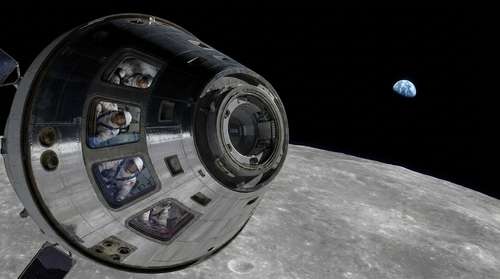
For more than half a century, the high-water mark for human travel into the cosmos belonged to a crew that never actually meant to set a record. In April 1970, an oxygen tank explosion forced the Apollo 13 astronauts into a harrowing, elongated orbit that carried them 248,655 miles from Earth just to survive. Now, that historic benchmark belongs to a new generation of explorers. On April 7, 2026, the Artemis II mission officially claimed the NASA distance record. Carrying a history-making crew of four, the Orion capsule eclipsed the previous mark, reaching an unprecedented peak distance of 252,756 miles (406,788 kilometers) from our home planet before executing a flawless pivot back toward Earth.
A Historic Orion Spacecraft Lunar Flyby
The record-breaking milestone occurred as the crew navigated a massive, figure-eight "free-return trajectory" around the Moon. This highly efficient flight path leverages lunar gravity to slingshot the capsule back toward Earth, minimizing the need for massive, risky engine burns in deep space. During this daring Orion spacecraft lunar flyby, the crew ventured more than 4,100 miles farther into the void than Jim Lovell, Jack Swigert, and Fred Haise did 56 years prior.
As the spacecraft sailed around the lunar far side—a battered, heavily cratered region permanently hidden from human eyes on Earth—the astronauts experienced a tense but expected 40-minute communications blackout. Emerging from the shadow of the Moon, the crew successfully re-established contact with Houston, officially securing their status as the farthest-traveled humans in history.
The Crew Redefining Human Limits
This landmark lunar orbit mission is piloted by a trailblazing quartet of NASA astronauts and one international partner. Commander Reid Wiseman leads the team, joined by pilot Victor Glover, who has officially become the first Black man to navigate a lunar flight. Mission specialist Christina Koch is making history as the first woman to venture this deep into the solar system. Jeremy Hansen represents the Canadian Space Agency, becoming the first non-American to leave low Earth orbit. Operating within the Orion capsule—fittingly dubbed "Integrity"—the team successfully monitored life-support systems under maximum stress while sharing their awe-inspiring vantage point with millions watching below.
Before hitting their peak distance, the crew even received a recorded message from the late Apollo 13 commander Jim Lovell, who welcomed the Artemis team to his "old neighborhood" and proudly passed the torch to the new generation.
How the Apollo 13 Record Broken Reshapes Lunar Science
While the 1970 journey was fundamentally a rescue operation, the current voyage is a calculated scientific triumph. With the Apollo 13 record broken under controlled, meticulously planned conditions, mission control is reaping the rewards of modern orbital photography and observational geology.
During their closest approach—sweeping just 4,067 miles above the desolate gray surface—the crew focused their high-resolution lenses on more than two dozen specific geologic targets. Equipped with state-of-the-art camera systems, they heavily documented the Orientale Basin. This 600-mile-wide, 3.8-billion-year-old impact crater features concentric rings stretching across both the near and far sides of the Moon. Because the human eye remains unparalleled in identifying subtle geological variations and lighting contrasts, the crew's live observations are providing invaluable structural data that robotic probes simply cannot match.
Paving the Way for Deep Space Exploration 2026 and Beyond
Having successfully exited the lunar sphere of influence today, April 7, the Artemis II crew is currently embarking on a four-day, high-speed cruise back to Earth. Their anticipated splashdown in the Pacific Ocean off the coast of San Diego is slated for Friday, April 10. Recovery teams aboard the USS John P. Murtha are already moving into position to retrieve the capsule and evaluate the crew's physiological response to deep space radiation.
The overwhelming success of this flight serves as the ultimate proving ground for deep space exploration 2026 initiatives. Proving that Orion's life-support and navigation systems can sustain humans over an extended, quarter-million-mile journey is the mandatory prerequisite for the program's next ambitious phase. Artemis III, scheduled to follow in the coming years, will attempt to land humans near the lunar South Pole—an area rich in permanently shadowed water ice, which is absolutely critical for establishing a sustained lunar base.
For now, the world watches as four modern explorers hurtle back toward Earth at thousands of miles per hour. They carry with them terabytes of scientific data, firsthand accounts of the lunar far side, and a brand-new milestone in the annals of human achievement. The legacy of Apollo has finally been eclipsed, opening the door to an era where humanity's reach extends further than it ever has before.