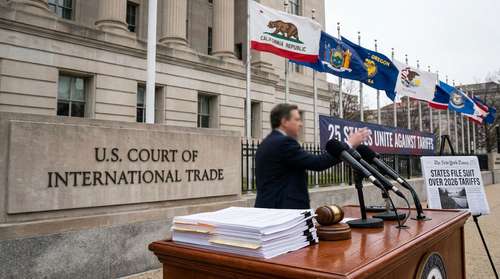
The escalating trade battle between the White House and state governments has reached a new boiling point. In a massive legal challenge filed on Monday, a coalition of attorneys general launched a coordinated strike against the administration's latest round of import duties. The central claim in the high-stakes Trump tariff lawsuit 2026 is that the president has vastly overstepped his constitutional authority, threatening to penalize American consumers while sparking profound global supply chain disruption.
25 States Sue Trump Over Sweeping Import Levies
The legal action, formally docketed as State of Oregon v Trump, was filed in New York by a heavily Democratic coalition that includes several Republican governors. Joined by officials from states like California, Michigan, Delaware, and Massachusetts, the 25 states sue Trump to immediately halt double-digit levies imposed on 60 major trading partners.
This Court of International Trade lawsuit targets import penalties ranging from 10% to 12.5%, which officially took effect in late July. Because these taxes apply to 59 countries and the European Union, they effectively cover 99.4% of all U.S. imports. State leaders warn that taxing such a staggering volume of incoming goods shifts the financial burden directly onto the shoulders of domestic buyers, local businesses, and regional economies.
The Battle Over Section 301 Tariffs
To justify the latest round of widespread trade penalties, the White House is relying on Section 301 of the Trade Act of 1974. Historically utilized to address unfair foreign trade practices, Section 301 tariffs give the executive branch broad retaliatory power. The administration currently claims that foreign trading partners have failed to adequately crack down on goods produced using forced labor, necessitating an aggressive economic response.
The U.S. Trade Representative (USTR) spent months soliciting public comments regarding these labor practices. However, the states argue that the compiled testimony does not actually support implementing massive, universal taxes as a remedy. Instead, the lawsuit alleges the USTR acted arbitrarily, failing to conduct meaningful, country-specific investigations before slapping fees on nearly all imported goods. White House spokesman Kush Desai defended the move this week, characterizing the duties as a legally sound tool to eliminate unreasonable practices that burden American commerce.
A Pretext for Rejected Policies?
State attorneys general contend that the forced labor justification is merely a smokescreen to recycle old, unconstitutional strategies. Earlier this year, the U.S. Supreme Court struck down the president's flagship emergency tariffs, ruling in February that the administration lacked the authority to enact such broad measures without congressional approval. Following that major legal defeat, temporary stopgap tariffs kept rates high until they expired in July.
The plaintiffs argue the new Section 301 strategy is simply an illegal pretext designed to bypass the Supreme Court's definitive ruling. New York Attorney General Letitia James emphasized in a statement that the executive branch does not possess the unilateral power to levy blanket taxes on whichever countries it chooses, regardless of the legislative packaging.
Economic Fallout: Import Taxes, Inflation, and Consumers
For everyday Americans and domestic manufacturers, the immediate concern is the rising cost of living. The coalition stresses that the administration's actions will spark severe import taxes inflation, meaning the added costs of international goods are quickly passed down to the retail level. From back-to-school clothing and agricultural equipment to vital manufacturing electronics, the sheer scope of the duties leaves almost no consumer sector untouched.
Michigan Attorney General Dana Nessel recently highlighted that trade-dependent states cannot afford these sudden financial barriers. Furthermore, major logistical hubs are bracing for heavy global supply chain disruption. Slapping sudden 12.5% duties on 99.4% of imports forces American importers into a frantic scramble to reroute supply lines or absorb devastating financial losses. The uncertainty surrounding these policies makes it incredibly difficult for domestic manufacturers to reliably forecast their expenses for the coming fiscal year.
What to Expect from the Court of International Trade Lawsuit
The legal battle ahead will test the boundaries of executive power over international commerce. As State of Oregon v Trump proceeds, the federal trade court must determine if the administration actually conducted the rigorous investigations required by the 1974 Trade Act, or if the tariffs are an unlawful overreach.
- Potential Injunctions: If the court issues a preliminary injunction, businesses could see a temporary reprieve from the duties while the lawsuit plays out.
- Duty Refunds: Importers may eventually be eligible to file for refunds on tariffs already paid if the courts rule the policy illegal.
- Continued Compliance: Until a judge intervenes, domestic importers have no choice but to comply with the new rates.
The outcome of this historic clash will fundamentally shape the limits of presidential trade authority and dictate the economic reality for millions of Americans navigating an increasingly volatile global market.