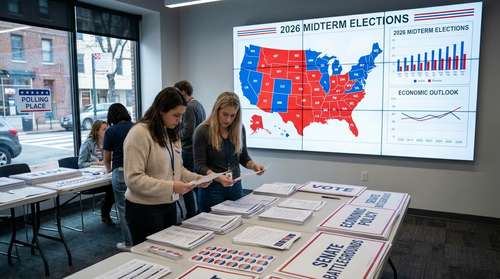
The 2026 Midterm Elections are shaping up to be a definitive referendum on aggressive trade policies and executive actions. With Americans increasingly citing affordability as their primary concern, both major parties are racing to dominate the narrative ahead of critical 2026 primary filing deadlines.
The Supreme Court, Trade Policy, and Economic Voting Issues
In February 2026, the Supreme Court delivered a monumental 6-3 ruling that struck down the sweeping tariffs implemented under the International Emergency Economic Powers Act. The administration swiftly retaliated by invoking Section 122 of the Trade Act of 1974 to levy a 10% global tariff, which could potentially rise to 15%. This abrupt pivot in trade policy has established profound economic voting issues as the cornerstone of the impending elections. The Tax Foundation estimates these newly imposed levies will increase the tax burden on the average American household by roughly $600 this year.
Consequently, the electorate is highly mobilized. The cost of living and domestic political division remain top priorities for Americans, with widespread dissatisfaction over how rising prices are exacerbated by a volatile global market. The administration's Affordability Doctrine—an aggressive strategy emphasizing state intervention to lower consumer goods and energy prices—is facing public skepticism. Campaigns on both sides are fiercely battling to frame these economic metrics as either protective domestic policies or reckless consumer taxation.
US Senate Battlegrounds: Defending the 53-45 Map
Control of the upper chamber hangs in a delicate balance. While Republicans currently hold a 53-45 Senate majority, the party faces a mathematically and politically daunting map. A record ten senators have announced they will not seek re-election, injecting immense unpredictability into the cycle. The most fiercely contested US Senate battlegrounds are expected to be Georgia, Maine, Michigan, and North Carolina.
In Georgia, incumbent Democrat Jon Ossoff faces a grueling defense but has already posted an intimidating $11 million in his first-quarter campaign finance records, setting a historic benchmark for an off-year incumbent. Conversely, Maine's Susan Collins begins her race with $3.2 million on hand, defending a vulnerable seat in a state that firmly backed the Democratic presidential ticket in 2024. North Carolina presents another prime Democratic target, where former Governor Roy Cooper is heavily favored to challenge Trump-backed Michael Whatley. Additional offensive opportunities for Democrats include Ohio, where former Senator Sherrod Brown is mounting a highly publicized comeback bid.
House Majority Outlook 2026: An Emerging Shift?
The House majority outlook 2026 suggests a highly volatile environment for the incumbent party. Recent special elections have already provided a bellwether for national sentiment; in Georgia's deeply conservative 14th Congressional District, a fragmented field led to a surprisingly competitive showing for Democrat Shawn Harris, pushing the race to an April runoff. Furthermore, an aggressive mid-decade redistricting battle is playing out across at least six states, largely unchecked by federal courts, which will dramatically alter the electoral map.
Current political polling data underscores a tangible shift in momentum. A late March Morning Consult tracking poll reveals Democrats maintaining a 45% to 42% lead on the generic congressional ballot—a significant 6-point net swing since early 2025. Fox News polling corroborates this trend, capturing a 52% to 46% Democratic advantage among registered voters. Polymarket prediction traders are mirroring these surveys, currently pricing in a 35% probability that Republicans will drop below 190 seats, which would translate to a devastating net loss of over 25 seats for the GOP.
Early Spending and Campaign Finance Records
The sheer scale of early organizational efforts is unprecedented. An analysis of recent campaign finance records reveals that candidates from both sides of the aisle are amassing formidable war chests. Beyond Ossoff's record-breaking haul in Georgia, Senator Thom Tillis of North Carolina brought in $2.3 million in the first quarter, ending with $4 million in the bank as he stares down a highly competitive primary and general election. The financial arms race reflects the estimated $10 billion expected to be spent during this cycle, with a significant portion funneled through independent expenditure groups and high-net-worth donors.
This influx of capital is actively shaping strategy ahead of the crucial 2026 primary filing deadlines. Candidates lacking early financial viability are being systematically pressured by party leadership to step aside, consolidating resources for the marquee matchups. In states with tightening primary deadlines, these financial disclosures serve as the ultimate litmus test for a campaign's longevity, fundamentally altering the competitive landscape before a single ballot is officially cast.
Demographic Shifts and the Independent Voter
What is fundamentally driving this political realignment? The data points to a collapse in support among crucial demographic groups. The GOP's traditional advantage among men has been cut in half since late 2025, while independent and moderate voters are firmly holding their ground for Democratic candidates. Furthermore, working-class, non-college-educated white voters—the foundational bedrock of the current administration's coalition—are demonstrating notable frustration with the ongoing trade-war fallout and persistent inflation.
In critical swing states like North Carolina, unaffiliated voters now surpass registered members of both major parties, reaching a staggering 2.9 million. These independent voters are heavily influenced by pragmatic, kitchen-table realities rather than strict partisan loyalty. If consumer prices remain elevated due to the 10% global tariff and supply chain restructuring, the administration risks completely fracturing its base just months before voters head to the polls.
As total campaign spending accelerates toward an unprecedented $10 billion projection, the upcoming elections will rigorously test the durability of populist economic policies. Whether the current administration can stabilize consumer costs or the opposition successfully capitalizes on middle-class anxieties will ultimately decide the balance of legislative power in Washington.