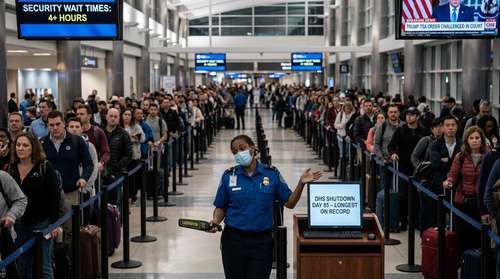
The cascading effects of the DHS shutdown 2026 are pushing American transportation infrastructure to the breaking point. As of Monday, the funding lapse officially reached its 44th day, surpassing last fall's closure to become the longest government shutdown history has ever recorded. For travelers, the political gridlock translates into miles-long security lines, missed flights, and widespread confusion. In response to the intensifying crisis, President Donald Trump took unprecedented unilateral action late Friday, signing a directive to force back pay for tens of thousands of essential screeners. But with constitutional challenges looming and broader funding unresolved, the relief may only be temporary.
Record-Breaking Standoff Leaves 100,000 Unpaid
The current DHS funding impasse began in mid-February and has left over 100,000 federal workers without paychecks for six grueling weeks. While the broader federal government remains open, the targeted freeze on the Department of Homeland Security has crippled agencies ranging from the Coast Guard and FEMA to Customs and Border Protection.
House and Senate lawmakers remain fundamentally deadlocked over immigration enforcement spending. While the Senate advanced a bipartisan measure to reopen most of the department, House Republicans rejected the compromise, insisting on comprehensive border security funding. Consequently, the burden has fallen squarely on federal workers and the broader economy, which has already absorbed an estimated $2.5 billion in losses. The crisis hit a boiling point over the weekend as nearly 500 Transportation Security Administration (TSA) officers formally resigned, completely unable to cover basic living expenses like mortgages and groceries.
The Trump TSA Executive Order: A Constitutional Gray Area?
Facing escalating pressure from the aviation industry and frustrated voters, the White House intervened. The Trump TSA executive order, signed on Friday, directs Homeland Security Secretary Markwayne Mullin and the Office of Management and Budget to immediately repurpose existing funds to compensate airport security personnel.
Labeling the situation an "unprecedented emergency," the President stated the maneuver was necessary to "quickly stop the Democrat Chaos at the Airports". The directive leverages unspent funds that supposedly have a "reasonable and logical nexus to TSA operations," effectively bypassing standard congressional appropriations.
While the intervention addresses the immediate TSA back pay status—with some officers expected to see direct deposits as early as Monday—it has ignited a political firestorm in Washington. Democratic leaders and legal scholars argue that shifting funds without congressional approval violates the separation of powers. Furthermore, the order offers no financial relief for other unfunded DHS sectors, keeping the overarching Department of Homeland Security news heavily focused on systemic dysfunction.
TSA Airport Wait Times Today: Navigating the Chaos
For the millions of Americans traveling this week, the political battles in Washington have immediate, tangible consequences. TSA airport wait times today remain highly volatile, despite the promise of returning paychecks.
At major international hubs like Hartsfield-Jackson Atlanta and New York's JFK, passengers have routinely encountered lines stretching well past four hours. The severe staffing shortage prompted acting TSA Administrator Ha Nguyen McNeill to warn lawmakers that the agency is experiencing the highest wait times in its two-decade history. Officials further cautioned that if the situation deteriorates, several smaller regional airports might be forced to shut down operations entirely.
To prevent a total operational collapse, the administration controversially deployed Immigration and Customs Enforcement (ICE) agents to assist at critical checkpoints. However, the measure has done little to shorten the massive queues. Aviation experts heavily advise travelers to arrive at their terminals a minimum of three to four hours prior to departure. The anxiety is palpable; at Houston's George Bush Intercontinental Airport, some panicked families even spent the night at the terminal to ensure they wouldn't miss early morning international flights.
What the Future Holds for Travelers and Workers
Even if the executive order successfully stabilizes the immediate payroll crisis, the structural damage to aviation security will take months to repair. The TSA requires four to six weeks to adequately train new officers, meaning the hundreds of vacancies created by recent resignations cannot be filled overnight. Additionally, travel-risk advisers note that the shutdown has severely delayed Global Entry enrollment interviews and Trusted Traveler card production.
Industry leaders warn that until a permanent legislative solution completely breaks the deadlock, business travel and corporate mobility programs will remain severely disrupted. The coming weeks will test whether the emergency pay measures can prevent further resignations, or if the federal court system will intervene and halt the diverted payments entirely.
Until lawmakers hash out a permanent agreement, passengers should prepare for an unpredictable travel season defined by long waits, stressed security personnel, and sudden policy shifts.